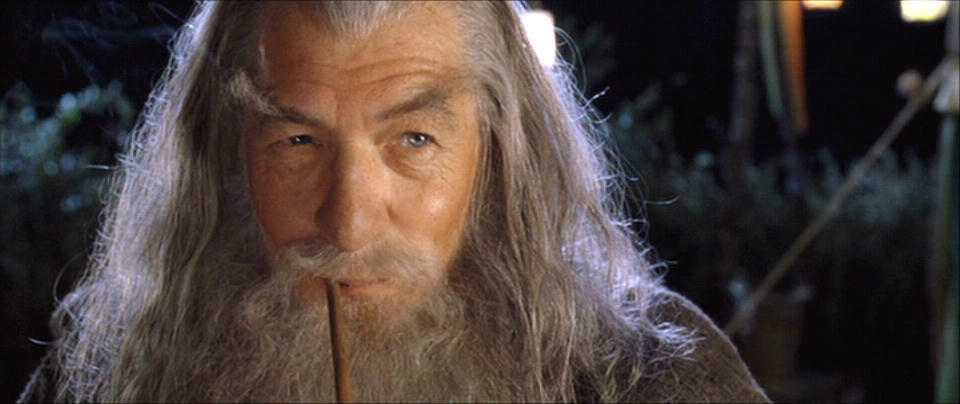
‘Yes, yes my dear sir and I do know your name Mr. Bilbo Baggins. And you do know my name, though you don’t remember that I belong to it. I am Gandalf, and Gandalf means me.”
Whilst J.R.R Tolkien’s The Hobbit was famously written, in the first instance, for said writer’s children, it has been famously described as being ‘a children’s book’, a coded criticism in many respects, meaning that because it has been marketed for primarily children, it is devoid of substance, nuance and meaning that more intelligent and world-wise adults are able to discern.[1] It is for that reason that my first opinion of Peter Jackson’s three films of the same name, released in 2012, 2013 and 2014, was low and, as I discovered recently, severely limited. I remember vividly, going to the cinema to see ‘An Unexpected Journey’ at the ripe age of 20, immediately welling up at the ‘Concerning Hobbits’ refrain that accompanied the film’s opening titles, before launching into an internal criticism of everything I perceived to by divergent from the original text. ‘How could a short book, for children, be strung out into three long films’, was my main point of contention. Oh the irony, when I had spent the past couple of years challenging the sanctity of texts so voraciously, unable to witness the way in which I was clinging so unconsciously to this one! This essay is in part a mea culpa but also a celebration of what I now regard to be a film that bridged The Hobbit to the rest of Tolkein’s legendarium with, perhaps, more consciousness and success than by Tolkien himself.
This is not to say that The Hobbit films were and are perfect. Even after my most recent re-watch, there are still some significant issues that have persisted over time: the films have the visual aspect of a video game, thanks to the choice to film using 3D Red Epic Cameras at 48 frames per second. Where so much of the deeply immersive storytelling in The Lord of The Rings films was borne from the physical prosthetic, make-up, costuming and set-design work, so successful in that they enabled audiences to feel as though the characters, races and cultures of Middle Earth were in some way real, the reliance on technology and digital design in The Hobbit creates more of a visual and, hence, emotional distance from the characters and the world they inhabit. This is not to say that video games are not deeply immersive, they evidently are and this is because we are able to take action and actively inhabit those worlds.[2] In the medium of film, however, where we are able to become engrossed in the worlds of films, we are, whilst observers and critics too, experientially more passive and in a position of surrender to the camera. No amount of good acting or writing in The Hobbit films allows them to land with as much impact as Jackson’s predecessors as a result of this overemphasis of a frame ratio and visual effects that take from the story more than they give. This was and still is, with all the merit I would give Jackson for experimenting with this cinematic technology, disappointing.
Equally disappointing are the ‘wink-wink-nudge-nudge’ moments of shoehorned nostalgia, for example when the One Ring falls onto Bilbo’s finger in the exact same way it falls on Frodo’s in The Fellowship of the Ring. Furthermore, I think the relationship between Tauriel and Kili is hopelessly contrived and whilst I am appreciative of the filmmakers’ efforts to include a female character, where there are a grand total of zero in the book, it is somewhat frustrating that her only narrative significance revolves around an ill-fated and yet remarkably lacklustre romance plot.
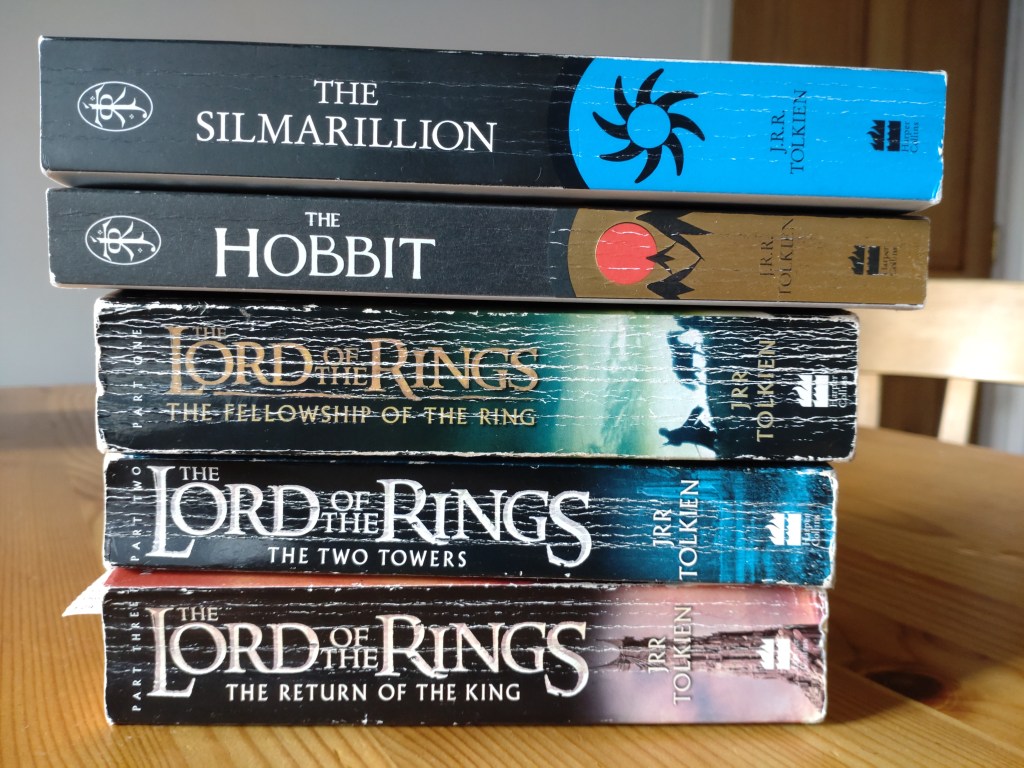
Yet, from this re-watch, I was able to discern that Jackson put in more work than I previously was even aware of to expand The Hobbit story into its rightful context within Tolkien’s mythology, in particular in its temporal position as a precursor to The Lord of The Rings. It is in this where I think The Hobbit films showcase some narrative brilliance on the part of its director. My opinion of this was enabled by my reading of The Silmarillion last year, a dense and remarkably realised mythology of the First Age of Middle Earth that Tolkien wrote prior to and, perhaps according to Christopher Tolkien, concurrently with The Hobbit in the 1930s. In a letter, Tolkien wrote that ‘The Hobbit was not intended to have anything to do with [The Silmarillion] […] It has no necessary connexion with the ‘mythology’, but naturally became attracted towards this dominant construction in my mind, causing the tale to become larger and more heroic as it proceeded’.[3]He suggests here that the progressive adventurous sensibility of The Hobbit came about in its tangential relationship with The Silmarillion: almost that The Hobbit couldn’t help but become more epic as a result of its exposure, in his imagination and writing, to the truly sweeping and awesome aspect of The Silmarillion. However, he is clear that there was no over-lap between the two: however much The Hobbit was influenced by The Silmarillion in terms of narrative grandiosity, the narratives themselves were quite separate. Only in Tolkien’s own retrospect and re-jigging post-Hobbit and aided by The Lord of The Rings do we see an intersection begin to merge between what were previously disparate texts.[4] It is here where I argue Jackson, with the benefit of Tolkien’s retrospect and the extensive appendices that accompany the legendarium, was able to successfully bridge some of the gaps left behind by Tolkien’s source texts. In short, Jackson and his team did their research, it shows, and The Hobbit films deserve much more credit than I believe they have received for this.
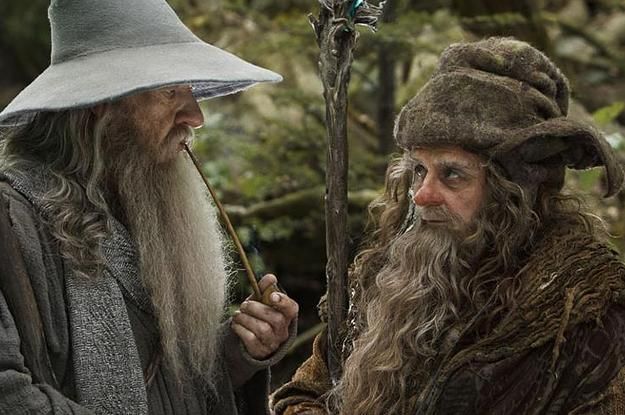
Fittingly, it would seem that the main mechanisms that Jackson uses to help bridge these narrative gaps are the wizards Gandalf the Grey and Radagast. In saying this, I do not aim to reduce their roles to mere plot devices: on the contrary, in some way I see it as nigh on poetic that these characters, who are so well-loved and revered by both characters in the stories and by readers and audiences too, who have so much power, wisdom and benevolence, should be the ones to ensure the successful metaphysical narrative weaving across the media of novel and film between The Hobbit and The Silmarillion. Perhaps we shouldn’t be so surprised. Whilst Radagast is elusive throughout Tolkien’s texts, Gandalf is presented as a character whose wizardry extends beyond telekinesis and otherworldly intuition to his ability to construct and affirm meaning for the characters around him. Indeed, when we first meet him in the very first chapter of The Hobbit, he engages an unwitting Bilbo into something of a verbal sparring match, after the latter has wished him a ‘Good morning!’. Looking at Bilbo ‘from under long bushy eyebrows that stuck out further than the brim of his shady hat’, Gandalf asks him:
‘“What do you mean?” he said. “Do you wish me a good morning, or mean that it is a good morning whether I want it or not; or that you feel good this morning; or that it is a morning to be good on?”’[5]
In his interrogation of the exclamation ‘Good morning!’ is a playfulness with which Gandalf employs and perceives language, pointing to the number of different ways in which Bilbo’s deceptively simplistic phrase could be used and interpreted. Gandalf’s questions expose the realms of meaning that underlie even the most apparently obvious of statements and, as such, successfully and wittily deconstructs both the phrase Bilbo has used and, importantly, the complacency with which he used it. As a result, along with the play, is an assertion of dominance, expressed through the performed uncertainty around what Bilbo means: in his questioning he demonstrates his own command of and ability to wield language, and therefore his ability to construct meaning. By questioning Bilbo in this way and subtly asserting his own dominance over language and its multiplicity of meanings, Gandalf’s introduction is none too reminiscent of ‘in the beginning was the Word, and the Word was with God, and the Word was God’, yet perhaps with more of a knowing wink and a glint in the eye from underneath those bushy eyebrows. Although Saruman is described as ‘subtle in speech’, I would argue that it is Gandalf’s playfulness with language that marks him out as more flexible in his thinking and the more compelling to those around him.[6] This linguistic dominance is developed later on in the novel where Gandalf uses narrative to convince the shape-shifter Beorn to allow Thorin’s Company of dwarves and Bilbo to stay in his hall having been pursued by goblins through and from the Misty Mountains. Aware of Beorn’s reticence for opening his home to strangers, and with a particular dislike for dwarves, Gandalf weaves the tale of the Company’s adventures with hints at their number and regular interruptions by the arriving dwarves at such a pace as to not offend Beorn.[7] We are told towards the episode’s end that,
‘Bilbo saw then how clever Gandalf had been. The interruptions had really made Beorn more interested in the story, and the story had kept his from sending the dwarves off at once like suspicious beggars […] “A very good tale!” said [Beorn]. “The best I have heard for a long while. If all beggars could tell such a good one, they might find me kinder.”’[8]
Gandalf successfully uses language and, slightly differently to his first encounter with Bilbo, the delay and deferral of meaning to ensure he is able to get what he wants and needs. Even though he and the Company are in a vulnerable enough position so as to rely on Beorn’s hospitality, Gandalf is able to use his, again, playful and ‘clever’ control of language and meaning to endear himself and the others. In particular, Tolkien emphasises that it is ‘the story’ and the means by which it is told that secures safety and, therefore, it is clear that the ability to use language in this way is as powerful a weapon for Gandalf as any of the other magic he may be able to perform. This is confirmed through the echo of the description of the dwarves as ‘beggars’: the story does not prevent Beorn from seeing the dwarves as ‘beggars’, yet the power of the narrative seems to enable Beorn to move past his preconceived distrust and disdain for the dwarves, even conceding that he might be more open in general if each story he met was ‘good’ enough. By ‘good’ we don’t necessarily mean that plot points of the narrative, although they help, but the way in which Gandalf has adeptly guided Beorn through what is essentially a carefully constructed unfolding of the truth. The irony of which is that perhaps Beorn’s distrust is not entirely misplaced, given Gandalf’s masterful yet creatively tentative handling of what actually happened and how many they are. Nevertheless, what is clear is that Gandalf the Grey occupies an important role in Tolkien’s work as a conduit and creator of meaning, which makes it all the more appropriate that his character is one of two wizards used by Jackson, in this same vein, to bridge the narrative gaps between The Silmarillion, The Lord of the Rings and The Hobbit. These narrative bridges revolve around the shadowy figure of The Necromancer.
The Necromancer is only named four times in The Hobbit text, and the gift that Jackson gives a film audience is a cinematic expansion of these short hints given, of course, by Gandalf both about him and his fortress at Dol Guldur, thereby building something of a narrative bridge from The Hobbit to The Lord of the Rings. One hint appears in the very first chapter of the novel, where Gandalf describes his adventure to retrieve Thror’s map: ‘I was finding things out, as usual; and a nasty business it was. Even I, Gandalf, only just escaped’; and one, satisfyingly cyclical, in the final chapter, ‘Gandalf had been to a great council of white wizards […] they had at last driven the Necromancer from his dark hold in the south of Mirkwood.[9] Furthermore, the episode is given reference to, again with little expansion in The Silmarillion: ‘Mithrandir [the Elvish name for Gandalf] at great peril went again to Dol Guldur and the pits of the Sorcerer, and he discovered the truth of his fears [that the Necromancer was ‘the first shadow of Sauron returning’], and escaped’.[10] Moreover, Jackson, I would argue, successfully interleaves the council meeting and Gandalf’s investigation of Dol Guldur mentioned here into The Hobbit narrative, with the council, attended by Gandalf, Galadriel, Elrond and Saruman the White, taking place during the Company’s sojourn at Rivendell early on in the first film of the trilogy, and then the investigation of Dol Guldur after the Company enter Mirkwood in the second film. This latter interleaving is particularly poignant narratively because as the Company encounters the corruption of the old Greenwood forest, we see Gandalf explore the root of that corruption, which I think works seamlessly. The expansion of these moments in the films serve to build important narrative connections that Tolkien either hints at or simply misses. The revelation that The Necromancer is the spirit of Sauron beginning to re-take form in the final film in The Hobbit trilogy is an important set-up for what happens sixty years later in The Lord of the Rings, plus is an excellent opportunity to see Galadriel in all her power. What was, perhaps, a missed opportunity was Jackson’s lack of emphasis as to why the council does nothing to organise against Sauron once it is revealed that he has returned. Saruman clearly underestimates Sauron’s ability to fully amass power, as described very late on in the appendices of The Silmarillion, but I think, what should be, an extremely pertinent moment becomes slightly lost within the narrative of the Company.[11] In truth, there is a lot of action in this film: it begins with Smaug’s destruction of Lake Town and his killing at the hands of Bard, then the confrontation at Dol Guldur, Thorin’s antagonism and obsession with the Arkenstone, followed by the Battle of the Five Armies. There is a lot of action and huge visuals to be swept along with. The decision to not challenge Sauron comes thirty minutes into the film and, most unfortunately, is not particularly circled back to. Gandalf’s last lines in the film seem like a particular waste, even though they replicate those in the novel: ‘You’re a very fine person, Mr Baggins, and I’m very fond of you; but you’re only quite a little fellow in a wide world after all’. In the novel, these words are delivered as Balin, Bilbo and Gandalf discuss the prosperity of the Men of the Lake after the Battle of the Five Armies and Bilbo’s hand in helping to ensure that peace. [12] Jackson’s use of them almost sentimentally, however, as almost a parting caution to Bilbo about the power of his magic ring is slightly too cryptic to ensure the sort of foreshadowing that could have been used to more explicitly weave the end of The Hobbit films to the larger narrative of The Lord of the Rings. However, as I said at the beginning of this essay, whilst true merits of these films have emerged with time and further investigation, they are by no means perfect.
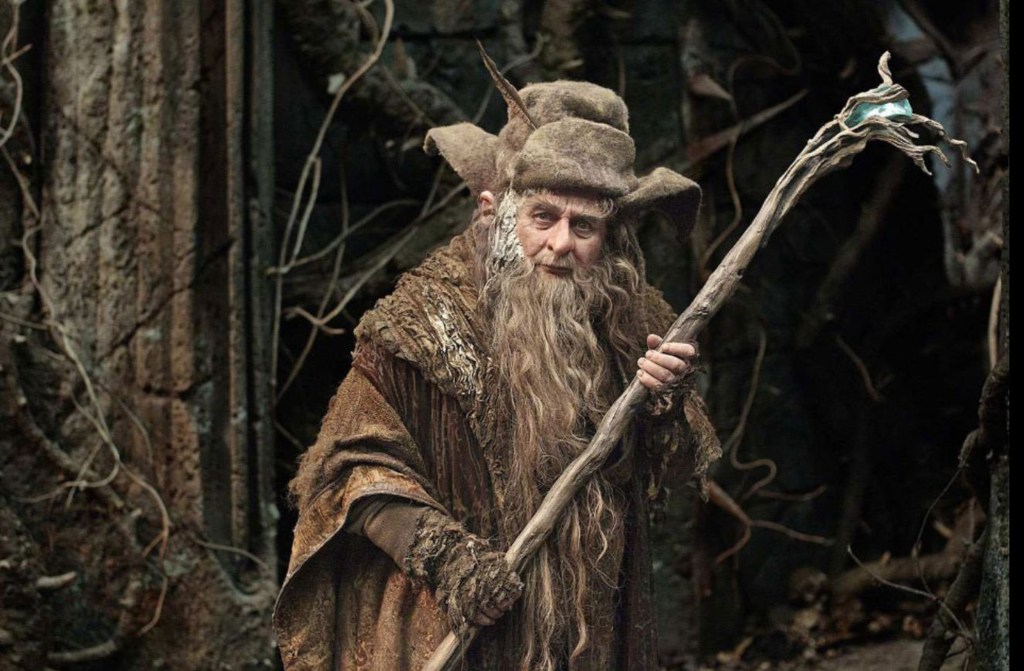
Something that cements Jackson’s attempt at narrative restructuring with, I argue, some great degree of success comes courtesy of the elusive and reclusive wizard Radagast. Whilst having scant mention anywhere in Tolkien’s books, his inclusion in these films was a brilliant, heartful choice which I think shows true warmth for the text on the part of the filmmakers. Not only does Jackson use Radagast to root The Hobbit films more securely into Tolkien’s context of Middle Earth, but he uses the wizard to bridge The Hobbit to some of the earliest events in the Elder days of the High Elves in The Silmarillion. In the first Hobbit film, when describing the corruption of Greenwood, Radagast describes the giant spiders in the forest as ‘some kind of spawn of Ungoliant’. In doing so, the filmmakers reference one of the most destructive and shocking moments in the early history of the Elves, where the first Dark Lord Morgoth, Sauron’s original master, uses a great, ravenous, corrupted spider called Ungoliant to destroy the sacred trees of light in Valinor, where she ‘belched forth black vapours as she drank, and swelled to a shape so vast and hideous that Melkor [precursor to the nomenclature Morgoth] was afraid’.[13] Whilst the film only makes a small reference to this early and haunting moment of the mythology, so grotesque that even a character as epically vengeful and envious in the history of literature as Morgoth is rendered frightened, this connection built by Jackson through Radagast between the current condition of the Greenwood and the originators of decay and destruction at the very beginning of Tolkien’s world, shows how much thought has gone into what these Hobbit films could serve. They are not mere adaptations of one novel, but offer an explicit narrative bridge across the legendarium. These films are then, perhaps, more faithful adaptations of the legendarium than audiences claiming The Hobbit to be a children’s book are even aware of. We can see that the two wizards help to create this greater sense of meaning across the texts: Gandalf is used to enable The Hobbit to look forward to the later The Lord of the Rings, whilst Radagast is used to root The Hobbit in the legendarium, looking back to the past as he does to The Silmarillion, where previously The Hobbit was almost adrift between the bigger epic narratives.
All this to say: perhaps making The Hobbit into a film was never going to be as simple as the reductive mindset of ‘it’s a children’s book’ would allow. I may have been dismissive of these films when they first came out, arguing that so short a book could hardly require a three-film adaptation; but I am convinced as a result of this recent re-watch that, in making these films, Jackson undertook a bigger project, enfolding The Hobbit into the rest of the legendarium, enlarging its prospects rather than keeping it a stand-alone novel, whilst simultaneously paying homage to the warmth and good humour that has made it such a beloved narrative since 1937. With all of the richness embedded in the text, even and especially unconsciously done, The Hobbit appears, like its namesake protagonist, to have more to it than what meets the eye. There are faults with the films, it cannot be denied; but I do not think that this cinematic trilogy should be so easily discarded either. It makes sense that the novel, surprisingly dense as it is with the range and length of adventures contained within it and, as we have seen, extending beyond it, could not fit an average feature-length running time. My lasting thought upon writing this is that perhaps it would have been more suited to a television series format so that the barrage of episodic action could have been more evenly placed alongside the intricate narrative weaving that, it has become evident, is also required.


 Harping On