On Friday 5th April, I trundled down to London to visit two very excellent friends. We have partaken in a number of cultural weekends in the capital over the past few years, with trips to see the Savage Beauty exhibition at the Victoria and Albert Museum, The Vulgar: Fashion Redefined at the Barbican, the Vogue 100 exhibition at the National Portrait Gallery, the West End production of Tennessee Williams’s Cat on a Hot Tin Roof starring Sienna Miller and Jack O’Connell (where somehow we managed to get seats in a box, very jammy), amongst many other lovely, fun activities. This weekend was in every way just as lovely: in spite of a sketchy visit to a fancy restaurant off Regent’s Street where we were made to feel like actual scum, we shopped in Arket, visited the new Archlight cinema in Battersea, drank all the Taddy Lager at a Samuel Smith’s next to Liberty’s and spotted BBC Middle East correspondent Jeremy Bowen at Denmark Hill station and started smirking at him by accident. He definitely thought we were insane. The highlight of the trip, however, amongst all the other loveliness, was our visit to the Dior: Designer of Dreams exhibition at the Victoria and Albert Museum.
My first academic introduction to Dior came through the documentary, Dior and I: a fly-on-the-wall film that followed Belgian designer Raf Simons as he took up the mantle of creative director in 2012. I had been aware of John Galliano’s tenure, largely thanks to Lily Cole who was a veritable goddess in his designs, but had little actual passion for the house of Dior beyond that. I have a penchant for the theatrical in fashion, but I was more into Alexander McQueen, Vivienne Westwood and Marc Jacobs at Louis Vuitton at the time. Galliano was famously fired from Dior after an anti-Semitic rant outside a café in Paris, and this created a space at Dior for something new and different. The film introduced us to Raf Simons, with his refreshingly modern aesthetic and his endearing emotionality. Reading from Christian Dior’s autobiography and discussing art, it became clear that Dior was on the cusp of being reimagined for a new generation. I fell for the brand then and there.
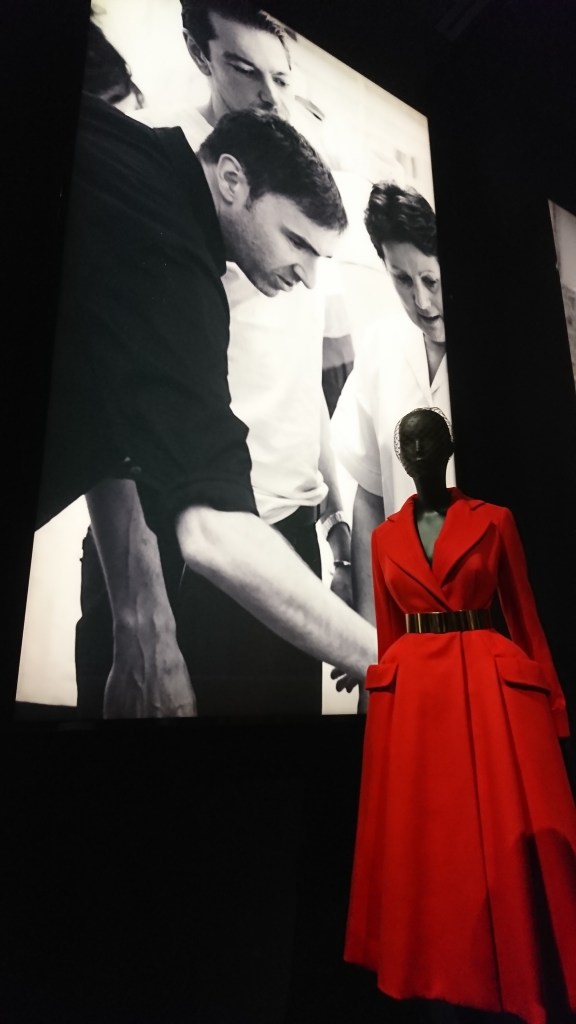
I came to learn from Dior: Designer of Dreams that the fact that there is even a house of Dior is nigh-on miraculous. Christian Dior founded the label in 1947, creating the ‘New Look’: he divined an ultra-feminine silhouette, re-introducing women to sensuality after the austerity, deprivation and destruction that encompassed life during the Second World War. In no more than ten years, he built a booming, globally successful fashion house, placing his love for women at the very heart of his work. He introduced the H line, the Bar jacket and many other ingeniously crafted designs to emphasise curves, create drama and indelibly flatter. Tragically, he died in 1957; but in the short but very sweet time he had, he laid the foundations for one of the best-loved fashion houses of all time.
I believe the key to Dior’s success in his lifetime and beyond can be attributed to his commitment to women. Indeed, he seems to have dedicated his whole sartorial life to making women look and feel beautiful. He said:
‘Deep in every heart slumbers a dream, and the couturier knows it: every woman is a princess’.
It is one thing for men to say that they love and support women, but it is almost overwhelming how much Christian Dior repeatedly practiced and demonstrated that love through his creations. He knew how to make women feel special through the alchemical combination of silhouette, colour and craftsmanship. He in no way objectified women: instead, he placed womanhood and femininity on a pedestal to be absolutely adored. I used to be very sceptical of traditional notions of femininity: I’ve read my Judith Butler, I understand that gender is performance in many ways. However, where so much disrespect and abject hatred of women and their bodies has been witnessed and experienced throughout history, for a man to be so readily loving and devoted to women, is amazing. Similarly, I do not subscribe to monarchy or regal inequality in any way, but I think the reference to princess-hood can be read more archetypally. His work helps to bring women back to the sense of their own worthiness: that, yes, each one of us is unique and special, with dreams and ambitions, and a powerful capacity for conscientiousness, compassion, joy and love. All of these things make us inherently beautiful. I know a lot of women, including myself, have a hard time believing that, but Christian Dior is here to remind us, in a sartorial, fashionable way, that it is truly is the case.
Christian Dior’s legacy has been kept intact thanks to a line of wonderful designers who placed women and what women want at the core of their work. Everyone, from Yves Saint Laurent to Maria Grazia Chiuri, have adhered to his silhouettes and inspirations, but subtly and ingeniously regenerated and refreshed them for each generation of women that passed their way. The exhibition presented and reflected this fact beautifully, placing pieces from all of Dior’s eras next to one another: for example, these two dresses from 1953 and 2019:
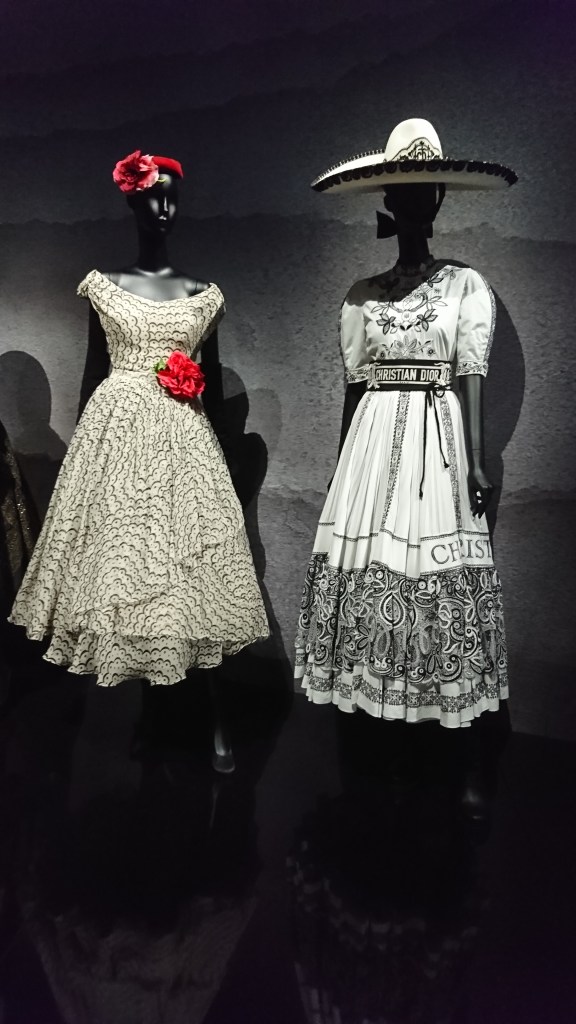
Both of these dresses nod to Dior’s interest in Mexican art and sartorial sensibility, speaking to each other across the years.[1] Although the Dior logo splashed across the dress on the right is a dead giveaway that it is a 21st century piece, they could both feasibly have come from the same collection. Similarly, the 18th century-inspired collections exhibit both continuity within the house of Dior and their individual designer’s unique perspective and flair:
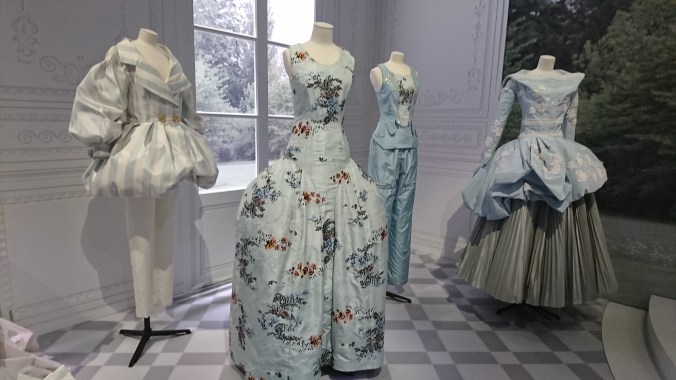
On the far left we have Gianfranco Ferré’s imagining of an 18th century coat, followed by Raf Simon’s cornflower blue dress with drop-waist hip emphasis; then we have another Raf Simons creation, this time a two-piece of intricately embroidered top with combat trousers; and finally a theatrical John Galliano dress with a billowing top and voluminous pleated skirt. All of the pieces are intrinsically Dior and could have walked down the runway in exactly the same show. But, we are also introduced to the subtle modernity of Simons, somehow taking an archaic hip style and making it contemporary and cool; the free-spirited proportion-play of Gianfranco Ferré; and the drama and craftsmanship of Galliano. The accusation has been levelled (at Simons in particular) that these collections for Dior are archivist; however, we can see clearly how the directors have honoured the history and mystique of the house whilst also exploring their own creative interests and personal aesthetics. It makes the collections personal but also part of a fluid, historical whole.
I will always have the softest of soft spots for Raf Simons because his work is just so polished, interesting and fun; but this exhibition formally introduced me to the work of Maria Grazia Chiuri. Up until now, I have reservedly watched Chiuri’s tenure blossom with popularity from afar. I was not convinced that slapping ‘We should all be feminists’ and ‘Why have there been no great women artists’ onto T-shirts to be sold for hundreds of pounds was particularly intersectional. I am still absolutely sure that capitalising on a buoyant new wave of feminism for commercial gain whilst reinforcing exclusivity and hierarchy is not how I want my intersectional feminism to look. However, this exhibition taught me that this woman bloody well knows how to make fabulous clothing. We wandered around the exhibition, pointing to one exquisite dress after another, exclaiming ‘I want that. I want that. I want that’, most of them originating from her sketchbook. Chiuri’s silhouettes are not as avant-garde as a Galliano, nor are they as refined and modern as a Simons, but they are dreamy beyond belief. Deceptively simple forms make way for frothy, fairytale content: her dresses become canvases for beautiful entwining flowers, embroidered constellations, elegant tulle and third eyes.

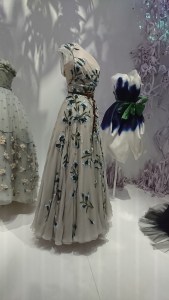
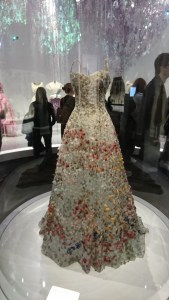

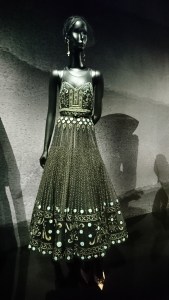
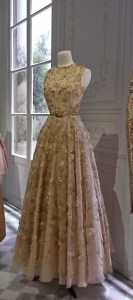
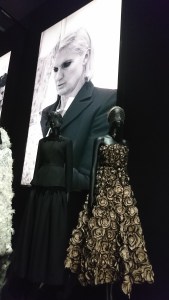
I have a newfound respect for what Chiuri is accomplishing at Dior. Namely, creating exceptionally designed clothing, luxurious without being fussy, whilst also, with those clean and elegant lines, very wearable. I would opt for any of these dresses in a heartbeat (please sartorial gods, please).
Without spoiling the exhibition too much for those who are still to visit, the final room was quite literally breathtaking. We audibly gasped and gaped at the twinkling ballroom setting we found ourselves in, debating whether or not we’d overreacted to the splendour on show. The gasps and squeals that came behind us as others entered the room confirmed not. The whole effect was magical: the glittering dresses, the rosy lighting, the cavernous space, everything. Time permitting, we could have sat in that room for ages just absorbing it all.
Dior: Designer of Dreams was another triumph for the Victoria and Albert museum. The layout and story of the exhibition is pitch perfect, demonstrating seamlessly the historical threads of the fashion house, as well as showcasing the individual contributions of the creative directors. The exhibition is a tribute to everyone who has been involved with the house: from Christian Dior himself and his creative directors, to the petit mains creating the designs at the atelier and the women chosen to represent the brand (it features dresses worn by Natalie Portman, Charlize Theron, Rihanna and Lupita Nyong’o). It celebrates womanhood, femininity and the princess within each woman, and the paradox that is a success built upon a winning and delicate combination of history and modernity. Needless to say, if you can get to it, go.
[1] What was also brilliant was that the curators had taken great pains to stress the pitfalls and damage of cultural appropriation, highlighting the ways in which Grazia Chiuri in particular sought practical help and input from Mexican women in the production and presentation of her Mexican-inspired collection.
 Harping On