Love Note series – Mulan

Mulan, Mulan, 1998

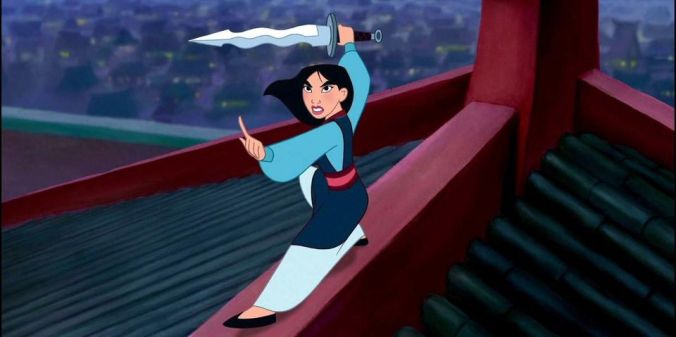
Mulan with shan yu sword

Mulan holds a very special place in my heart. She begins the film as a slightly disorganised, hapless, disgrace (by ancient Chinese standards) and then channels her strength, determination and courage into saving the whole of China from the Huns, both as a soldier and, when she becomes a disgrace again for doing that, in a traditional hanfu dress. Even from a short synopsis, we can see that over the course of the film, Mulan effectively redefines what it means for a woman to bring honour to her family in China, and shows that placing women in arbitrary boxes based on gender and capability is not in the interests of individual women or society as a whole.

Mulan and Little Brother

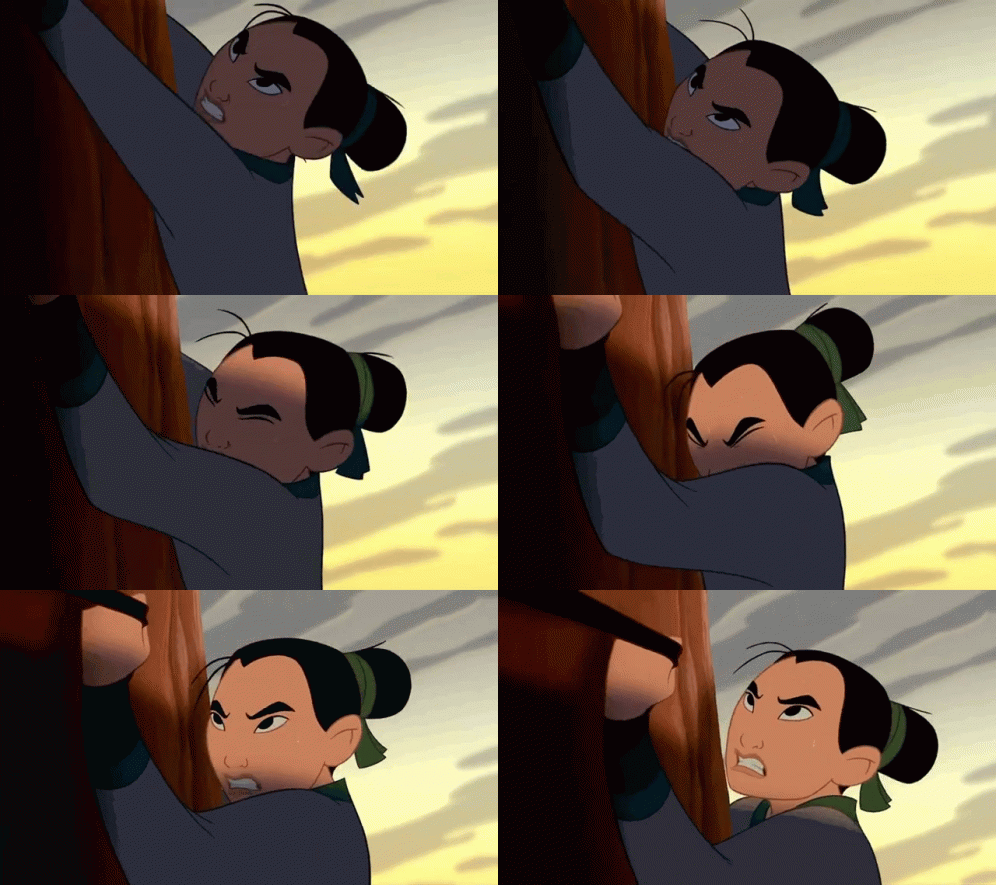
One of the things I love most about Mulan is that she is resourceful, a creative thinker and easily comes up with ideas and solutions to benefit herself and others. Over the course of the film, we see her attach a bone on a stick for her dog Little Brother to chase whilst simultaneously spreading chicken feed; out of her whole army unit, she is the first to understand how to use two weights to climb to the top of a pole and retrieve an arrow; she uses a cannon to trigger an avalanche that destroys the vast majority of the Hun army whilst saving the lives of all of her comrades; and she devises a plan to rescue the Emperor by having her mates drag up. Her ingenuity coupled with the strength and combat skills she acquires (in particular during the song ‘Dark Side of the Moon’ where the main refrain is ‘we are men’, the irony of which is amazing), make Mulan an incredible force to be reckoned with. No wonder she seems so threatening and at odds with the confining moral and social standards that prevail.
Mulan Climbing

Like Pocahontas and Esmeralda, Mulan also conveys incredible emotional sensitivity. She communicates with her dragon guardian Mushu, has a precious relationship with her horse Khan and is a deeply reflective individual. Her greatest desire, apart from saving the life of her father who is too old to fight in a war, is to become comfortable with her own identity. Her journey over the course of the film is to work out how she can be in the world and be comfortable within herself, whilst also serving the needs of her family and making them proud of her. Whilst, as is archetypal, she is met with set-backs and obstructions, where she takes the opportunity to assess what she has done and who she is. Ultimately though, her self-perception and her own sense of failure all fades in the wake of her needing to make a choice to do the brave and right thing, which she almost always does.

When shit hits the fan with Shan Yu and his allies surviving the avalanche and moving to attack the Imperial City, Mulan doesn’t think twice about gathering herself together and going to raise the alarm and fight back. In doing so, she carves out a place for herself and ultimately earns the respect and gratitude of an entire country. As such, Mulan shows us that in spite of the negative voices around us and within us that tell us that we are not good enough, that we don’t belong and that we have nothing to contribute to the world, we should stir up enough courage to carry on anyway. Ultimately we are defined not by who we or others think we are, but by the actions we take and the way we conduct ourselves in the world. If we live by this principle, of trying to be good and doing the best we can no matter whether it’s fighting in a war or feeding some chickens, that is enough. The rest of the world will fall into place around you.

Crowd bwing to Mulan

Love Note series – Pocahontas

Pocahontas, Pocahontas, 1995

download

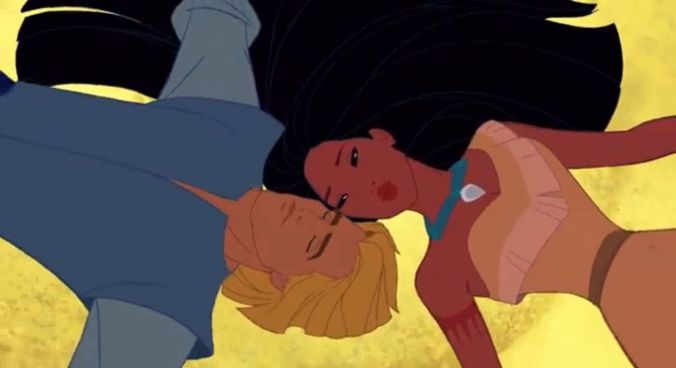
Pocahontas is vastly underrated and one of my all-time favourite Disney films. I was transported from the very opening shots: America, covered in woodland and accompanied by indigenous drumming, makes me think of how truly astounding the continent must have looked and been before the environment and its native people were decimated and destroyed by white European colonial invaders. Pocahontas is not only an incredibly bittersweet interracial love story, but is a strong rebuke to colonialism and a love letter to Native American culture. Indeed, Russell Means, who voiced Pocahontas’s father Chief Powhatan, remarked that this film is the greatest representation of Native American culture and life ever seen in a Hollywood motion picture.[1] The screenwriters’ and animators’ attention to detail is second-to-none: from casting Native American actors, using indigenous language in the script, the inclusion of intricate jewellery and body art down to the positioning of the teepees at the beginning of the film, which all face in the same Eastern direction as they would have done in the seventeenth century, this film gives a sensitive and conscious platform to a beautiful culture. And at the figurehead of it all we have Pocahontas, described by the animators as Disney’s first depiction of a woman, not a teenager, in the animated title role.[2]

Pocahontas and John SMith

It does seem that Pocahontas operates on a different maturity level to most of the Disney princesses that precede her. I think this may have been because she was an actual historical figure, so extra sensitivity was required in the representation of her and her story, despite the heavy poetic license taken in the film. She risks a lot for the sake of a man she has fallen in love with, but the price for that isn’t losing her voice or developing Stockholm Syndrome (I’m so sorry Beauty and the Beast fans, I still cannot deal with that relationship dynamic!). She is presented as spiritual, closely connected to the animals, plants and people around her, demanding respect for her community whilst showing fascination for John Smith’s. She prevents a war and helps guide both sides to a place of tentative love and acceptance over hatred. And yet, she still manages to keep things light-hearted and sassy, as the situation requires.

Pocahontas lol

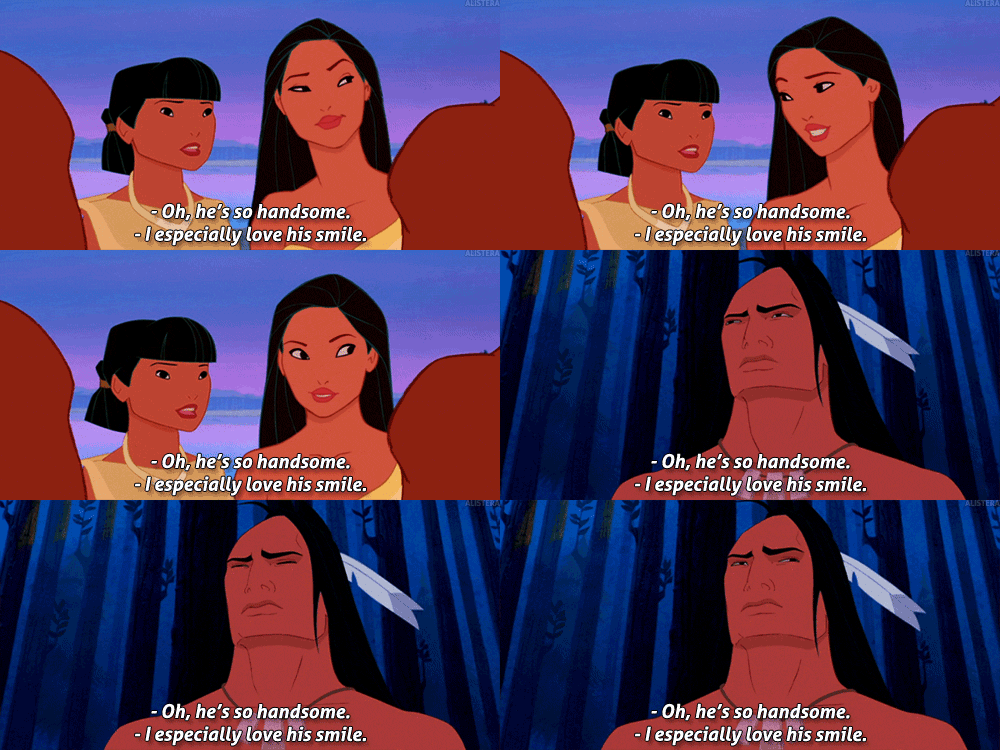
I love Pocahontas because she is playful, free-spirited and boundlessly curious. I love her relationship with best friend Nikomma who will happily tell her when she’s being a show off, which reminds me very much of my own relationship with my sister (I’m the show off). Indeed, my sister and I used to pretend to be Pocahontas and Nikomma when we were playing outside in the garden or on the beach (I was Pocahontas and Nicole was Nikomma, naturally). Pocahontas is deeply in tune with nature and her inner world, looking to the plants and animals around her, as well as her dreams for guidance and comfort. Her relationship with Grandmother Willow reminds me of mine and my sister’s relationships with our own beloved Grandma, and I love that she is willing to sit crossed-legged in front of her Elder to ask questions, heed advice and dialogue with her so that she might cultivate her own inner wise Self. Indeed, in many ways Grandmother Willow is Pocahontas’ inner wise Self, it depends on if you believe if she is actually real or just a figment of her imagination.

Pocahontas

Nowhere is this exploration of wisdom and connection with the natural world better explored in the film than during the song ‘Colours of the Wind’, written by Alan Menken and Stephen Schwartz. The song is accompanied by some of the most stunning animation that Disney has ever produced, and sees Pocahontas effectively deconstruct racist colonial narratives of who is considered civilized and who is considered savage. It is beautiful because the pithiness of the white colonial small-minded and deeply destructive dualistic ideology is visually dwarfed by the outstanding and overwhelming beauty of the natural world and the deep connection that Pocahontas sings of. My favourite line is ‘Come run through the hidden pine trails of the forest / Come taste the sun-sweet berries of the earth / Come roll in all the riches all around you / And for once, never wonder what they’re worth’. In other words, get over your racist capitalist bullshit John Smith and connect to something more powerful, more beautiful and more unifying.


[1] https://www.youtube.com/watch?v=RoHTikVNvbU [09:19, accessed 2nd July 2019].

[2] https://www.youtube.com/watch?v=RoHTikVNvbU [12:53, accessed 2nd July 2019].

Love Note series – Disney Women (part one, Esmeralda)

Before I went on holiday last week I had a burst of writing energy and, before I knew it, had four posts ready to be published. They are quintessential Harping On taking-silliness-seriously, and I am very excited to provide a little bit of light relief for myself and anyone reading this. I didn’t post last week because I was busy reading, swimming and sunning myself (more thoughts on that coming soon), so I hope that this Love Note series will more than make up for it.

As some of you will know, Disney holds a particularly big place in my heart. Fantasia is one of my top five favourite films of all time; Disney films in general are veritable nostalgia-fests when you need them; they provide the ultimate songbook for shower sing-a-longs; and can be hot topics for debate whenever the situation arises. Deconstructing Disney has long been one of my favourite past times (see here for an example), and I think it is a worthwhile endeavour. Like the fashion industry, such is the Walt Disney company’s power and reach that whatever its commercial and creative decisions, both good and bad, it affects us all even if we don’t care about them. I’d rather keep my eyes and ears open to Disney and what they are doing than to keep myself ignorant.

In light of this, and on a lighter note, I have written my series of blog posts on four of my favourite Disney leading women. They are each inspiring, interesting and courageous in their own ways and have taught me a lot about what it looks like to be a woman with conviction, especially in the face of patriarchal bullshit. I hope you enjoy them!

First up…

Esmeralda, The Hunchback of Notre Dame, 1996

Esmeralda featured image

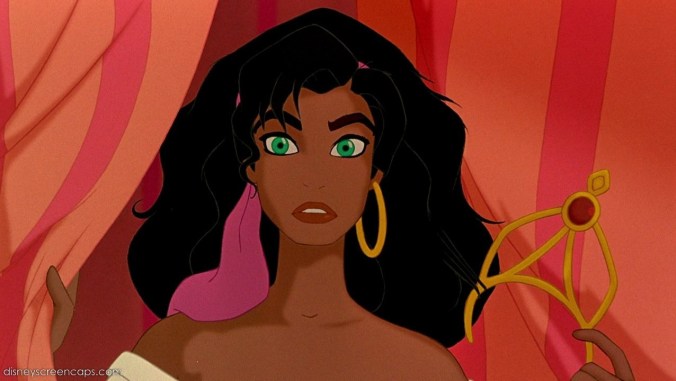
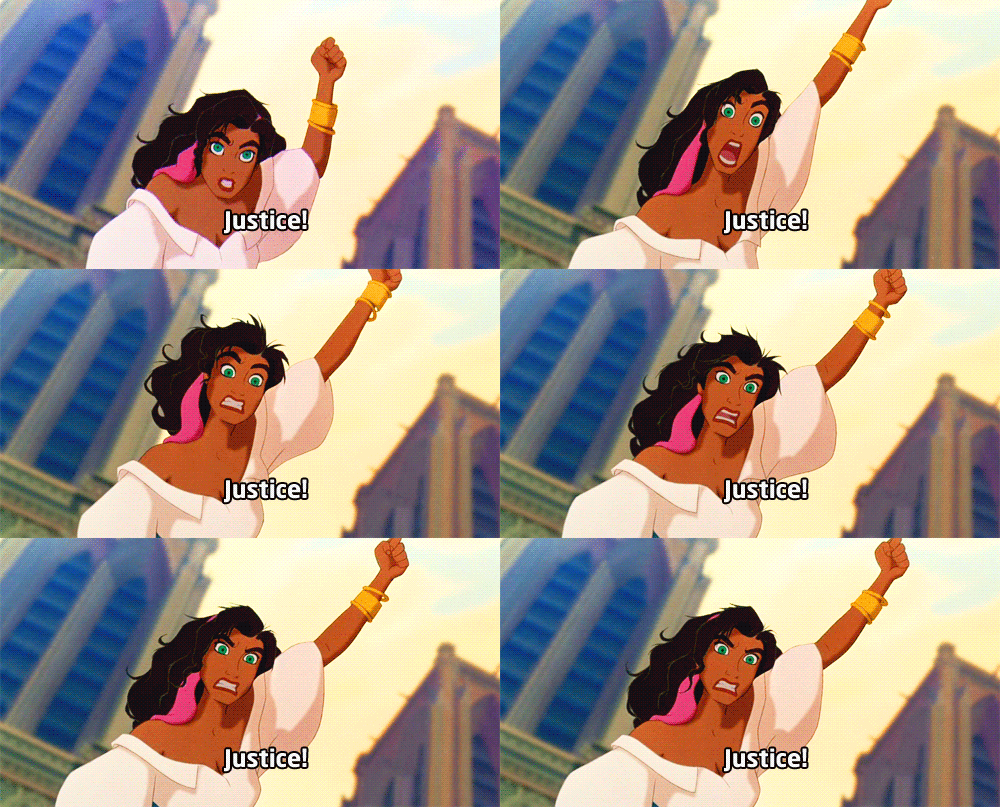
Harping On legend has it that when I met Esmeralda at Disney World on my 5th birthday, I ‘lost my shit’. Esmeralda was very, very important to me. I had two Esmeralda dresses, a Disney’s Hunchback of Notre Dame pencil case, an Esmeralda doll and a tambourine. She was my absolute hero. She stood up to a repressed, privileged prick, Claude Frollo, who spent his entire life and career persecuting Roma gypsies like her, and actively abused and encouraged abuse of Quasimodo, whose mother he kills at the beginning of the film, who then hides behind his rampant sexual desire for her by calling her a witch. Like I said, a prick. She derides Frollo for his cruel treatment of those who are vulnerable and refuses to back down when told to do so. Esmeralda is uncommonly brave, standing up for what is right even though it comes at a great risk to her own personal freedom and safety.

Esmeralda

One of the most moving parts of the whole film comes during her song ‘God Help the Outcasts’, with music by Alan Menken and Stephen Schwartz. Whilst every around her prays for glory, wealth and fame, Esmeralda declares:

‘I ask for nothing, I can get by

I know so many, less lucky than I

Please help my people, the poor and down-trod

I thought we all were children of God’.

Here, she clearly declares that she doesn’t want to ask for anything for herself because she knows of people who are much more desperate and worse off than she is. Esmeralda is selfless in spite of her own hardship, putting the needs, trials and suffering of her community before her own.

What is interesting is that whilst she addresses ‘God’ throughout most of the song, Esmeralda actually begins the song by speaking directly to a statue of Jesus. She demonstrates that in spite of the way she stands up for others and for what she believes in, she has internalised some of the xenophobic elements of medieval Paris, providing the caveat:

‘Yes I know I’m just an outcast

I shouldn’t speak to you

Still, I see your face and wonder

Were you once an outcast too?’

It is a moment of complete vulnerability as she enters a conversation with Jesus and subsequently God, a divine power that is bigger than her and whose help and comfort she needs. By adopting the language of her persecutors, with the label ‘outcast’, it suggests that she holds an internal belief that she is not worthy or good enough for finding refuge in prayer or communicating with God so candidly. However, she then goes on to draw a line of comparison between the two of them, demonstrating a sophisticated knowledge of Christian doctrine by suggesting that because Jesus was also considered an ‘outcast’ in his time, and especially in the run-up to his death, then it must be appropriate for her to speak to him. He was vulnerable, tried to help the needy and stood up to and threatened power structures, just she like she does. It is a beautiful, heartfelt moment, giving us a window into her internalisation of her ‘outcast’ status as a gypsy but also her ability to appeal to that which is vulnerable and considered by society as ‘unworthy’ in others, thus rendering everyone truly equal.

Esmeralda’s kindness and humility, coupled with her fiery resistance, her don’t-give-me-shit attitude towards future honey Phoebus, and her divine friendships with Quasimodo and goat Djali, make her one of Disney’s all-time greats. She is one of the most important and indispensable characters in the story and a true inspiration. She taught me that resisting injustice and standing up for others who are more in need of help than I am requires an immense amount of courage and bravery; never easy to do, but important beyond measure.

Esmeralda and DJali