Leaving Facebook

Facebook has become something of a monolith since its inception in 2004, and stands as one of the biggest hallmarks and influencers of 21st century culture. The sheer volume of people registered to Facebook (2.2 billion in January 2018) has meant that it has demanded cultural and critical attention. For a long time, however, this was quite severely lacking. This is partly because Facebook evolved and grew faster than it took for us to collectively understand what it was doing, but also, perhaps, because it was mythologised in films like The Social Network. This focused our attention on the melodrama of Facebook’s turbulent founding and not how it explicitly came to affect its users’ daily lives.[1]

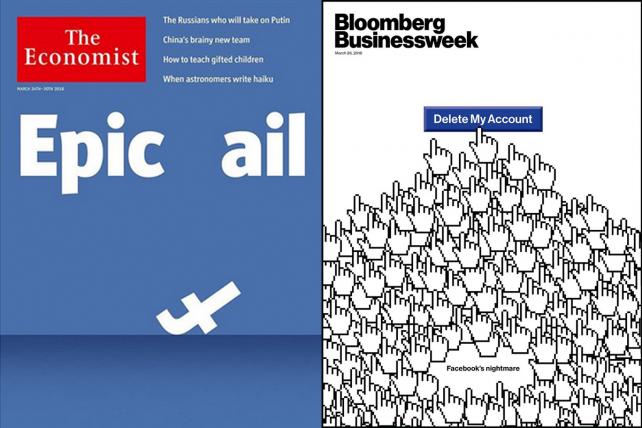
We are getting a better sense of this now. The list of breaches and indiscretions with which Facebook has been involved is building into an unsavoury rubbish heap: hate speech and uncensored violent content is uploaded and left unchallenged by Facebook’s moderators; democracy has been undermined with the prolific use of ‘fake news’ campaigns being employed on the platform during elections worldwide (including the 2016 EU Referendum and the US Presidential election); personal data was harvested and used by Cambridge Analytica to implement targeted electoral campaigns without user permission; the use of algorithms to ‘personalise’ the experience of using Facebook has created echo chambers that reduce the diversity of content, thus stifling debate and difference[2]; and last year in the UK, Facebook recorded revenues of £842.4m but only paid £5.1m in corporation tax, opting to route revenues through Ireland where the rate of corporation tax is significantly lower.[3]

It is important to recognise that very rarely have Facebook actually broken any laws, bar the data breach involving Cambridge Analytica, for which they have been fined £500,000 by the UK’s Information Commissioner’s Office (ICO).[4] Many of these indiscretions fall into murky territory that, whilst ethically questionable, do not come against any legal roadblocks. This is because they are largely editorial decisions and actions taken by the senior executives at the company, imparting policies and practices that develop and evolve beyond law-makers’ abilities to interrogate and keep up with them. As a result, some might argue that users should take more responsibility for engaging with Facebook: that they should build a greater understanding and awareness of user algorithms and limit the amount of data they share. I would argue, however, that users are woefully under-informed about the mechanisms behind Facebook. Collectively, we have limited critical capabilities to pin down and analyse something that changes so frequently, bogs its own privacy policy down in heavy, technical jargon and has been actively complicit in giving user’s data away regardless of said ‘privacy’ policy. As Virginia Heffernan writes in Wired: ‘Nothing about Facebook is intrinsically organized or self-regulating. Its terms of service change fitfully, as do its revenue centres and the ratio of machine learning to principled human stewardship in making its wheels turn’.[5] She implies that it is difficult for users to take responsibility for their use of Facebook when the people controlling it place the platform in a permanent state of flux, barely taking responsibility for any of the changes themselves. Facebook’s questionable mechanisms seem to be kept obscure until they become glaringly obvious, by which time users are playing catch up with the various data and privacy difficulties that they find themselves in. Again, Facebook aren’t doing anything illegal with their practices, but the moral implications of how they treat billions of people is becoming increasingly sour. No wonder we’ve seen desperate saccharine Facebook adverts appearing on TVs and billboards in the past couple of months promising to re-build trust with their users, in attempt to recover their damaged reputation.

Things get even murkier when we acknowledge that we are currently witnessing the unfolding of an enormous mental health crisis that is, in many ways, being fuelled by social media platforms like Facebook.[6] Indeed, the head of the NHS in England has stated that ‘there is emerging evidence of a link between semi-addictive and manipulative online activities and mental health pressures on our teenagers and young people’ on social media sites like Facebook and the Facebook-owned Instagram.[7] He urged social media companies to ‘take responsibility’ for the way in which their platforms cultivate anxiety and depression in the people who use them, in particular young adults. Again, Facebook has not broken any law in developing a user experience that encourages people to compare themselves to others, cultivates FOMO (‘fear of missing out’), establishes unrealistic standards of happiness and perfection, and reinforces compulsive posting with likes and shares. However, when we see mental illness becoming an increasingly dangerous, pervasive and normal condition that 1 in 4 people suffer from at any one time, and we know that social media use contributes enormously to feelings of inadequacy, loneliness and isolation, Facebook has to start being accountable for what it gives to the world.[8]
Facebook

In light of all of this, I come to myself. I rarely write blog posts about my personal life; however, seeing as so much of my personal data is in the hands of those who seek to make it public both with and without my permission, it seems fitting that my break-up with Facebook is similarly public. I am aware that none of this is anyone’s business other than my own and that I am most probably indulging my tendency to be over-the-top, but here it is anyway. In writing this, I do not want to self-righteously judge anyone else’s opinions about or use of Facebook. I know that for many people, Facebook isn’t really a big deal and they use it proactively with a good amount of emotional distance, which is more than OK. In the words of my favourite yogi Adriene Mishler, it’s important to ‘find what feels good’ and try to live the kind of life that you want to live: I’m working out how best to do me.

In November 2007, I was 15 years old and fresh from a school Classics trip to Rome and Sorrento. The trip was great because I met lots of really nice people, ruins are cool and we had lots of hilarious adventures. Afterwards, I joined Facebook so that we could all share our photos. In the ten years since then, Facebook joined me during my GCSEs, A-Levels, my undergraduate degree, my Masters and on my first years in the world of full-time work. I still cannot believe that I have spent a whole decade of my life logging onto Facebook. It was the site of an ex-boyfriend asking me out (I know) and then dumping me a year later (I KNOW); used as a rudimentary marketing platform for various plays I performed in, magazines I worked for and blogs I wrote for; a place where my post-adolescent identity crisis played out in the form of taking and sharing every Buzzfeed quiz possible; it helped me to engage with the wave of inspirational intersectional feminism that swept into my life aged 19 and has empowered me ever since; it was where I engaged with the resurgent socialism of British politics in the form of Jeremy Corbyn’s Labour; and I used it to full effect when I published my first novel, Tender is the Gelignite. I bloody loved Facebook.

Now, I have decided to leave Facebook. I am leaving Facebook for a combination of reasons, most of which I discussed at the beginning of this post. I think of myself as someone who tries to the best of their ability to make informed, conscious decisions about how I spend my time, in everything I think and do. I no longer want to support a site that purports to be a platform for sharing and collectivism when it undercuts basic freedoms to democracy and contentment with life. Capitalism, with the way in which it isolates and alienates us from ourselves and each other, leaves a big vacuum for connection. It does not surprise me that billions of people use Facebook in an attempt to feel like they belong to something bigger than themselves. In many ways, it is the new opiate of the masses: simultaneously a reflection of people’s lives and an illusion by which people live. It is constructed, under the guise of being a communal space, to distract us from taking care of ourselves, which is ultimately the work we need to do if we are to live our content imperfect lives and be of help and support to others.

I am also becoming increasingly aware of the insidious way that social media use can affect the way in which our brains function. This is not only with regards to mental health but with the way in which our neural pathways are affected by Facebook’s carefully constructed mechanics. Very recently, I listened to a podcast from Ed Miliband and Geoff Lloyd’s series ‘Reasons to be Cheerful’ entitled ‘Silicon Valley Serfs: protecting kids from tech overload’. It is an excellent episode, featuring the amazingly eloquent Baroness Beeban Kidron and Dr Richard Graham, which does well to veer away from a frantic reactionary view that all technology is harmful. It does, however, acknowledge the large impact that social media use has on children’s social and neural development. I couldn’t help identifying with many of the things they were discussing, largely because when I first started using Facebook I was still effectively a child. After a solid ten years of use, how much has Facebook potentially affected the way in which I think, perceive and respond to the world around me and the people in it?

In particular, I am concerned with the neural responses and ‘highs’ from having my posts and photos, and by extension myself, being validated with likes. In 2017, Sean Parker, one of the founders of Facebook, discussed the ‘social-validation feedback loop’ that Facebook’s developers helped to create with the ‘like’ button, which acts as a little ‘dopamine hit’.[9] This dopamine hit, a boost in positivity, encourages users to upload more to their wall/timeline, thus stimulating a potentially addictive or compulsive set of behaviours. It is for this reason that users who have taken a break from Facebook have reported symptoms of not only relief from the pressure of uploading, but also of withdrawal.

To be perfectly honest, I like getting ‘likes’. It feels nice. It feels like people care about what I say and what I do. However, it is falsely self-satisfying and damaging. I am sharing certain, predominantly positive things, to present myself in a certain way that isn’t 100% authentic. I have realised that in doing so, I don’t just get validation for whatever is happening in my life, I also get validation for the behaviour of sharing certain things that happen in my life in a certain way. I am someone who suffers from bouts of low self-esteem and it slightly terrifies me how much weight I have both consciously and unconsciously staked on people liking my posts. When I was younger, I definitely deleted posts that didn’t get much attention, I definitely compared the likes I got for photos with other people and I thought the number of ‘friends’ that I had on Facebook had some kind of bearing on how well-liked I was. It is not a healthy way to have lived and conducted myself for ten years and I am concerned about the way it will impact my thinking and self-worth going forward. Whilst I am more conscious of the way in which Facebook works now, and I have definitely distanced myself from the platform in recent years, it is time to take more definitive action.

Up until now, on a practical level, I have only been toying with the idea of leaving Facebook because there are a number of binds that are keeping me stuck. The first is that Facebook is an undoubtedly extremely convenient way to keep in touch with friends. Messenger is a good app and because phone numbers change so frequently, it is a very useful way to always have a means of communicating with people. The second bind is that whilst I know that it is politically problematic and probably damaging to my mental wellbeing, Facebook is a very good tool for sharing and marketing my work.

I have two solutions to this problem. If you want to stay in touch with me and don’t have my number, please message me in the near future and get my number! I also have an email address on my blog that you can use to contact me and I am on Twitter @E_S_Harper. At the moment, I find Twitter to be the least problematic social media platform that I use. I cannot say the same for Instagram, which I feel is just as problematic as Facebook, if not more so. I have been curtailing my use of that and going forward, will only use it in as professional a capacity as possible, to promote my writing, and to talk about other books, music, films and artworks that I like. I also have to admit that I have relied on Facebook to help track and remember special events like birthdays, which is great but also ridiculously lazy. If I’m going to be a responsible adult, I need to start taking this shit more seriously. You are all going in my diary.

Additionally, I have set up an author page called ‘Elizabeth Harper – Harping On’ that I would love people to like and subscribe to. I will be switching the admin rights to another Facebook account which will be virtually blank and with which I can post articles onto the author page. The author page will be my primary form of interaction so please do follow my updates there. I’m still very excited to write and share my work and I believe that this will be a much healthier way of doing so.

[1] I would go as far as to argue that The Social Network, released in 2010 and based on a book called The Accidental Billionaires by Ben Mezrich in 2009, was made far too soon after the founding of Facebook. I think it is hard to be comprehensively reflective about a major cultural development only 6 years after it first began, which is perhaps why they both focused heavily on the biographies of the individuals involved and not what Facebook actually did and meant. I look forward to future books, films, podcasts and other forms of media that will deliver a more thorough critique of Facebook and its cultural impact.

[2] ‘Facebook Said Its Algorithms Do Help Form Echo Chambers. And the Tech Press Missed It’, Huffington Post [accessed 14:50, 11th July 2018] https://www.huffingtonpost.com/zeynep-tufekci/facebook-algorithm-echo-chambers_b_7259916.html

[3] Facebook tax bill edges up to £5m in UK, The Financial Times [accessed 15:25, 11th July 2018] https://www.ft.com/content/67f9c34e-a909-11e7-93c5-648314d2c72c

[4] ‘Facebook fined for data breaches in Cambridge Analytica scandal’, The Guardian [accessed 15:21, 11th July 2018] https://www.theguardian.com/technology/2018/jul/11/facebook-fined-for-data-breaches-in-cambridge-analytica-scandal

[5] ‘Who will take responsibility for Facebook?’, Wired [accessed 11:46, 12th July 2018] https://www.wired.com/story/mark-zuckerberg-who-will-take-responsibility-for-facebook-now/

[6] ‘A systematic review of the mental health outcomes associated with Facebook use’, Frost, R.L. and Rickwood, D.J., 2017, Computers in Human Behavior, 76, pp.576-600. [accessed 11:27, 12th July 2018] https://www.sciencedirect.com/science/article/pii/S0747563217304685?_rdoc=1&_fmt=high&_origin=gateway&_docanchor=&md5=b8429449ccfc9c30159a5f9aeaa92ffb#!

[7] ‘Facebook has young people in an ‘insidious grip’, warns head of NHS England’, The Daily Telegraph [accessed 15:17. 11th July 2018] https://www.telegraph.co.uk/news/2018/07/08/facebook-has-young-people-insidious-grip-warns-head-nhs-england/

[8] https://www.mind.org.uk/about-us/what-we-do/

[9] ‘Ex-Facebook president Sean Parker: site made to exploit human ‘vulnerability’’, The Guardian [accessed 13th July 2018] https://www.theguardian.com/technology/2017/nov/09/facebook-sean-parker-vulnerability-brain-psychology
In defence of ‘mother!’

WARNING: contains spoilers

Earlier this year, the infamous Razzie awards- the annual mock awards show that coincides with the Academy Awards- announced nominations for the year’s worst films. As per usual, and quite rightly so, there was space in the nominations for the likes of the Transformers, Fifty Shades and Pirates of the Caribbean franchises. This list, however, also saw the questionable inclusion of Darren Aronofsky’s ‘mother!’, a film that is a far cry from the vapid, passable films it shares company with. The nominations the film received for Worst Film, Worst Actress, Worst Actor and Worst Director come off the back of a deluge of criticism that the film received upon its release. The Razzies as an awards show aren’t designed to be taken too seriously; but they indicate that an almost general consensus has been reached that this film is a pretentious, soupy shock-fest of little substance and poor performances.[1]  In tabloid magazines, such as Grazia, Jennifer Lawrence has been ordained with a certified career blip because the film did not reach the box office heights she is used to with the likes of The Hunger Games and X-Men. In addition, the relationship between Lawrence and Aronofsky, which developed and then fell apart after filming, also became offal for the entertainment press. [2] In the meantime, ‘mother!’ was downplayed and over looked by critics, awards bodies and guilds, with the challenging issues that the film raises seemingly ignored.

This is not the first time that a dark, challenging female-centric film has failed to be acknowledged by the cultural establishment, for example Lynne Ramsay’s We Need to Talk About Kevin starring Tilda Swinton, or Lars Von Trier’s Melancholia and Nymphomaniac led by Kirsten Dunst and Charlotte Gainsbourg respectively. Some might argue that we don’t need to worry about this, because the likes of the Academy Awards, BAFTAs and Golden Globes aren’t necessarily worth respecting as they are so ‘weirdly subjective’ anyway, in the words of Cate Blanchett. These awards bodies only acknowledge films released at a specific time of the year, and only seem to celebrate films that reaffirm the Hollywood, film-making dream, rather than challenge it: see the recent successes of Argo, The Artist, La La Land, Birdman etc. Yet, when complex films about women are in such short supply, it is frustrating that brutal, stonking, belters of films are pushed to the fringes of small arthouse cinemas. Where are the column inches for Marielle Heller’s Diary of a Teenage Girl, Andrea Arnold’s American Honey or Sean Baker’s The Florida Project? I am not arguing that ‘mother!’ needs to be universally liked. The fact that it has managed to both enthral and revile audiences is, in my opinion, much to its credit; any film that rattles people to a state of unrest on either end of the enjoyment spectrum suggests that it is worth paying attention to. However, I would like to make the case that far from being the shambles that many critics and commentators would have us think, ‘mother!’ was one of the best films last year, shockingly timely and, in the opinion of Mark Kermode, a film that will ‘impress’ the further away you get from the initial ‘oppressive’ experience of viewing it.[3]

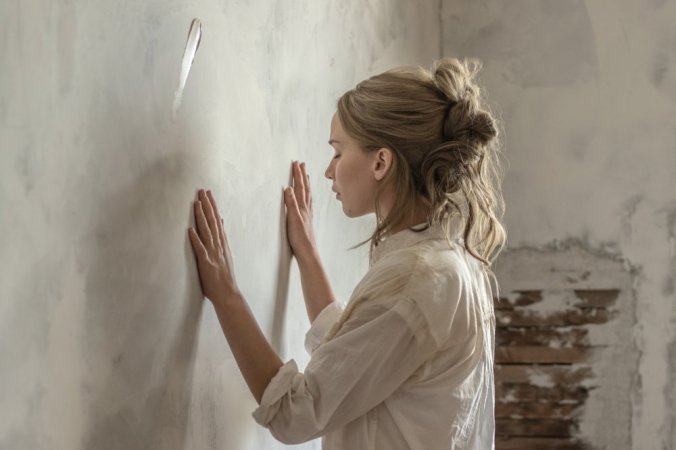
mother!’ offers so many different readings, but I think the most significant is the film’s critique of the concept of the female muse. Jennifer Lawrence’s character, ‘Mother’, is constantly referred to as the ‘inspiration’ for ‘Him’, Javier Bardem’s egocentric writer. This is because her time is consumed with nurturing their house and home. She is referred to as ‘inspiration’ again by ‘Him’s’ publicist, the ‘Herald’ played brilliantly by Kristen Wiig, and then by the multitude of people who come into their house before all hell breaks loose. I argue that it’s the treatment of ‘Mother’ as this symbolic, abstract figure that enables the violence brought upon her by everyone in the house. The arguably mild micro-aggression displayed by ‘Him’ at the beginning of the film, such as his constantly inviting all and sundry into their home, not listening to ‘Mother’ and making a mess and expecting ‘Mother’ to clean it all up, paves the way for others to do so, and worse. This manifests when ‘Him’ and his ‘guests’ ignore her, in particular when two slam themselves repeatedly on the sink and rip it off the wall and when strangers begin to paint her walls a different colour; when a male stranger propositions ‘Mother’, he refuses to take no for an answer then calls her a ‘cunt’(a scene practically lifted from the Everyday Sexism blog or the Bye Felipe Instagram account); and when the braying crowd, who have killed her baby, start to violently beat her up and only stop when ‘Him’ tells them to. The idea of a woman serving passively as ‘inspiration’, as a beautiful muse, feeds the idea that women, particularly when confined to a domestic space, do not have subjectivity. Instead, they are vessels and symbols for men to fetishize in the name of creativity. It is the denial of a whole, complex personhood that results in a woman becoming a patriarchal doormat. Not being listened to may seem like a simple annoyance, but the more people ignore her, the more danger ‘Mother’ is in. She is drowned out by the throngs of people who invade the home, before being owned, used and abused by them all. The ringleader appears in the form of ‘Him’.

Nowhere is this seen better than when ‘Mother’ is breastfeeding her newborn son in a boarded up room that keeps the intruding guests out. In a film of claustrophobic close-ups, the shots of ‘Mother’ and her suckling baby feel softer, calmer and intimate whilst the bond between mother and child begins to strengthen. All the while, however, ‘Him’ looms in the background, watching them unblinking, unflinching, determined to show the child off to a hallway teeming with his ‘guests’. He does not care that ‘Mother’ has only just given birth, he does not care that she wants to keep the child safe and out of sight, he does not care that she wants to nourish and sustain him; he only wants to feed his own ego and vanity. In the end, he waits and watches with frightening menace, taking his opportunity to take the child from her when she inadvertently falls asleep. His entitlement can only come from viewing his wife as unequal to him: she is at times revered as a vague yet divine source of inspiration, but this also makes her vulnerable to whatever violent and aggressive whims and desires he is able to act upon her and her body.

mother-2017-005-jennifer-lawrence-hands-wall

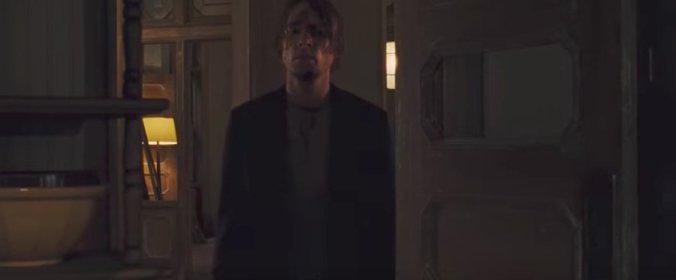
As a result, ‘mother! is an explicit warning of the danger posed to women who are reduced to an abstract, symbolic concept instead of respected as multi-faceted, interior beings with their own thoughts, ideas and desires. The ‘muse’ figure is essentially a dehumanised figure and the consequences for the woman, as shown in this film, are nightmarish. The final twist of the knife comes at the end of the film, where the narrative circles back to its opening scene. Instead, however, of Jennifer Lawrence’s ‘Mother’, calling ‘Baby?’ to ‘Him’, it’s a new incarnation of a different woman in the exact same position. It suggests that this whole torturous experience is undeniably about to happen all over again. It would appear that men like ‘Him’ always have a second chance, they are redeemable. Women, on the other hand, do not have this privilege, but are merely inspirational fodder to be exploited again and again, one after the other from the patriarchal conveyer belt. Of all the characters in the film, the one who seems to understand this the most is the scene-stealing Domhnall Gleeson’s ‘Oldest Son’. In a frantic scene, ‘Oldest Son’ kills his younger brother in a fit of rage because he doesn’t believe that anyone in his family genuinely loves or values him, asking ‘Mother’ if she understands.  Later on, he returns to ‘Mother’ alone in the house and tells her, ‘You do understand. Good luck’.[4] This tense, quiet scene foreshadows all of the horror to come and the ‘luck’ ‘Mother’ will need to navigate through it. Additionally, it is immediately of no comfort that ‘Him’ appears to enfold ‘Mother’ in his arms; she is undoubtedly within the belly of the beast, deep in the clutches of her abuser.

domhnall gleeson

Whilst the film’s violence has been condemned by many, it is the rejection of a woman as a dispensable image to inspire men that feels so timely. Within Western art, women have all too often played the role of a figurative muse for men, with horrible consequences for their emotional wellbeing. You just have to look to the experiences of Elizabeth Siddal, Edie Sedgwick, Marianne Faithfull, Amelie Gautreau and Uma Thurman, who all suffered from the acute power imbalance at play with the men who ‘revered’ them and for whom they provided some sort of ‘inspiration’. Importantly, this film marginally pre-dates the allegations reported against Harvey Weinstein, and the increased, renewed scrutiny of men like Woody Allen, Roman Polanski, Quentin Tarantino, Louis CK and many others who work in the creative industries and have allegedly abused women. With the subsequent #MeToo and Time’s Up movements that have flourished in the wake of these allegations, the production of art will undeniably have to change. Women can no longer be used as mere muses and inspirations for writers and directors. What is ironic, however, is that such a reading of progressiveness can be taken from ‘mother!’ when Darren Aronofsky has come under criticism for his allegedly manipulative and ‘abusive’ practices: his direction triggered a well-documented panic attack from Lawrence during the process of filming, he banned bottled water from the set of Noah (2014)which led to Emma Watson falling ill, something he recommended she should ‘use for the scene’, and allegedly separated Natalie Portman and Mila Kunis to play them off one another during the filming of Black Swan (2010).[5] It is wildly frustrating that a film that critiques the patriarchal disposal of women in the name of creativity, is allegedly practised by the film’s very director.

It is also as a result of this that we have to be careful about completely embracing the film’s apparent environmental agenda. Aronofsky said himself ‘I want to make a film about Mother Nature. I wanted to make a film from her perspective’, and it is an interpretation that has been picked up by Mark Kermode and Naomi Klein. [6] Aronofsky believes he has made a film that presents ‘Mother Nature’, through allegory, suffering the horrors that human beings reap on the natural world, i.e. her. Whilst I am in favour of more texts that critique environmental destruction, climate change and take aim at the over consumption of selfish, ignorant human beings, using the figure of ‘Mother Nature’ to do this is unhelpful and dangerous. ‘Mother Nature’ is perhaps the most mythologised, idealised version of femininity ever thought up. She is a ‘mother’, she ‘brings life’ and she is ‘cruel’, all stereotypes constructed about/for women that are projected onto the natural world. ‘Mother Nature’ is, ultimately, a vacant, arbitrary symbol, representing bags of patriarchal dogma and we need to be critical of that. What is frustrating is that reading the Earth as a woman feeds into the problematic negation of subjectivity that the film does so well to portray. Indeed, focusing on a figurative ‘Mother Nature’ undercuts all the work ‘mother!’ does to critique the presentation of women as abstraction. It is so ironic yet, perhaps, unsurprising that Aronofsky, given his dodgy history of abusive practice towards his actresses and partners, encourages us to think of Earth embodied as a woman. This should serve as an enormous reminder to us that we must not limit our interpretations of texts to whatever the writer/director may or may not have intended.

In its presentation of the danger posed to female muses, ‘mother!’ is radical and unflinching. Art, in all its forms, is barbaric if it is leeched from or comes at the expense of the subjectivity and personhood of those close to the artist. Importantly, Aronofsky is not exempt from this and we must approach his diagnosis of his film as about ‘Mother Nature’ with a large, healthy amount of critical scepticism and a copy of Roland Barthes’s ‘Death of the Author’. Nevertheless, ‘mother!’ is an important film because it does so much to highlight that this construct of the ‘female muse’ is a dehumanising, unsustainable abuse of power. It is a performative, disorientating film that bombards the senses with unrelenting noise and visual horror, but that does not mean that it is a mess that lacks any political awareness. I would encourage as many people as possible to steel up some nerves, get a bottle of gin ready for the credits and watch this film. It deserves to be given some critical attention because its presentation of gendered power imbalance in art is so unfettered, so immersive and so appropriate in this era of #TimesUp. It reminds us that film should not just be reassuring, escapism; we need films that challenge us, hold up a mirror to the dynamics at play in the world around us and to give us the impetus to ask one of the most important questions of all: ‘what are we going to do about it?’.

[1] ‘Film Review: mother! is a pretentious mess’ http://www.bbc.com/culture/story/20170914-film-review-mother-is-a-pretentious-mess

[2] ‘Jennifer Lawrence set to end things with Darren Aronofsky?’, Grazia, https://graziadaily.co.uk/celebrity/news/jennifer-lawrence-set-end-things-darren-aronofsky/

[3] Kermode and Mayo’s Film Review, BBC Radio Five Live http://www.bbc.co.uk/programmes/p05g6x9d

[4] https://www.youtube.com/watch?v=-vhra0KrIfs [accessed 28th May 2018].

[5] ‘Why Do We Let “Genius” Directors Get Away With Abusive Behavior?’, https://www.buzzfeed.com/imransiddiquee/hollywood-abusive-auteur-problem?utm_term=.bj3Gjm8QO#.hjrxNYnr3,  Imran Siddiquee, Buzzfeed [Posted on 25th October 2017, at 11:55 pm]; ‘Emma Watson fell ill on Noah set after Darren Aronofsky banned bottled water’, https://www.theguardian.com/film/2014/feb/17/emma-watson-noah-darren-aronofsky-banned-bottle-water, Ben Child, The Guardian, [Posted on 17 February 2014, at 12.48 GMT]; ‘5 Things You Didn’t Know About Natalie Portman’, https://www.vogue.com/article/5-things-you-didnt-know-about-natalie-portman, Maria Ward, Vogue [Posted on 20th August 2016 at 11:00].

[6] Naomi Klein contacted Aronofsky to note how ironic it was that the film was released whilst Hurricane Irma left a trail of devastation in the Caribbean and on the mainland USA. Also note later on Jennifer Lawrence’s description of her breakdown due to her immersion in the scene being ‘too much’, compared to Aronofsky’s satisfaction with the events that occurred during filming.  https://www.youtube.com/watch?v=pyZVUC5jeVw&t=162s [1:13, accessed 8th March 2018].

First response: ‘The Brothers Karamazov’ and religion

I read The Brothers Karamzov over a seven month period, from November 2016 to June 2017. Sigmund Freud described the novel as ‘the most magnificent novel ever written’, which is hardly an overstatement.  Unfortunately, it also renders it extremely difficult to condense into such a small space what makes this novel so brilliant. I am not going to attempt to give a full academic reading of it or compose a coherent overarching argument here; even in the months that have passed since finishing it, I am still overwhelmed and disorientated by the scope and volume of potentially interesting areas to pin down and explore: from the characters and their psychological shifts and traumas; the various plots; and its tragicomic abyssal relationship with time as the novel sceptically celebrates old Russia whilst also sceptically acknowledging its own inherent and deeply restless modernity. Mikhail Bakhtin referenced Dostoevsky as the writer of the ‘polyphonic novel’; whilst I have not yet read all of Dostoevsky’s oeuvre, this is the noisiest book I have ever read and I am still piecing together the various fragments that stood out to me during this reading.

I want to share some thoughts about moments in The Brothers Karamazov that were particularly arresting and interesting. I will begin with some thoughts on religion in the novel, and in particular the movement downwards that I observed in the Elder Zosima and subsequently Alyosha. John Donne also made his way into this piece for comparative purposes after an insightful conversation with my wonderful friend and early modernist, Annie Dickinson. Whilst the speaker of Donne’s Sonnet 14 from the Divine Meditations does not throw himself physically downwards, there is a metaphysical topographical movement downwards as he calls for the disintegration of his multiple and fragmented self. In both texts, this passionate movement downwards, whilst motivated in part by religion, is an act that I argue can provide inspiration and insight beyond religion’s dogmatic trappings.

One of the most important spaces in The Brothers Karamazov is the monastery where Alyosha lives and works as a novice before being sent off into the world by the Elder Zosima. It is one of the first settings the novel introduces us to as Alyosha sits with his father Fyodor, his brother Ivan, the Elder Zosima and a collection of other monks and family acquaintances who want to observe the settlement of the inheritance dispute between Fyodor and his eldest son Dmitri, who is running late. Over the course of the novel’s earliest stages, Alyosha spends a lot of time running backwards and forwards around the town, which in part constructs the unsettling restlessness of the novel, but always returns to the monastery; it is like a fixed point of safety for him from the sensual, emotionally hyperactive and jealous aggression that consumes the Karamazov family.

Whilst the Russian Orthodox Church is discussed and played with at length at various points throughout the novel (Fyodor Karamazov mocking the monks in the monastery;  the  soap operas of various pilgrims who believe in and visit Elders; Ivan Karamazov mocking Alyosha by telling him to eat fish soup; the Elder Zosima’s corpse beginning to rot thereby inciting denouncement from the fickle mystical monks at the monastery etc.), the moment that chimed most powerfully with me throughout all of these episodes was during the digression into the Elder Zosima’s history and personal doctrine. The novel’s third person speaker warns us that the homilies are jotted down by Alyosha during Zosima’s final hours and so are full of potentially unreliable information; indeed Alyosha is said to have expanded upon and added his own memories and philosophies to the homilies. In spite of this, however, what is described is an incredibly moving section that uses the doctrine of Russian Orthodox Christianity as its bedrock, but is a call for affiliation that goes beyond the confines of religion alone. This means that even for someone who is not a strict religious, God-believing Christian, Zosima’s language and ideas can bring connection and revelation.

There are a number of moments that I would like to draw on in particular. Primarily, the act Zosima talks about and performs a number of times:

                ‘Love to throw yourself down on the earth and kiss it. Kiss the earth and love it, tirelessly, insatiably, love all men, love all things, seek this rapture and ecstasy. Water the earth with the tears of your joy, and love those tears’.[1]

  The first observation I made with this is Zosima’s insistence on moving down towards the Earth and kissing it. It is an action that appears at other times in the novel; notably when Zosima bows down to supplicate his servant Afansy whom he wronged when he was young (p.298) and when Alyosha, in Zosima’s stead, beholds the Milky Way and bows down to kiss the Earth in his rapture (p.362). Whilst institutional Christianity has always favoured an upward motion, with arches, high ceilings and spires all dominating Christian architecture, it may seem odd that Zosima chooses to move in the opposite direction. The movement downwards is perhaps a nod to Russian folk culture, which privileges a relationship to the Earth and, in so doing, the communal relationship that exists between human beings. This is something discussed by Russian critic Bakhtin with regard to carnival-esque folk life in Rabelais and His World:

                ‘To degrade an object does not imply merely hurling it into a void of non-existence, into absolute destruction, but to hurl it down to the reproductive lower stratum, the zone in which conception and a new birth take place. Grotesque realism knows no other level; it is the fruitful earth and womb. It is always conceiving’.[2]

Bakhtin argues that a movement downwards metaphysically privileges the areas of the body that are considered ‘grotesque’ compared to the superior, divine rational capabilities of the thinking head. Yet, he argues, these lowly, oftentimes bawdy organs, depicted as engorged in carnival-esque texts, for example in Gargantua and Pantagruel  and The Fight Between Carnival and Lent by Bruegel  the Elder, or emphasised in the squatting choreography of traditional Slavic folk dances, are the most important part of the body’s sexual, reproductive capability. This is because a movement downwards, a movement towards the Earth, also indicates a movement towards rejuvenation and the bringing forth of all life.

Zosima’s aforementioned feverish appeal to his followers appears similarly engaged in this joyful embracing of all of Earth’s grotesquely born life. ‘Love’, ‘all’ and ‘kiss’ are repeated, followed by a quick succession of adverbs, verbs and adjectives that are familiarly sibilant, like ‘tirelessly’, ‘insatiably’, ‘seek’ and ‘ecstasy’. The overall effect is a panted, sexual, frantic and joyful admonition for human beings to take care of one another and revel in the wonder of life. As Bakhtin refers to ‘the fruitful earth and warm’, Zosima encourages his followers to ‘water the earth’, so as to bring forth the fruit. It is a collective, positive, hopeful vision for human beings that brims with excitement. Zosima encourages followers like Alyosha to show selflessness in their love for one another and the Earth, making use of the body’s movement downwards and the emission of emotional bodily fluids in their worship and in the display of that love. The traditional Biblical command to ‘love thy neighbour’ seems so stale and uninspiring in comparison.

This passage reminded me of some of the religious poetry of John Donne that, whilst entreating unambiguously to a Christian God, conveys an energy and passion that is intriguing whether we believe in the God being addressed or not. More specifically, I would like to draw comparison with Sonnet 14 from Donne’s Divine Meditations, originally published in 1633. Donne wrote these devotional sonnets a couple of hundred years before Dostoevsky wrote The Brothers Karamzov; however, there are similarities that can be observed in the almost pulsating sexual energy of the language used. The same frantic pace is present in Donne’s poem through the fast staccato rhythm that bursts forth from the very beginning:

                ‘Batter my heart, three-personed God; for you

                As yet but knock, breathe, shine, and seek to mend;

                That I may rise, and stand, o’erthrow me, and bend

                Your force, to break, blow, burn, and make me new’.[3]

 The use of commas here to break up the quick successive actions of knocking, breathing, shining, rising, overthrowing, bending, breaking, blowing and burning, work in a similar way to the ones in Zosima’s passage; the commas create a quick rhythm that sounds equally panted and rapturous. Whilst Zosima uses sibilance to convey the sexual watering of the Earth with tears and love, the speaker in Donne builds the ideas to a noisy almost violent climax; a heavy ‘b’ opens the poem, paving the way for a crescendo  of ‘b’ sounds at the end of the fourth line to describe personal annihilation at the hands of God. The sound reflects the power and force behind this destruction, but also the speaker’s yearning and desirous anticipation of them. This employment of commas throughout all of the lines continues throughout the rest of the sonnet and culminates in the following lines:

                ‘Take me to you, imprison me, for I

                Except you enthral me, never shall be free,

                Nor ever chaste, except you ravish me’.[4]

A quick succession of ideas, separated by commas, brings the poem to an end, with the speaker’s desire to be ‘ravished’ by God. ‘Ravish’ has a twofold meaning here: it suggests an almost violent sexual experience: ‘ravished’ in the Oxford English Dictionary reads both, ‘to drag off or carry away (a woman) by force or with violence (occasionally also implying subsequent rape)’, and, ‘to transport (a person, the mind, etc.) with the strength of some emotion; to fill with ecstasy, intense delight, or sensuous pleasure; to entrance, captivate, or enrapture’.[5] The speaker is in a traditionally feminised position, to be sexually overwhelmed and overpowered here; the significant difference being that he consents and desires force to be exerted on him. Additionally, the adjectives used to describe ‘ravished’ in the OED could all be employed to describe the emotional outpouring of Donne’s speaker, whose fast-paced, broken language echoes the rapture and sexual ecstasy at the prospect of being overcome by God.  The emotion of the speaker rises to an almost fury through the pace and final idea of ravishment. It suggests that engaging with God and the Christian faith on such an intimate and personal level can be euphoric and exciting.

Furthermore, what is significant in both Zosima’s speech and in Donne’s Sonnet 14 is that the rapturous construction of the language points more specifically to each speakers’ desire to have their subjectivity removed or disintegrated. It is, in effect, a movement downwards. Whilst Zosima physically throws himself to the ground in his selfless love and devotion to the world and the people in it, and entreats others to do the same, Donne’s speaker wants to be broken down, reduced and disintegrated by God’s influence. This is because he recognises that without God’s divine influence, his constructed sense of self is impossibly fractured. This is evident in the aforementioned quotation when he declares ‘for I except you enthral me’. There is a separation between the speaker’s ‘I’ and ‘me’ and he suggests that although God enthrals and empowers him, he is also enthralled and empowered by himself. This is not something he wants to continue, instead he wants his split self to broken down into one God-ful singularity. This is hinted at earlier on in the poem:

                ‘I, like an usurped town, to another due,

                Labour to admit you, but oh, to no end,

Reason your viceroy within me, me should defend,

                But is captive, and prove weak and untrue’[6]

Here, again, we see that the speaker sees his self as split and confused; the comparison made is with a town being overtaken and supplanted by those who are external or rivals in some capacity. In a similar vein, Donne’s speaker sees his subjecthood as split and confused, which makes it difficult for him to fully admit God into his life.

Additionally, Donne’s speaker feels that his ability to reason and be reasonable is something given to him by God; however, he suggests that he is not currently governed by reason. There are two potential arguments for why this is the case, and both potential readings hinge on the ambiguous statement ‘me, me should defend’. Here, Donne creates a distinction between ‘me’ and ‘me’ through the comma that physically and rhythmically breaks them apart. He suggests both that God-given reason should defend ‘me’ from ‘me’, but also that ‘me’ should defend God-given reason from ‘me’. As a result, the line ‘but is captive, and prove weak and untrue’, refers to both reason and the speaker himself. This is because the tugging between the contrasting ‘me’ and ‘me’ leaves the speaker impotent and lacking reason, but also that reason within him is dimmed and unfulfilled. This seems to contrast with the way in which the speaker describes God as ‘three-personed’, perhaps giving reference to the holy trinity of the Father, the Son and the Holy Ghost. I, however, would argue that the speaker acknowledges that although God is split into three separate but entwined entities, this is impossible for himself. Multiplicity within his own self cannot be successful because the constant tugging between ‘me’, ‘me’, ‘I’ and ‘reason’ prevents him from living up to the standards that he believes God requires. For the speaker, I argue, the only way forward for his fractured self is to be broken down, disintegrated and then melded together in a singular new whole, something he anticipates with a sexual fervour.

The physical and metaphysical movement downwards discussed by Zosima and Donne’s speaker can be read as a supplicatory act, bowing down to the limitless power of a Christian God. I, however, would argue that moving downwards in this way is a passionate act of self-disintegration. They are not simply humbled by God: they are invigorated by their love for others and with their hope for self-improvement.  Whilst God has, inevitably, inspired these responses in Zosima and Donne’s speaker, the presentation of these emotional, excitable characters is such that the texts are not bogged down and laden heavy with Christian dogma. The sexual, desirous reverie conveyed in the brisk, energetic language suggests a bacchanal devotion to the idea of helping people, loving all and freely and looking beyond the trappings of ourselves to be of service to a greater idea or project. I think this extends beyond religion: there are many moments in The Brothers Karamazov where Zosima appears to subscribe to a form of both socialism and vegetarianism, which I want to discuss at length in future with the help of Gerard Manley Hopkins (another poet whose work provides inspiration and joy beyond the potentially  arbitrary boundaries of religion).  Because Dostoevsky and Donne present characters that are loud, emotional and conflicted that conceive beyond themselves, as opposed to characters that are strict, composed and self-righteous, they have written about religion in a way that does away with religious dogma, with heavy, performative language that reveals their ‘modern’ potential. These characters are enabled by their passion and their love, joyful in their disintegration and rich in the goodness of throwing themselves to the ground, whether physically or metaphysically. It is in this presentation of religion that I think both Dostoevsky and Donne can inspire those for whom Christianity may have no relevance.


[1] The Brothers Karamazov, Fyodor Dostoevsky transl. Larissa Volokhonsky and Richard Pevear (London: Vintage, 2004), p. 322.

[2] Mikhail Bakhtin, Rabelais and His World trans. Helene Iswolsky (Indiana: Indiana University Press, 1984), p. 21.

[3] ‘Sonnet 14’ lines 12-14, John Donne: The Complete English Poems ed. A. J. Smith (London: Penguin Books, 1996) p.314.

[4] Ibid.

[5] Oxford English Dictionary

[6] Ibid lines 7-8.

‘Tender is the Gelignite’ eBook launch

Merry fucking Christmas bods. My novel Tender is the Gelignite is now available to buy as an eBook.instagram post_ebookw

Get your copy here >

First and foremost, thank you to all those who have supported me so far by purchasing the physical edition of the book. I received lots of photos of Tender is the Gelignite on people’s bookshelves and breaking free from Amazon packaging. The whole situation literally made my heart sing. Thanks as well to those who have written reviews on Amazon, I really appreciate all your readings and perspectives. If you’d like to add one and haven’t already, please feel free to do so.

As a special treat, all those who have a physical copy of the book should now be able to download the electronic Kindle version completely free. This is true for anyone who plans to buy the physical book in future; you’ll also get the eBook for free.

Nothing screams Christmas like a foul-mouthed down-trodden young woman setting her workplace on fire. For the rest of December, the eBook of Tender is the Gelignite will be available for just £1.99, after which time it will go up to £3.50.

Publishing the novel as an eBook was pretty much a no-brainer because I want Tender is the Gelignite to be as widely available and accessible as possible. There were also a few other things that we needed to consider and which I want to share with you:

1) Making physical books is expensive, and Amazon likes to take a lot of credit for it (by way of $$$). Buying the eBook is an equally valid way to support me, your new favourite author, for the price of a coffee.

2) The eBook can be lent to a pal through Amazon for up to 14 days – share the joy/pain of reading my novel with others.

3) Whilst the book is a pretty thing, having the eBook available means you don’t have to lug your copy around everywhere. If you do not have a Kindle, you can still download the digital version of Tender is the Gelignite from Amazon’s Kindle Store and read it on a device that you do have. Amazon has Kindle reading applications available for Windows, Mac, iPod Touch, iPad, iPhone, Android, Windows Phone 7 and BlackBerry.

Thanks again for all your amazing support.

Download your copy of Tender is the Gelignite here >