A case for Lockwood and Dean in Emerald Fennell’s new adaptation of ‘Wuthering Heights’

As it does for many students, the third year of my university degree course entailed an extended independent project: a culmination of two and a half years building academic expertise in research, negotiating criticism and secondary material, deep and thoughtful analysis of language all framed within the construction of an elegant yet convincing argument. Whilst my department opted for a 7000-word long essay over a dissertation of 12,000-15,000 words (with one staff member morbidly commenting that they didn’t want to give students ‘too much rope with which to hang themselves’) it was still a rigorous task that began with a scintillating and frightening proposition: what on earth to write about?

Making any kind of decision for me initiates a period of profound reflection and soul-searching: I spent my early twenties distracting myself and others no-end with ‘Which Disney princess are you?’ Buzzfeed quizzes (answer: Pocahontas), and making a collage ‘All About Me’ at work a few years ago triggered something of an existential crisis. Before eventually deciding to write my long essay on the concept of ‘nothing’ in the elegiac and ekphrastic poem ‘Phantom’ by Don Paterson, a topic I picked the day before the deadline for submitting the topic, I was in torment trying to work out what I wanted to write about. I landed on a number of different options which, compounding my own purgatorial sense of ‘who am I and what shall I write about?’, were batted away by various academics.

These included one idea I had about the number three appearing in folklore (I still don’t understand the reservation about that one; Freud’s ‘Theme of the Three Caskets’ was going to anchor the thing, and my subsequent interest in Jungian analysis would open up my ideas in numerous different ways). Similarly, and most relevant for this essay, was an idea I had about cinematic adaptations of ‘Wuthering Heights’, and why, in my opinion, they never seemed to work. Another tutor dissuaded me from this task, citing either Queenie Leavis or Virginia Woolf in an attempt to communicate his perception that this topic was somewhat juvenile and I should do something more mature.

With the news that Emerald Fennell is writing, producing and directing a new adaptation of Wuthering Heights, which started production in 2025, I have decided to return to my juvenile project. Instead, however, of performing a deep-dive into the adaptations that have come before, I will consider what I hope will emerge in this new adaptation. There has already been plenty of comment and controversy surrounding the casting of her adaptation – Margot Robbie and Jacob Elordi would certainly not have been my choices for Cathy and Heathcliff, and I think many others agree – but I want to focus more on what I hope to see: which characters will be given prominence, will all of the idiosyncrasies, physical violences and clipped unhinged moments of the novel – biting, blows, ravings, hair-pullings – be woven in?

The first place to start was with re-reading the novel, which I did in the summer of 2024 in the waning months of pregnancy. The last time I read Wuthering Heights was when I was eighteen and studying it alongside Milton’s Paradise Lost and Webster’s The White Devil for A-Level. Back then, Gothic themes were prevalent not just in my studies but in noughties teenage culture at large, with the figure of the vampire in particular famously resurging in the Twilight novels and subsequent films, weekly doses of The Vampire Diaries on ITV2 and its spin-off The Originals, and True Blood for a more risqué proponent of the genre. The Noughties vampire craze is certainly something worth exploring in and of itself, and whilst I wasn’t the most adamant Twi-hard, I was certainly enamoured with the Gothic’s propensity for danger and romance. Wuthering Heights was no exception, with the emotional melodrama from all and sundry, the family saga and the theatricality of the various settings, from the Yorkshire moors to the two homesteads of Wuthering Heights and Thrushcross Grange. These are all, undoubtedly, kindling for the teenage imagination, which became ever so apparent upon returning to the text as a heavily pregnant 32 year-old woman. I am curious to see if Fennell’s new adaptation will ring in a new wave of Gothic story-telling, perhaps already begun with the re-make of Nosferatu and Ryan Coogler’s Sinners, and what that will tell us about the cultural moment in which we find ourselves.

Wuthering Heights remains a vivid and dramatic novel, with every character demonstrating a degree of emotional dysregulation, impetuousness and violence; characters I raged alongside as a teenager but now seem astonishingly unhinged in that unnerving, hopeless, hilarious and deeply endearing way that adolescents often are. This is because much of the action is being played out by just them: teenagers. As adaptations of The Great Gatsby are in danger of following Nick’s cue and romanticising its protagonist and anti-hero Jay Gatsby, adaptors of Wuthering Heights are in danger of imbuing this novel, and its key protagonists Catherine Earnshaw and Heathcliff, with a sage maturity that is not adolescent when it really should be.

After all, this novel does not start with the mad entanglements and upheavals of the Earnshaws, Lintons and Heathcliffs, with the relationship between Catherine Earnshaw and Heathcliff in particular eclipsing most of the rest of the novel’s drama in our collective imagination. The novel, in my mind, starts at ‘the sea-coast’ with a pompous, avoidantly attached man who shrinks ‘icily into [himself] like a snail’ when the girl onto whom he has heaped attention starts to return his affection, causing her to ‘doubt her own senses’ and leave with her mother.[1] In the aftermath, and fancying himself a misanthrope who wants to remove himself from society, he decamps to Yorkshire and arrogantly plunges himself into the company of Mr Heathcliff, his new landlord. It is through him, Mr Lockwood, that Nelly Dean’s history of the families of Wuthering Heights and Thrushcross Grange emerges.

Adaptation, like translation, is an art form in and of itself, and it is inevitable that changes and modifications to a literary text are made when it is fashioned from, in the case of Wuthering Heights, a novel into a film or television screenplay. The end goal cannot be to lean into translating the novel too literally for the screen; however, the success of the novel, I argue, relies as much upon its structure as it does on its characterisation, and to do away with any sense of framed narrative, the sense of a story-within-a-story that is created through the use of Lockwood and Dean, erroneously indulges and intensifies the most melodramatic parts of the work. I want to see an adaptation of Wuthering Heights that makes much of these two and the containment they provide. For, in my mind, Wuthering Heights is not a psychological novel, even though the psychology of the characters is absolutely central to the development of the plot, with trauma, addiction, grief, abuse and emotional breakdown all exhibited. Without minimising the severity of any of these, I still see Wuthering Heights as Gothic adolescent drama; what elevates it to greatness as a novel is through its considered structure, the theatrical blocking of various scenes – the various entrances and exits of characters between rooms and locations reads almost like a play – and the way in which Bronte skilfully maps pathos onto a most singular and evocative environment: the Yorkshire moors. Personally, I am thrilled that we are not in the heads of Catherine Earnshaw, Heathcliff, Hindley, Catherine Linton and Linton Heathcliff and whoever else. These characters are so erratic, dogmatic, cruel and selfish that we absolutely need distance from them. Bronte’s genius is that she gives us two characters, Lockwood and Dean, who are two imperfect filters for the chaos and sheer ridiculousness of the rest of the characters: they make Catherine, Heathcliff and Hindley et al. bearable, but they do not hold a sense of moral superiority over them.

Primarily, far from being a vacant empty vessel of character into whom the story is poured, as one might argue Captain Walton is in Mary Shelley’s Frankenstein, Lockwood is consistently presented as creepy, malevolent, egotistical and, yes, ridiculous. He presumes to visit Heathcliff at the start of the novel and before much happens gets into a scrap with some dogs after ‘winking and making faces at them’, driving the bitch, and seeming matriarch of the pack, to break into ‘a fury’, leaping onto him and inciting the others to ‘assault’ his ‘heels and coat-laps’, thus requiring him to fend them off with a poker before calling for help.[2] Here, Bronte presents a scene of buffoonery that is also laced with something sinister, as buffoonery often is: Lockwood offers no culpability, explaining his decision to make faces, which caused the ruckus, with an entitled degree of passivity – ‘I unfortunately indulged’ – as though it wasn’t completely his fault for winding them up. As such, within the first couple of pages, our narrator is presented as a ghosting fuckboy who wantonly upsets women, and I like to think of the bitch as some retributive symbol for the girl he messed about at the seaside.[3] Bronte continues her characterisation of Lockwood as a man who is conceited towards the workers at Thrushcross Grange, affronted as he is by prescribed mealtimes (‘a matronly lady taken as a fixture along with the house, could not, or would not comprehend my request that I might be served at five’) and a ‘servant-girl’ cleaning a fireplace and ‘raising an infernal dusk’; and who takes a predatory interest in young Catherine who he describes as ‘scarcely past girlhood’ but who is physically ‘irresistible’ and ‘exquisite’.[4] Indeed, later on in the novel he pursues his interest in young Catherine indirectly, revealing to us that he ‘should like to know [the] history’ of ‘that pretty girl-widow’ and remonstrances himself with regards to her personality: that he should ‘beware of the fascination that lurks in Catherine Heathcliff’s brilliant eyes. I should be in a curious taking if I surrendered my heart to that young person, and the daughter turned out a second edition of the mother!’[5] Here, we see one of the many instances that Bronte provides of his predatory and wolfish behaviour, with repeated reflections that dwell on her physical appearance and his consistent overestimation of his own desirability.  

As such, we can see that Lockwood is as dogmatic and deluded as many of the other characters. I would argue that his name also reflects this, with the image of ‘lock’ hinting that there is something extremely limited and limiting in his social ineptitude, that his perspective is unmoving and even, perhaps, that there is something in his nature that is controlling and desires to dominate, something that Heathcliff appears to be drawn to in the first chapter, loosening up and relaxing into ‘a grin’ as he does when Lockwood threaten to enact violence on the dogs: ‘If I had been [bitten], I would have set my signet on the biter’.[6] It is this fixedness that ultimately makes him the perfect character to dream Cathy’s visitation in Chapter 3: he is outsider enough to be unfamiliar with the family history and, thereby, experiences the full terror of the ghostly child at the window, and his cynicism and pragmatism about the presence of a ghost or a spirit, even in the dream realm, makes it all the more believable that the past has an almost supernatural presence in the lives of the living at Wuthering Heights. Lockwood is perplexed and perturbed at Heathcliff’s sobbing and crying out for Cathy, remarking that ‘there was such anguish in the gush of grief that accompanied this raving, that my compassion made me overlook its folly, and I drew off, half angry to have listened at all, and vexed at having related my ridiculous nightmare, since it produced that agony’.[7] He is convinced that nothing actually happened, with his reference to Heathcliff’s ‘folly’ and ‘raving’, clearly showing his belief that Heathcliff is acting irrationally and is annoyed at himself for having stoked it by relaying his dream. He doesn’t want to feed the psychodrama that is playing out in front of him and promptly leaves, taking us with him, and is drawn into it only in so much as he feels embarrassed and guilty by, what he perceives to be, Heathcliff’s extreme emotional response and the part he played in exacerbating it. In a novel teeming with emotional outbursts, we need Lockwood as this container of the chaos, and I think an adaptation’s success relies on it too.

Of course, Lockwood is not alone in his containment of the drama: Bronte teams him up with Nelly Dean in the relay of the tale, thus ensuring the essential distance we feel from the emotional tumult. These two characters become ‘companionable’, not only in the way in which they spend time almost cosied up storytelling together in the novel, but through Bronte’s use of them to construct and elevate the drama of the novel itself.[8] They are essential. Like Lockwood, Bronte presents Nelly as removed enough from the action and entanglements of the main characters by tracking her movements beyond the others, but she is inherently bound up with them too and is, thereby, able to deliver and weigh in on the emotional upheaval, because it is partly hers too. This is most evident in the scene in Chapter 17 where Doctor Kenneth relays Hindley’s death to her and knows that she’ll need to ‘nip up the corner of [her] apron’ for the tears that will come, which they do. He reflects that Hindley died ‘barely twenty-seven […] that’s your own age; who would have thought you were born in one year?’ To which Nelly responds that ‘ancient associations lingered’ around her ‘heart’ and she ‘sat down in the porch, and wept as for a blood relation’.[9] This scene reminds us that Nelly is relatively young and not the matronly or even crone-like figure that she has embodied in the cinematic imagination. Whilst she tends to Cathy, Heathcliff and Hindley as almost a nurse when they are young, for example when they all fall ill with measles, we are reminded of the fact that she is practically one of them by Bronte not only having her describe how she played with them before Heathcliff’s arrival, but in the way in which she describes joining in with Hindley’s campaign of physical violence towards Heathcliff when he has been admitted to the household, revealing that she ‘plagued and went on with him shamefully’ along with Hindley, and subjected him to ‘pinches’. [10] This has led to some critics, for example the academics on the ‘In Our Time’ episode on the novel to somewhat simplistically label her narration as ‘unreliable’, which is, in my mind, a moot point.[11] Reliability, I would argue, is not something that we should be aiming for or looking for, especially from a first-person narrator, as though there is some ultimate truth to be found. Furthermore, what is so mysterious and evocative about this novel is that we don’t really ever see the full drama play out: we mostly hear about it through recounts of events from dishevelled and upset characters. The energy, however, is conducted through Nelly, who Bronte brings close enough to the core of the drama for them to be somewhat enveloped by the emotion, and at times becomes an active participant and instigator, but who is still able to contain the drama as a whole.

In all likelihood, Fennell’s adaptation will centre on Cathy and Heathcliff, indeed most of the press attention has already fixated on them. As a culture, we are strangely obsessed with their story, fascinated as we are with their wildness, their desire for the disintegration of their physical boundaries to become one ego (‘I am Heathcliff’) which, I reiterate, is a movingly adolescent perception of love and relationships.[12] This, in spite of the fact that Cathy dies around half way through the novel, and we spend as much time, if not more, with her daughter. As a side note, the opportunity to explore doubling and doppelgangers is ripe here, and I think that David Lynch could have made a very curious and provocative adaption of Bronte’s work. I really hope that Fennell uses the gifts of Lockwood and Nelly Dean to contain and conduct the narrative. Looking at the cast list, I am heartened and excited to see Hong Chau playing Nelly Dean, with a younger version of the character being played by Vy Nguyen. This is a casting choice that suggests that Fennell is offering a truly reimagined Nelly, taking us away from the staid matrons of old to give us a more dynamic character who more accurately reflects Nelly in the novel: a peer of the main protagonists alongside whom she effectively grows up.

There is no sign of a Lockwood yet; we can but hope.   


[1] Wuthering Heights, Emily Bronte (London: Penguin 1985), p. 48.

[2] Ibid, p. 49.

[3] https://www.urbandictionary.com/define.php?term=fuck%20boy accessed 15:03, 10/05/2025.

[4] Ibid, p.51; 53.

[5] Ibid, p. 74; p.191.

[6] Ibid, p. 49.

[7] Ibid, pp.71-71.

[8] Ibid, p.76.

[9] Ibid, p.220.

[10] Ibid, pp.78-79.

[11] https://www.bbc.co.uk/sounds/play/b095ptt5, 20:10 [accessed 14:50, 10/05/2025].

[12] Ibid, p.122.

Ruth

Ruth reflected

that we are flowers;

as time passes

we bud, we bloom

only to contract

and bud then bloom

once more –

I feel so grabbed

by big dusty hands

that clench, yank

when I am fatigued,

yearning for response:

a cushion beneath

my head,

a break in the

heat,

words whispered

softly.

*

A blackbird

flew into my

window this morning;

 distracted,

misinterpreting

my sterile light

for hers: a

false promise

or maybe she is

just so tired.

She huddled under

a tree, sheltered by

thin foliage

and waited, paused,

shuddering

camouflaged by

compassionate shrubby green.

I pressed my palms together

And through the glass

I wished, I whispered:

‘I love you’

‘I love you’

‘I love you’.

In my mind’s eye

scooping up

her feathered body,

tending to her,

calming her,

before releasing her

to the moon and clouds.

Pendulum

There isn’t much to say.

There isn’t much to do

between the pendulum-swing

of witchcraft and watercolour.

Tending to our plot

dipping our toes

into the rhythms and melodies

honeyed by memory.

*

Other sweetnesses have been

gardened: mowing, planting

with friends and the bees;

the snails communing in the weeds;

travelling and trusting to the hedgerows of hawthorn,

custodians running and guarding the roads

in a wash of white, with

sprinkled cow parsley waving nearby.

*

Dancing under the yellowing light

of a half-moon waxing with radiance

before rooting into vegetables, trellis and earth;

toasting to rites and riots whilst

casting feathered petals to the wind in future’s honour

my ankles and thighs deep in

shadowy waters of black salmon:

I am careful as I continue to tread softly in blind faith.

Jupiter cazimi – abundance and luck!

And all I

can think

about is

the robin

lying dead

on the grass,

its beak

gaping open,

its defiant

red breast

castigating

the sky;

the backs

of my friends

as they laugh

on their way

through the dimming city

and I say goodbye

to a time and

way of life

in the half light;

the ache in my

arms from hauling

a door

we are struggling

so hard to

hang, a threshold

trying to materialise.

In the kitchen,

I turn to

‘The Lark Ascending’

and weep as

I chop the radishes

and spring onions,

a silent howl

as my tears pour,

once again

stricken

with the frailty,

beauty, terror

and despair

of living a life

in love and in

loss.

And whilst

I chop,

I hear my love,

he’s sweetly pottering and

planning in the

next room;

I feel my

moon circle,

with gentle,

loving solidity,

picking me up

as I stand

half-collapsed

at the sink

washing cups,

their hands

in the suds

with mine;

I am with the

smile of

my sister

as she examined

my ear

and accepted my

gifts of housewarming:

bread

salt

wine.

There are blockages

already beginning

to clear.

There is so much fear.

And the spirit of adventure,

it still whispers

my name.

*

‘The mystery of life is not a problem to be solved, but a reality to be experienced.’

Søren Kierkegaard

The fifth season

‘Three white butterflies to know you’re near…’

‘Grandfather please stand on the shoulders of my father while he’s deep-sea fishing’ – Lana Del Rey, Did you know that there’s a tunnel under Ocean Blvd (2023)

I try to

smile sweetly

at April,

but my teeth

hurt.

I force myself

to consider

the miracle

of primroses

that scatter

the churchyard

wantonly;

but I hanker

for the crows

and their inky capes.

I grab T.S Eliot

in the morning;

pick my skin;

mangle my words;

then accidently

smashed the

almond blossoms

on the floor and

cried.

A month begins

with the

interplay

of shadow and darkness

under relentless

grey; the new

Del Rey album

knows.

I asked to

see, hear and know;

all I received

was the same old puppet

show and I

feel all the

ways I don’t

live up to the sun.

Today, I keep it small:

there’s nothing

much to do

except to give thanks

that I have a plot

safe enough

soft enough

to wait this out;

let woundedness have her moment,

her head between her paws,

her sighs reverberating

off the wardrobe;

compassion whispering reminders

through the blinds,

of the hallowed blue sky

as the wheel

it turns, it turns.

*

Then,

there we were

singing

‘Under the Bridge’

in murmured

unison.

Magnolia! Magnolia!

And our laughter

recalled the

sunbeams.

We sat down

We sat down

to breakfast

on beans and eggs

and I gazed

at the blue

sky, shyly

peeping

through tendrils

and coverlets

of grey.

I thought of the

sweetness of

slow, cold,

void-full

January,

and how

she is

time-dishonoured.

The tentative and loving

bite in her beauty

and patience is

lost

when we

are forced

to rise in

the darkness,

beating our

way though the

shadows and furies

when our bodies,

our souls

ache to awaken

with her.

No wonder

we struggle,

when the

rhythms of

cogs are

venerated, ghosts

of deeper

more sacred

practice,

woefully ignored,

rendering us

ghosts in our

turn.

So I do only

that which is needed,

to suit the

naked limbs

of the trees.

I allow poetry to

pull me

down slowly,

kindly and

passionately

and –

of course! –

there is so much

lusciousness

in January.

She was never

barren,

her darkness

prismatic,

her kisses sent

in hellebore.

With huge love and gratitude to Nikki McKinney at The Bell Jar Flowers for her generous permission to use this photograph as the featured image for this poem. Nikki arranged, designed and provided flowers for my wedding and I never realised how much I cared about these beautiful creations until I met her. She is a true artist. Her work can be found at https://www.thebelljarflowers.co.uk/

Beauty’s beyond

‘My life has been the poem I would have writ,

But I could not both live and utter it’

Henry James Thoreau

And I cried

in the kitchen,

for Beauty’s beyond

me.

I know it

should not

matter

but it

does.

That when

I write and

dance and sing

and feel

that I am

being shut

out of realms

of divinity:

the glassy plains

of the transcendent.

I am Earth-bound,

with a soul

that yearns

to unite with airy loftiness

but stumbles

and mumbles

in the clunk

and failure,

whilst other

gossamer souls

soar and delve

mining and mirroring

the riches of

abundant plenty.

*

He held me

and looked me

straight in the eye.

I realised

that my

art is in

my living:

the bounding

of my heart;

the alchemy

of my emotions;

the boundaries

of my bones;

the glory of

my joyous, shining

belief in the

brilliance and radiance

of connection.

My laughter.

My fury.

My dreams.

My choices.

My desires.

A living breathing

Mythology.

I may not

leave behind

masterpieces,

as I fumble and float forward,

but maybe even

simply

the attempt

is something mythic

something magic

something uncontained.

Beauty came to me

Beauty came

to me

at the kiss

of day meets night meets day.

The moon,

a rosy bulb

hung playfully,

dimpled and laughing

as the sky heralded

shift.

For a second,

Fear hit;

then I heard

ever so many

hundred years past,

leaves of

ecstasy,

caught in a

breeze

chill-bent

delicious,

my huddled

warm body

yearning for the

season’s clear,

fresh cutting

through the

doldrums and dog days.

Cat-like

I writhe and

paw

at the

tantalising promise

of a dream;

the strength it

has given me.

A golden roof,

glittering ascendant spires

that make

me want to

scream and

dance in the

city’s story,

however temporary.

Still I feel

the gaze of

lustful hope

cast through time,

the dear soul

landing in the

hence, the

hereafter,

finding me.

And it was bodily;

it was beauty.

Heat fear

Heat fear

hits hard.

It

feels like

initiation.

As if no

other clues

were needed:

webs have

been cast,

coating and covering,

capturing the dusty

careworn

messages of the season;

the snakes, too,

are abroad,

surfacing,

cutting a break,

running their

bellies across

the scorched ground

whispering their

secrets.

And I am once

again

faced

with my

frightened tendencies

to abdicate

all sense of

capability:

body, mind, soul.

Calm arrives

in the song of

grasshoppers,

sentinels of relief,

humming with

the heat;

their tune

repeating, loving

like a heartbeat.

And most of all,

I revere the crone

decked in

cryptic black,

fan in hand,

resting under the awning:

smiling sardonically

at the ants

desperately

heaving

keeping the

machine

turning.

She beckons us

to draw into her shade;

to close the shutters

with soft force;

recline behind

the blinds;

to sample the

waters of siesta

and allow cool

showers of rain

to cast radically

soothing shawls

of reprieve.

An Unexpected Journey: Re-watching ‘The Hobbit’ trilogy

“I don’t think I know your name.’

‘Yes, yes my dear sir and I do know your name Mr. Bilbo Baggins. And you do know my name, though you don’t remember that I belong to it. I am Gandalf, and Gandalf means me.”

Whilst J.R.R Tolkien’s The Hobbit was famously written, in the first instance, for said writer’s children, it has been famously described as being ‘a children’s book’, a coded criticism in many respects, meaning that because it has been marketed for primarily children, it is devoid of substance, nuance and meaning that more intelligent and world-wise adults are able to discern.[1] It is for that reason that my first opinion of Peter Jackson’s three films of the same name, released in 2012, 2013 and 2014, was low and, as I discovered recently, severely limited. I remember vividly, going to the cinema to see ‘An Unexpected Journey’ at the ripe age of 20, immediately welling up at the ‘Concerning Hobbits’ refrain that accompanied the film’s opening titles, before launching into an internal criticism of everything I perceived to by divergent from the original text. ‘How could a short book, for children, be strung out into three long films’, was my main point of contention. Oh the irony, when I had spent the past couple of years challenging the sanctity of texts so voraciously, unable to witness the way in which I was clinging so unconsciously to this one! This essay is in part a mea culpa but also a celebration of what I now regard to be a film that bridged The Hobbit to the rest of Tolkein’s legendarium with, perhaps, more consciousness and success than by Tolkien himself.

This is not to say that The Hobbit films were and are perfect. Even after my most recent re-watch, there are still some significant issues that have persisted over time: the films have the visual aspect of a video game, thanks to the choice to film using 3D Red Epic Cameras at 48 frames per second. Where so much of the deeply immersive storytelling in The Lord of The Rings films was borne from the physical prosthetic, make-up, costuming and set-design work, so successful in that they enabled audiences to feel as though the characters, races and cultures of Middle Earth were in some way real, the reliance on technology and digital design in The Hobbit creates more of a visual and, hence, emotional distance from the characters and the world they inhabit. This is not to say that video games are not deeply immersive, they evidently are and this is because we are able to take action and actively inhabit those worlds.[2] In the medium of film, however, where we are able to become engrossed in the worlds of films, we are, whilst observers and critics too, experientially more passive and in a position of surrender to the camera. No amount of good acting or writing in The Hobbit films allows them to land with as much impact as Jackson’s predecessors as a result of this overemphasis of a frame ratio and visual effects that take from the story more than they give. This was and still is, with all the merit I would give Jackson for experimenting with this cinematic technology, disappointing.

Equally disappointing are the ‘wink-wink-nudge-nudge’ moments of shoehorned nostalgia, for example when the One Ring falls onto Bilbo’s finger in the exact same way it falls on Frodo’s in The Fellowship of the Ring. Furthermore, I think the relationship between Tauriel and Kili is hopelessly contrived and whilst I am appreciative of the filmmakers’ efforts to include a female character, where there are a grand total of zero in the book, it is somewhat frustrating that her only narrative significance revolves around an ill-fated and yet remarkably lacklustre romance plot.    

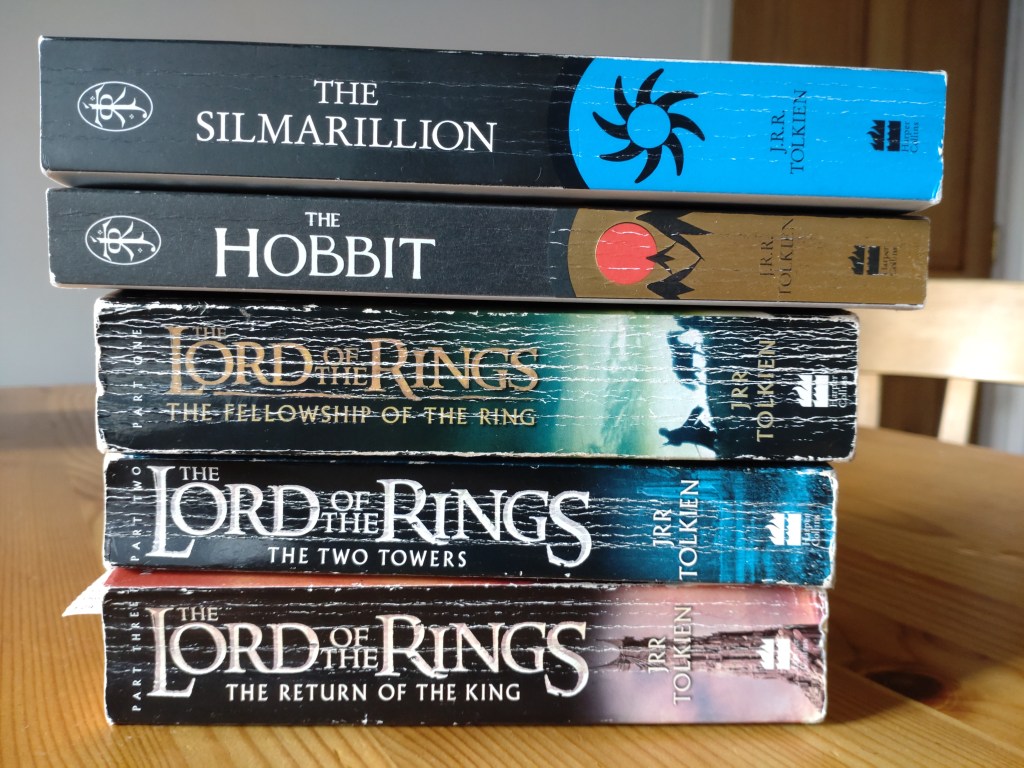
Yet, from this re-watch, I was able to discern that Jackson put in more work than I previously was even aware of to expand The Hobbit story into its rightful context within Tolkien’s mythology, in particular in its temporal position as a precursor to The Lord of The Rings. It is in this where I think The Hobbit films showcase some narrative brilliance on the part of its director. My opinion of this was enabled by my reading of The Silmarillion last year, a dense and remarkably realised mythology of the First Age of Middle Earth that Tolkien wrote prior to and, perhaps according to Christopher Tolkien, concurrently with The Hobbit in the 1930s. In a letter, Tolkien wrote that ‘The Hobbit was not intended to have anything to do with [The Silmarillion] […] It has no necessary connexion with the ‘mythology’, but naturally became attracted towards this dominant construction in my mind, causing the tale to become larger and more heroic as it proceeded’.[3]He suggests here that the progressive adventurous sensibility of The Hobbit came about in its tangential relationship with The Silmarillion: almost that The Hobbit couldn’t help but become more epic as a result of its exposure, in his imagination and writing, to the truly sweeping and awesome aspect of The Silmarillion. However, he is clear that there was no over-lap between the two: however much The Hobbit was influenced by The Silmarillion in terms of narrative grandiosity, the narratives themselves were quite separate. Only in Tolkien’s own retrospect and re-jigging post-Hobbit and aided by The Lord of The Rings do we see an intersection begin to merge between what were previously disparate texts.[4] It is here where I argue Jackson, with the benefit of Tolkien’s retrospect and the extensive appendices that accompany the legendarium, was able to successfully bridge some of the gaps left behind by Tolkien’s source texts. In short, Jackson and his team did their research, it shows, and The Hobbit films deserve much more credit than I believe they have received for this.

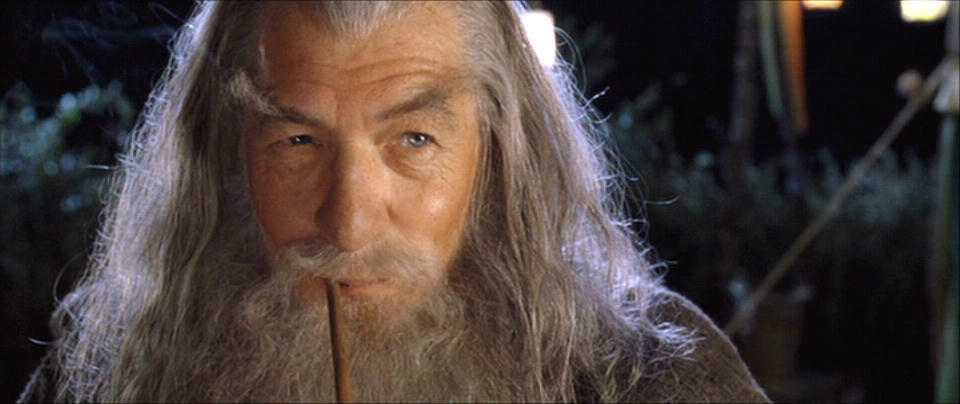
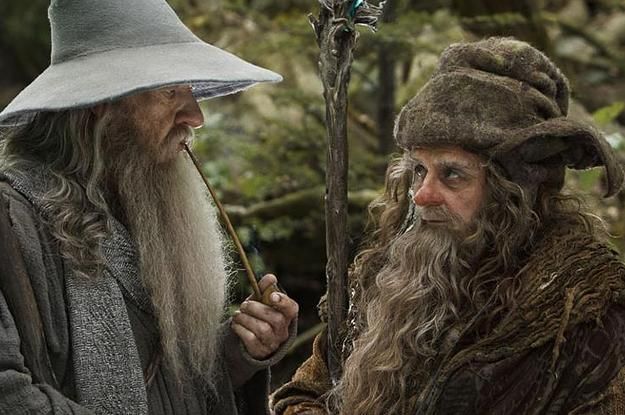
Fittingly, it would seem that the main mechanisms that Jackson uses to help bridge these narrative gaps are the wizards Gandalf the Grey and Radagast. In saying this, I do not aim to reduce their roles to mere plot devices: on the contrary, in some way I see it as nigh on poetic that these characters, who are so well-loved and revered by both characters in the stories and by readers and audiences too, who have so much power, wisdom and benevolence, should be the ones to ensure the successful metaphysical narrative weaving across the media of novel and film between The Hobbit and The Silmarillion. Perhaps we shouldn’t be so surprised. Whilst Radagast is elusive throughout Tolkien’s texts, Gandalf is presented as a character whose wizardry extends beyond telekinesis and otherworldly intuition to his ability to construct and affirm meaning for the characters around him. Indeed, when we first meet him in the very first chapter of The Hobbit, he engages an unwitting Bilbo into something of a verbal sparring match, after the latter has wished him a ‘Good morning!’. Looking at Bilbo ‘from under long bushy eyebrows that stuck out further than the brim of his shady hat’, Gandalf asks him:

‘“What do you mean?” he said. “Do you wish me a good morning, or mean that it is a good morning whether I want it or not; or that you feel good this morning; or that it is a morning to be good on?”’[5]

In his interrogation of the exclamation ‘Good morning!’ is a playfulness with which Gandalf employs and perceives language, pointing to the number of different ways in which Bilbo’s deceptively simplistic phrase could be used and interpreted. Gandalf’s questions expose the realms of meaning that underlie even the most apparently obvious of statements and, as such, successfully and wittily deconstructs both the phrase Bilbo has used and, importantly, the complacency with which he used it. As a result, along with the play, is an assertion of dominance, expressed through the performed uncertainty around what Bilbo means: in his questioning he demonstrates his own command of and ability to wield language, and therefore his ability to construct meaning. By questioning Bilbo in this way and subtly asserting his own dominance over language and its multiplicity of meanings, Gandalf’s introduction is none too reminiscent of ‘in the beginning was the Word, and the Word was with God, and the Word was God’, yet perhaps with more of a knowing wink and a glint in the eye from underneath those bushy eyebrows. Although Saruman is described as ‘subtle in speech’, I would argue that it is Gandalf’s playfulness with language that marks him out as more flexible in his thinking and the more compelling to those around him.[6] This linguistic dominance is developed later on in the novel where Gandalf uses narrative to convince the shape-shifter Beorn to allow Thorin’s Company of dwarves and Bilbo to stay in his hall having been pursued by goblins through and from the Misty Mountains. Aware of Beorn’s reticence for opening his home to strangers, and with a particular dislike for dwarves, Gandalf weaves the tale of the Company’s adventures with hints at their number and regular interruptions by the arriving dwarves at such a pace as to not offend Beorn.[7] We are told towards the episode’s end that,

‘Bilbo saw then how clever Gandalf had been. The interruptions had really made Beorn more interested in the story, and the story had kept his from sending the dwarves off at once like suspicious beggars […] “A very good tale!” said [Beorn]. “The best I have heard for a long while. If all beggars could tell such a good one, they might find me kinder.”’[8]

Gandalf successfully uses language and, slightly differently to his first encounter with Bilbo, the delay and deferral of meaning to ensure he is able to get what he wants and needs. Even though he and the Company are in a vulnerable enough position so as to rely on Beorn’s hospitality, Gandalf is able to use his, again, playful and ‘clever’ control of language and meaning to endear himself and the others. In particular, Tolkien emphasises that it is ‘the story’ and the means by which it is told that secures safety and, therefore, it is clear that the ability to use language in this way is as powerful a weapon for Gandalf as any of the other magic he may be able to perform. This is confirmed through the echo of the description of the dwarves as ‘beggars’: the story does not prevent Beorn from seeing the dwarves as ‘beggars’, yet the power of the narrative seems to enable Beorn to move past his preconceived distrust and disdain for the dwarves, even conceding that he might be more open in general if each story he met was ‘good’ enough. By ‘good’ we don’t necessarily mean that plot points of the narrative, although they help, but the way in which Gandalf has adeptly guided Beorn through what is essentially a carefully constructed unfolding of the truth. The irony of which is that perhaps Beorn’s distrust is not entirely misplaced, given Gandalf’s masterful yet creatively tentative handling of what actually happened and how many they are. Nevertheless, what is clear is that Gandalf the Grey occupies an important role in Tolkien’s work as a conduit and creator of meaning, which makes it all the more appropriate that his character is one of two wizards used by Jackson, in this same vein, to bridge the narrative gaps between The Silmarillion, The Lord of the Rings and The Hobbit. These narrative bridges revolve around the shadowy figure of The Necromancer. 

The Necromancer is only named four times in The Hobbit text, and the gift that Jackson gives a film audience is a cinematic expansion of these short hints given, of course, by Gandalf both about him and his fortress at Dol Guldur, thereby building something of a narrative bridge from The Hobbit to The Lord of the Rings. One hint appears in the very first chapter of the novel, where Gandalf describes his adventure to retrieve Thror’s map: ‘I was finding things out, as usual; and a nasty business it was. Even I, Gandalf, only just escaped’; and one, satisfyingly cyclical, in the final chapter, ‘Gandalf had been to a great council of white wizards […] they had at last driven the Necromancer from his dark hold in the south of Mirkwood.[9] Furthermore, the episode is given reference to, again with little expansion in The Silmarillion: ‘Mithrandir [the Elvish name for Gandalf] at great peril went again to Dol Guldur and the pits of the Sorcerer, and he discovered the truth of his fears [that the Necromancer was ‘the first shadow of Sauron returning’], and escaped’.[10] Moreover, Jackson, I would argue, successfully interleaves the council meeting and Gandalf’s investigation of Dol Guldur mentioned here into The Hobbit narrative, with the council, attended by Gandalf, Galadriel, Elrond and Saruman the White, taking place during the Company’s sojourn at Rivendell early on in the first film of the trilogy, and then the investigation of Dol Guldur after the Company enter Mirkwood in the second film. This latter interleaving is particularly poignant narratively because as the Company encounters the corruption of the old Greenwood forest, we see Gandalf explore the root of that corruption, which I think works seamlessly. The expansion of these moments in the films serve to build important narrative connections that Tolkien either hints at or simply misses. The revelation that The Necromancer is the spirit of Sauron beginning to re-take form in the final film in The Hobbit trilogy is an important set-up for what happens sixty years later in The Lord of the Rings, plus is an excellent opportunity to see Galadriel in all her power. What was, perhaps, a missed opportunity was Jackson’s lack of emphasis as to why the council does nothing to organise against Sauron once it is revealed that he has returned. Saruman clearly underestimates Sauron’s ability to fully amass power, as described very late on in the appendices of The Silmarillion, but I think, what should be, an extremely pertinent moment becomes slightly lost within the narrative of the Company.[11] In truth, there is a lot of action in this film: it begins with Smaug’s destruction of Lake Town and his killing at the hands of Bard, then the confrontation at Dol Guldur, Thorin’s antagonism and obsession with the Arkenstone, followed by the Battle of the Five Armies. There is a lot of action and huge visuals to be swept along with. The decision to not challenge Sauron comes thirty minutes into the film and, most unfortunately, is not particularly circled back to. Gandalf’s last lines in the film seem like a particular waste, even though they replicate those in the novel: ‘You’re a very fine person, Mr Baggins, and I’m very fond of you; but you’re only quite a little fellow in a wide world after all’. In the novel, these words are delivered as Balin, Bilbo and Gandalf discuss the prosperity of the Men of the Lake after the Battle of the Five Armies and Bilbo’s hand in helping to ensure that peace. [12] Jackson’s use of them almost sentimentally, however, as almost a parting caution to Bilbo about the power of his magic ring is slightly too cryptic to ensure the sort of foreshadowing that could have been used to more explicitly weave the end of The Hobbit films to the larger narrative of The Lord of the Rings. However, as I said at the beginning of this essay, whilst true merits of these films have emerged with time and further investigation, they are by no means perfect.

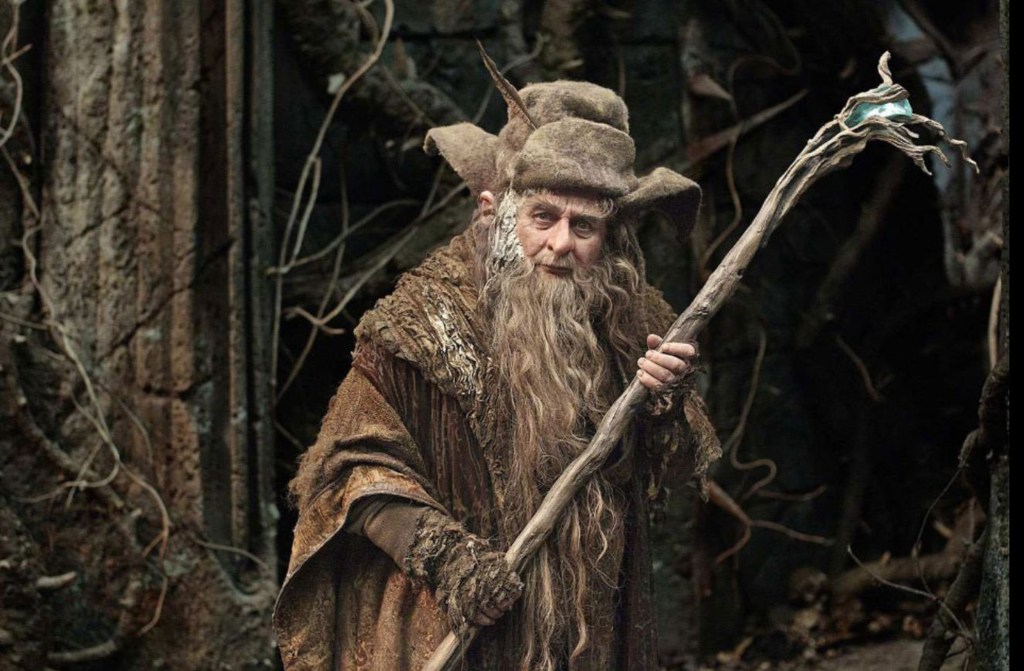
Something that cements Jackson’s attempt at narrative restructuring with, I argue, some great degree of success comes courtesy of the elusive and reclusive wizard Radagast. Whilst having scant mention anywhere in Tolkien’s books, his inclusion in these films was a brilliant, heartful choice which I think shows true warmth for the text on the part of the filmmakers. Not only does Jackson use Radagast to root The Hobbit films more securely into Tolkien’s context of Middle Earth, but he uses the wizard to bridge The Hobbit to some of the earliest events in the Elder days of the High Elves in The Silmarillion. In the first Hobbit film, when describing the corruption of Greenwood, Radagast describes the giant spiders in the forest as ‘some kind of spawn of Ungoliant’. In doing so, the filmmakers reference one of the most destructive and shocking moments in the early history of the Elves, where the first Dark Lord Morgoth, Sauron’s original master, uses a great, ravenous, corrupted spider called Ungoliant to destroy the sacred trees of light in Valinor, where she ‘belched forth black vapours as she drank, and swelled to a shape so vast and hideous that Melkor [precursor to the nomenclature Morgoth] was afraid’.[13]  Whilst the film only makes a small reference to this early and haunting moment of the mythology, so grotesque that even a character as epically vengeful and envious in the history of literature as Morgoth is rendered frightened, this connection built by Jackson through Radagast between the current condition of the Greenwood and the originators of decay and destruction at the very beginning of Tolkien’s world, shows how much thought has gone into what these Hobbit films could serve. They are not mere adaptations of one novel, but offer an explicit narrative bridge across the legendarium. These films are then, perhaps, more faithful adaptations of the legendarium than audiences claiming The Hobbit to be a children’s book are even aware of. We can see that the two wizards help to create this greater sense of meaning across the texts: Gandalf is used to enable The Hobbit to look forward to the later The Lord of the Rings, whilst Radagast is used to root The Hobbit in the legendarium, looking back to the past as he does to The Silmarillion, where previously The Hobbit was almost adrift between the bigger epic narratives.

All this to say: perhaps making The Hobbit into a film was never going to be as simple as the reductive mindset of ‘it’s a children’s book’ would allow. I may have been dismissive of these films when they first came out, arguing that so short a book could hardly require a three-film adaptation; but I am convinced as a result of this recent re-watch that, in making these films, Jackson undertook a bigger project, enfolding The Hobbit into the rest of the legendarium, enlarging its prospects rather than keeping it a stand-alone novel, whilst simultaneously paying homage to the warmth and good humour that has made it such a beloved narrative since 1937. With all of the richness embedded in the text, even and especially unconsciously done, The Hobbit appears, like its namesake protagonist, to have more to it than what meets the eye. There are faults with the films, it cannot be denied; but I do not think that this cinematic trilogy should be so easily discarded either. It makes sense that the novel, surprisingly dense as it is with the range and length of adventures contained within it and, as we have seen, extending beyond it, could not fit an average feature-length running time. My lasting thought upon writing this is that perhaps it would have been more suited to a television series format so that the barrage of episodic action could have been more evenly placed alongside the intricate narrative weaving that, it has become evident, is also required.


[1] The Hobbit, J.R.R Tolkien (London: HarperCollins Publishers Ltd, 2011), p.vii.

[2] https://www.theguardian.com/technology/gamesblog/2010/aug/10/games-science-of-immersion

[3] Ibid, p.vii.

[4] Ibid, p.xiii.

[5] Ibid, p.6.

[6] The Silmarillion, J.R.R Tolkien (London: HarperCollins Publishers Ltd., 2013), p.360.

[7] Ibid, pp.114-119.

[8] Ibid, pp. 119-120.

[9] Ibid, p.26; p.277.

[10] Ibid, p.360-1.

[11] Ibid, p.361.

[12] Ibid, p.282.

[13] Ibid, p.80.