A case for Lockwood and Dean in Emerald Fennell’s new adaptation of ‘Wuthering Heights’

As it does for many students, the third year of my university degree course entailed an extended independent project: a culmination of two and a half years building academic expertise in research, negotiating criticism and secondary material, deep and thoughtful analysis of language all framed within the construction of an elegant yet convincing argument. Whilst my department opted for a 7000-word long essay over a dissertation of 12,000-15,000 words (with one staff member morbidly commenting that they didn’t want to give students ‘too much rope with which to hang themselves’) it was still a rigorous task that began with a scintillating and frightening proposition: what on earth to write about?

Making any kind of decision for me initiates a period of profound reflection and soul-searching: I spent my early twenties distracting myself and others no-end with ‘Which Disney princess are you?’ Buzzfeed quizzes (answer: Pocahontas), and making a collage ‘All About Me’ at work a few years ago triggered something of an existential crisis. Before eventually deciding to write my long essay on the concept of ‘nothing’ in the elegiac and ekphrastic poem ‘Phantom’ by Don Paterson, a topic I picked the day before the deadline for submitting the topic, I was in torment trying to work out what I wanted to write about. I landed on a number of different options which, compounding my own purgatorial sense of ‘who am I and what shall I write about?’, were batted away by various academics.

These included one idea I had about the number three appearing in folklore (I still don’t understand the reservation about that one; Freud’s ‘Theme of the Three Caskets’ was going to anchor the thing, and my subsequent interest in Jungian analysis would open up my ideas in numerous different ways). Similarly, and most relevant for this essay, was an idea I had about cinematic adaptations of ‘Wuthering Heights’, and why, in my opinion, they never seemed to work. Another tutor dissuaded me from this task, citing either Queenie Leavis or Virginia Woolf in an attempt to communicate his perception that this topic was somewhat juvenile and I should do something more mature.

With the news that Emerald Fennell is writing, producing and directing a new adaptation of Wuthering Heights, which started production in 2025, I have decided to return to my juvenile project. Instead, however, of performing a deep-dive into the adaptations that have come before, I will consider what I hope will emerge in this new adaptation. There has already been plenty of comment and controversy surrounding the casting of her adaptation – Margot Robbie and Jacob Elordi would certainly not have been my choices for Cathy and Heathcliff, and I think many others agree – but I want to focus more on what I hope to see: which characters will be given prominence, will all of the idiosyncrasies, physical violences and clipped unhinged moments of the novel – biting, blows, ravings, hair-pullings – be woven in?

The first place to start was with re-reading the novel, which I did in the summer of 2024 in the waning months of pregnancy. The last time I read Wuthering Heights was when I was eighteen and studying it alongside Milton’s Paradise Lost and Webster’s The White Devil for A-Level. Back then, Gothic themes were prevalent not just in my studies but in noughties teenage culture at large, with the figure of the vampire in particular famously resurging in the Twilight novels and subsequent films, weekly doses of The Vampire Diaries on ITV2 and its spin-off The Originals, and True Blood for a more risqué proponent of the genre. The Noughties vampire craze is certainly something worth exploring in and of itself, and whilst I wasn’t the most adamant Twi-hard, I was certainly enamoured with the Gothic’s propensity for danger and romance. Wuthering Heights was no exception, with the emotional melodrama from all and sundry, the family saga and the theatricality of the various settings, from the Yorkshire moors to the two homesteads of Wuthering Heights and Thrushcross Grange. These are all, undoubtedly, kindling for the teenage imagination, which became ever so apparent upon returning to the text as a heavily pregnant 32 year-old woman. I am curious to see if Fennell’s new adaptation will ring in a new wave of Gothic story-telling, perhaps already begun with the re-make of Nosferatu and Ryan Coogler’s Sinners, and what that will tell us about the cultural moment in which we find ourselves.

Wuthering Heights remains a vivid and dramatic novel, with every character demonstrating a degree of emotional dysregulation, impetuousness and violence; characters I raged alongside as a teenager but now seem astonishingly unhinged in that unnerving, hopeless, hilarious and deeply endearing way that adolescents often are. This is because much of the action is being played out by just them: teenagers. As adaptations of The Great Gatsby are in danger of following Nick’s cue and romanticising its protagonist and anti-hero Jay Gatsby, adaptors of Wuthering Heights are in danger of imbuing this novel, and its key protagonists Catherine Earnshaw and Heathcliff, with a sage maturity that is not adolescent when it really should be.

After all, this novel does not start with the mad entanglements and upheavals of the Earnshaws, Lintons and Heathcliffs, with the relationship between Catherine Earnshaw and Heathcliff in particular eclipsing most of the rest of the novel’s drama in our collective imagination. The novel, in my mind, starts at ‘the sea-coast’ with a pompous, avoidantly attached man who shrinks ‘icily into [himself] like a snail’ when the girl onto whom he has heaped attention starts to return his affection, causing her to ‘doubt her own senses’ and leave with her mother.[1] In the aftermath, and fancying himself a misanthrope who wants to remove himself from society, he decamps to Yorkshire and arrogantly plunges himself into the company of Mr Heathcliff, his new landlord. It is through him, Mr Lockwood, that Nelly Dean’s history of the families of Wuthering Heights and Thrushcross Grange emerges.

Adaptation, like translation, is an art form in and of itself, and it is inevitable that changes and modifications to a literary text are made when it is fashioned from, in the case of Wuthering Heights, a novel into a film or television screenplay. The end goal cannot be to lean into translating the novel too literally for the screen; however, the success of the novel, I argue, relies as much upon its structure as it does on its characterisation, and to do away with any sense of framed narrative, the sense of a story-within-a-story that is created through the use of Lockwood and Dean, erroneously indulges and intensifies the most melodramatic parts of the work. I want to see an adaptation of Wuthering Heights that makes much of these two and the containment they provide. For, in my mind, Wuthering Heights is not a psychological novel, even though the psychology of the characters is absolutely central to the development of the plot, with trauma, addiction, grief, abuse and emotional breakdown all exhibited. Without minimising the severity of any of these, I still see Wuthering Heights as Gothic adolescent drama; what elevates it to greatness as a novel is through its considered structure, the theatrical blocking of various scenes – the various entrances and exits of characters between rooms and locations reads almost like a play – and the way in which Bronte skilfully maps pathos onto a most singular and evocative environment: the Yorkshire moors. Personally, I am thrilled that we are not in the heads of Catherine Earnshaw, Heathcliff, Hindley, Catherine Linton and Linton Heathcliff and whoever else. These characters are so erratic, dogmatic, cruel and selfish that we absolutely need distance from them. Bronte’s genius is that she gives us two characters, Lockwood and Dean, who are two imperfect filters for the chaos and sheer ridiculousness of the rest of the characters: they make Catherine, Heathcliff and Hindley et al. bearable, but they do not hold a sense of moral superiority over them.

Primarily, far from being a vacant empty vessel of character into whom the story is poured, as one might argue Captain Walton is in Mary Shelley’s Frankenstein, Lockwood is consistently presented as creepy, malevolent, egotistical and, yes, ridiculous. He presumes to visit Heathcliff at the start of the novel and before much happens gets into a scrap with some dogs after ‘winking and making faces at them’, driving the bitch, and seeming matriarch of the pack, to break into ‘a fury’, leaping onto him and inciting the others to ‘assault’ his ‘heels and coat-laps’, thus requiring him to fend them off with a poker before calling for help.[2] Here, Bronte presents a scene of buffoonery that is also laced with something sinister, as buffoonery often is: Lockwood offers no culpability, explaining his decision to make faces, which caused the ruckus, with an entitled degree of passivity – ‘I unfortunately indulged’ – as though it wasn’t completely his fault for winding them up. As such, within the first couple of pages, our narrator is presented as a ghosting fuckboy who wantonly upsets women, and I like to think of the bitch as some retributive symbol for the girl he messed about at the seaside.[3] Bronte continues her characterisation of Lockwood as a man who is conceited towards the workers at Thrushcross Grange, affronted as he is by prescribed mealtimes (‘a matronly lady taken as a fixture along with the house, could not, or would not comprehend my request that I might be served at five’) and a ‘servant-girl’ cleaning a fireplace and ‘raising an infernal dusk’; and who takes a predatory interest in young Catherine who he describes as ‘scarcely past girlhood’ but who is physically ‘irresistible’ and ‘exquisite’.[4] Indeed, later on in the novel he pursues his interest in young Catherine indirectly, revealing to us that he ‘should like to know [the] history’ of ‘that pretty girl-widow’ and remonstrances himself with regards to her personality: that he should ‘beware of the fascination that lurks in Catherine Heathcliff’s brilliant eyes. I should be in a curious taking if I surrendered my heart to that young person, and the daughter turned out a second edition of the mother!’[5] Here, we see one of the many instances that Bronte provides of his predatory and wolfish behaviour, with repeated reflections that dwell on her physical appearance and his consistent overestimation of his own desirability.  

As such, we can see that Lockwood is as dogmatic and deluded as many of the other characters. I would argue that his name also reflects this, with the image of ‘lock’ hinting that there is something extremely limited and limiting in his social ineptitude, that his perspective is unmoving and even, perhaps, that there is something in his nature that is controlling and desires to dominate, something that Heathcliff appears to be drawn to in the first chapter, loosening up and relaxing into ‘a grin’ as he does when Lockwood threaten to enact violence on the dogs: ‘If I had been [bitten], I would have set my signet on the biter’.[6] It is this fixedness that ultimately makes him the perfect character to dream Cathy’s visitation in Chapter 3: he is outsider enough to be unfamiliar with the family history and, thereby, experiences the full terror of the ghostly child at the window, and his cynicism and pragmatism about the presence of a ghost or a spirit, even in the dream realm, makes it all the more believable that the past has an almost supernatural presence in the lives of the living at Wuthering Heights. Lockwood is perplexed and perturbed at Heathcliff’s sobbing and crying out for Cathy, remarking that ‘there was such anguish in the gush of grief that accompanied this raving, that my compassion made me overlook its folly, and I drew off, half angry to have listened at all, and vexed at having related my ridiculous nightmare, since it produced that agony’.[7] He is convinced that nothing actually happened, with his reference to Heathcliff’s ‘folly’ and ‘raving’, clearly showing his belief that Heathcliff is acting irrationally and is annoyed at himself for having stoked it by relaying his dream. He doesn’t want to feed the psychodrama that is playing out in front of him and promptly leaves, taking us with him, and is drawn into it only in so much as he feels embarrassed and guilty by, what he perceives to be, Heathcliff’s extreme emotional response and the part he played in exacerbating it. In a novel teeming with emotional outbursts, we need Lockwood as this container of the chaos, and I think an adaptation’s success relies on it too.

Of course, Lockwood is not alone in his containment of the drama: Bronte teams him up with Nelly Dean in the relay of the tale, thus ensuring the essential distance we feel from the emotional tumult. These two characters become ‘companionable’, not only in the way in which they spend time almost cosied up storytelling together in the novel, but through Bronte’s use of them to construct and elevate the drama of the novel itself.[8] They are essential. Like Lockwood, Bronte presents Nelly as removed enough from the action and entanglements of the main characters by tracking her movements beyond the others, but she is inherently bound up with them too and is, thereby, able to deliver and weigh in on the emotional upheaval, because it is partly hers too. This is most evident in the scene in Chapter 17 where Doctor Kenneth relays Hindley’s death to her and knows that she’ll need to ‘nip up the corner of [her] apron’ for the tears that will come, which they do. He reflects that Hindley died ‘barely twenty-seven […] that’s your own age; who would have thought you were born in one year?’ To which Nelly responds that ‘ancient associations lingered’ around her ‘heart’ and she ‘sat down in the porch, and wept as for a blood relation’.[9] This scene reminds us that Nelly is relatively young and not the matronly or even crone-like figure that she has embodied in the cinematic imagination. Whilst she tends to Cathy, Heathcliff and Hindley as almost a nurse when they are young, for example when they all fall ill with measles, we are reminded of the fact that she is practically one of them by Bronte not only having her describe how she played with them before Heathcliff’s arrival, but in the way in which she describes joining in with Hindley’s campaign of physical violence towards Heathcliff when he has been admitted to the household, revealing that she ‘plagued and went on with him shamefully’ along with Hindley, and subjected him to ‘pinches’. [10] This has led to some critics, for example the academics on the ‘In Our Time’ episode on the novel to somewhat simplistically label her narration as ‘unreliable’, which is, in my mind, a moot point.[11] Reliability, I would argue, is not something that we should be aiming for or looking for, especially from a first-person narrator, as though there is some ultimate truth to be found. Furthermore, what is so mysterious and evocative about this novel is that we don’t really ever see the full drama play out: we mostly hear about it through recounts of events from dishevelled and upset characters. The energy, however, is conducted through Nelly, who Bronte brings close enough to the core of the drama for them to be somewhat enveloped by the emotion, and at times becomes an active participant and instigator, but who is still able to contain the drama as a whole.

In all likelihood, Fennell’s adaptation will centre on Cathy and Heathcliff, indeed most of the press attention has already fixated on them. As a culture, we are strangely obsessed with their story, fascinated as we are with their wildness, their desire for the disintegration of their physical boundaries to become one ego (‘I am Heathcliff’) which, I reiterate, is a movingly adolescent perception of love and relationships.[12] This, in spite of the fact that Cathy dies around half way through the novel, and we spend as much time, if not more, with her daughter. As a side note, the opportunity to explore doubling and doppelgangers is ripe here, and I think that David Lynch could have made a very curious and provocative adaption of Bronte’s work. I really hope that Fennell uses the gifts of Lockwood and Nelly Dean to contain and conduct the narrative. Looking at the cast list, I am heartened and excited to see Hong Chau playing Nelly Dean, with a younger version of the character being played by Vy Nguyen. This is a casting choice that suggests that Fennell is offering a truly reimagined Nelly, taking us away from the staid matrons of old to give us a more dynamic character who more accurately reflects Nelly in the novel: a peer of the main protagonists alongside whom she effectively grows up.

There is no sign of a Lockwood yet; we can but hope.   


[1] Wuthering Heights, Emily Bronte (London: Penguin 1985), p. 48.

[2] Ibid, p. 49.

[3] https://www.urbandictionary.com/define.php?term=fuck%20boy accessed 15:03, 10/05/2025.

[4] Ibid, p.51; 53.

[5] Ibid, p. 74; p.191.

[6] Ibid, p. 49.

[7] Ibid, pp.71-71.

[8] Ibid, p.76.

[9] Ibid, p.220.

[10] Ibid, pp.78-79.

[11] https://www.bbc.co.uk/sounds/play/b095ptt5, 20:10 [accessed 14:50, 10/05/2025].

[12] Ibid, p.122.


A squeeze of the hand

A squeeze of the hand

and then I was off, alone,

entering my cathedral:

arches of gold vermilion

crowning my gaze,

the mud underfoot, dark,

littered with

leaves who had rejoiced

their decline,

drifting, falling

to become food for the worms.

I placed

my raging head

against the brow

of a veined and shimmering

birch, whispering

greetings and thanks

in gasps of relief.

No one but me

and the breath of trees and

a squirrel gathering sweetly,

a magpie or two

like flashes,

shots of blue and black in the

corners of my vision,

with the others

more-than-human.

I smelt the sweetness

of exalting life and decay,

a scent that

I used to bathe in

under purpling childhood skies,

but that feels more

remote to me now.

I breathed in the past,

I breathed in homecoming.

The path winds and splits

and reunites.

And although I stepped gently onwards

I began to care not that

my feet would become dirty,

feeling, sensing

the pad of paws always

following, leading me

Walking through Tŷ Canol wood, Pembrokeshire

Upon receiving good news

Push through the gate

that hissed through its teeth at you

to turn back,

damming rivulets of paths

that are your birth right.

*

Bronzing mushrooms

chuckle as you pass;

twigs,

dried, collected, yellowing

like bones, crunch under your feet,

whilst the trees

maintain a lusty languor,

residing and bathing

in fresh dew.

*

Touch the bluestones

where lichen blossoms,

crafting a moonscape;

cradling moss

caress their rocks with fecundity:

ancient rotting restless renewing love.

*

Paw at the listening silence,

corpulent,

penetrated only by

the gentle coo

of two unseen birds

in soft dialogue.

*

I pause, standing still.

I lick the salt from my upper lip:

it tastes like my name;

it tastes like victory.

Photograph of Tŷ Canol wood taken by Colin Harper

Ruth

Ruth reflected

that we are flowers;

as time passes

we bud, we bloom

only to contract

and bud then bloom

once more –

I feel so grabbed

by big dusty hands

that clench, yank

when I am fatigued,

yearning for response:

a cushion beneath

my head,

a break in the

heat,

words whispered

softly.

*

A blackbird

flew into my

window this morning;

 distracted,

misinterpreting

my sterile light

for hers: a

false promise

or maybe she is

just so tired.

She huddled under

a tree, sheltered by

thin foliage

and waited, paused,

shuddering

camouflaged by

compassionate shrubby green.

I pressed my palms together

And through the glass

I wished, I whispered:

‘I love you’

‘I love you’

‘I love you’.

In my mind’s eye

scooping up

her feathered body,

tending to her,

calming her,

before releasing her

to the moon and clouds.

A50 back from Liverpool

The sky is

rent;

bruised

black and purple

against summer’s alabaster.

My heart

too;

my dreams

show me

in excellence,

excellence

that feels

unfounded:

the exam,

passed extraordinary;

the physical attraction

and animalism

I possess,

that of a star orbited

and yet

I look in a

ghostly mirror

and see my old

own known face.

Pale, my

hair scraped back and dark,

my lips painted

ruby red

in mockery.

How sad,

that my dream distinction

feels like

an alienation,

unnatural,

impossible.

But, I balked

at darkness

too:

hardly daring

to tread in

the forest

of pitch black;

hardly daring

to follow his

gaze to the

turtle,

bobbing, diving

in the currents

of an irrepressible stream;

too afraid

lest I lose my footing

and topple

into the deep.

Why I won’t be watching ‘Blonde’

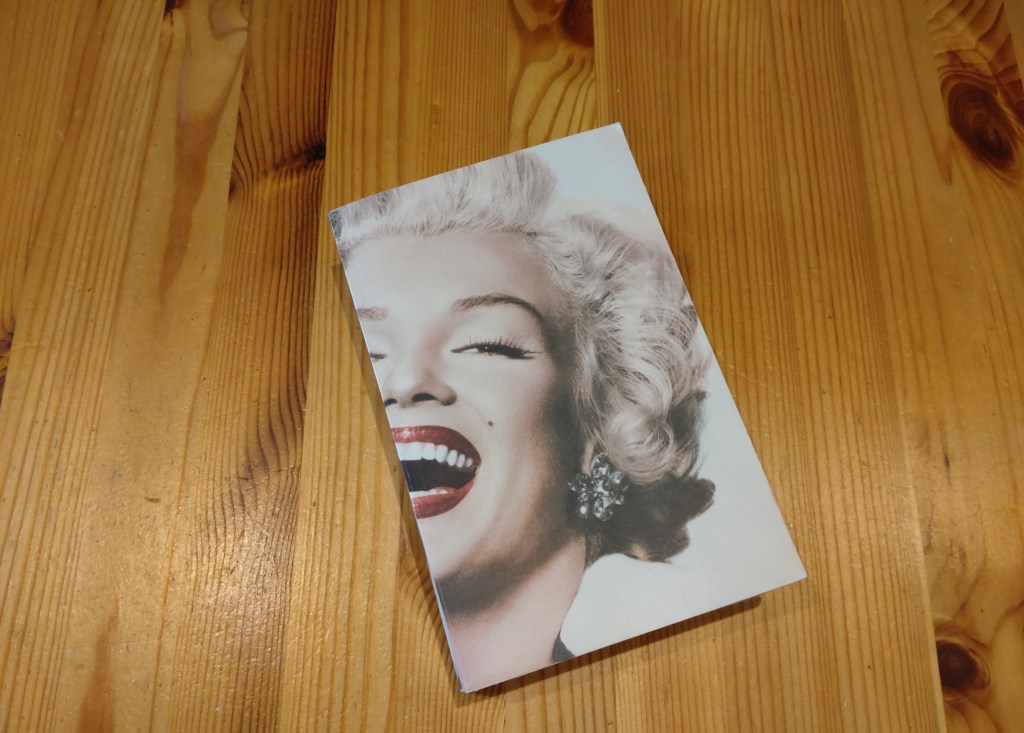
For my GCSE English Speaking and Listening assessment in 2007, the topic I landed upon was Marilyn Monroe. I vaguely remember how it began: ‘What do 20th Century Fox, red lipstick and *something else unremembered* have in common? Marilyn Monroe!’ I then proceeded to give what I’m sure was a very dull chronology of her life that I had lifted from ‘The Assassination of Marilyn Monroe’ by Donald H. Wolfe, which I had borrowed from a public library as part of my research. The choice to commit myself to this topic for an assessment was, with hindsight, a bemusing one: I had never seen a film of hers by that point and the first primitive reference to her I can recall was Geri Halliwell replicating the subway grating moment from The Seven Year Itch in the Spice Girls film ‘Spice World’ in 1997. Comically, during the Speaking and Listening, I even unknowingly mispronounced the name of Monroe’s film-noir Niagara, opting for ‘nia-garra’ over the generally agreed upon phonetic pronunciation ‘nahy-ag-ruh’. Very Alicia Silverston playing Cher Horowitz from Clueless, if I say so myself.

My interest in Marilyn Monroe didn’t end there: I had a Gentlemen Prefer Blondes poster on my bedroom wall; received books about her life and wardrobe for birthdays and Christmas; and I kept a black and white photograph of a still from Some Like It Hot on a wall in many lounges in various rented flats I’ve lived in over the years. A friend asked me once: ‘Why do you like her so much?’ I recall that my answer was somewhat vague: that she’d had a hard life and that ‘people’ had been unkind to her so remembering her was important. I still follow an account on Instagram called @perfectlymarilynmonroe that posts on a daily to weekly basis with lesser-known photographs and stories from Monroe’s life.

Over the past few months, I’ve been trying to wrack my brains as to why I felt passionately enough about Monroe to give a speech about her life at great length in front of a class of my peers. My deep fascination with her has, indeed, waned over the past few years largely without my noticing: emblematic of this is that the said photograph from Some Like It Hot is currently lying in a bag of other old posters, artworks and fragments from my early twenties, gathering dust. What is becoming clearer for me is that Monroe was a representation, as perhaps she was for many people, of some kind of angelic aspirational figure. Whilst being blonde has something of a cultural reputation for being ‘dumb’, I can only recall almost learning to revere blondness, in particular white blondness, both in my peers and in cultural figures. This started both with my first Barbie and my first intrusive worry about my physical appearance when I noticed, aged five, that all of my school friends were blonde and were, I felt intuitively, valued in a slightly different way than I was by parents and teachers. When I decided, slightly questionably, to ‘go blonde’ after a break-up when I was nineteen, I was immediately asked whether people had started responding to me in a ‘different’ way: a slightly coded enquiry, that left me feeling that my physical and sexual currency had somehow been elevated now that my hair colour was no longer its natural tawny (and, yes, I think gorgeous) brown. 

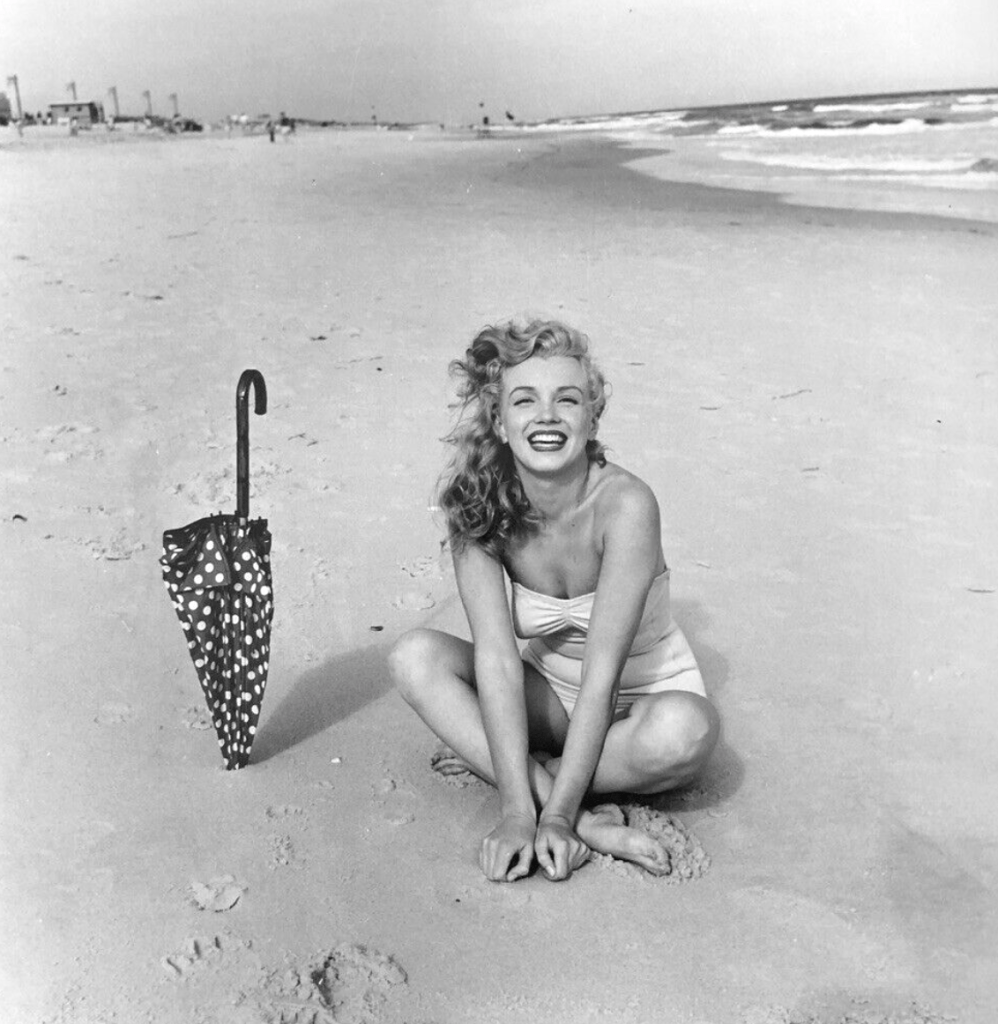
Monroe must be our culture’s ultimate archetype of this Aphroditic blonde. In the words of Anthony Burgess, she was an embodiment of ‘divine glamour’: physically unattainably beautiful, precious, witty and fun, whilst also seeming to transcend those humanly qualities into something celestial. Yet, her humanness meant that she never crossed into the realm of the purely and deathly symbolic: she seemed like an irreverent bodily, earthy being, vulnerable but also famously and gloriously comfortable in her own skin, like a cat. I am certain I projected a huge amount of my own adolescent gold onto her, seeing in her the goodness, radiance, beauty and joy that I couldn’t see consciously or couldn’t allow myself to accept in myself. As such, I began to uphold her as a role model I profoundly admired, believing I knew and understood her intimately, bittersweetly displacingknowing and understanding myself, and finding in my adoration a sense of meaning and belonging. I wonder if these feelings rooted for me are/were shared by others who upheld Monroe as a sacred role model. It is perhaps then no surprise or coincidence that my attachment to her has lessened, now, as a result of, amongst other things, therapy and by dedicating myself to practices that cultivate love, compassion and acceptance for myself. I don’t need to idolise someone externally when I have the qualities that I revere in abundance within myself.

As such, we arrive at why I have even been considering this at all. It is undeniable that Monroe has remerged in our public consciousness, famously through Kim Kardashian’s problematic wearing of the ‘Happy Birthday Mr President’ dress at the 2022 Met Gala, the publicity preceding the film Blonde, and the subsequent furore surrounding its release. Towards the end of a term, a pupil at school said to me of Blonde: ‘I read that that film did her dirty’. Nothing screams cultural permeation and significance more than a thirteen-year-old remembering and recounting something they’ve discovered on one of their voyages across the internet. Yes: Monroe is back, and it feels more complicated than ever.

I decided to start reading ‘Blonde’ by Joyce Carol Oates a month or two before the film was released. Even before its Netflix release on 28th September 2022, the film had already drawn a lot of internet attention thanks to both the intriguing promotional stills that featured uncanny representations of Monroe, played by Ana de Armas, and clips of the 14-minute standing ovation the film received at the Venice Film Festival. Once the film was released, however, everyone from the New York Times to the Independent and social media netizens decried it for being exploitative ‘trauma porn’, that capitalised upon speculation and conjecture about Monroe’s life. I particularly respected Mark Kermode’s shrewd framing of the film as a ‘horror film’ and ‘gothic melodrama’, which, in my mind, served to complicate the fact that it was essentially marketed as a biopic, in spite of references to Oates’ novel in the trailers.[1] I noticed that many of the comments and reviews that read as supportive of the film when the backlash kicked off harked back to the novel, almost claiming that because the film was an adaptation from a book, people needed to calm down about how Monroe was represented; that being an adaptation lent the film some kind of legitimacy. This was problematic on a number of different levels that could be the subject of an essay in and of itself. However, what concerned me the most was that people were appealing to the book as a zenith of some kind of authority, when the whole premise of the book in the first place is startlingly thorny.

Aside from the legal abstract that opens the book with the prerequisite publishing and copyright details, and the declaration of this novel as a work of fiction, Oates provides us with a lengthy ‘Author’s Note’ that forms a singularly disorientating read. Here is where the novel begins, before the introduction of any characters, settings or narration. It interweaves a number of bibliographic references to Monroe’s poetry, Monroe biographies, and secondary material reproduced and referenced throughout the novel, which are held in the same breath as assertions of ‘invention’:

Blonde is a radically distilled ‘life’ in the form of fiction, and, for all its length, synecdoche is the principle of appropriation […] The historic Marilyn Monroe did keep a journal of sorts and she did write poems, or poem-fragments. Of these, only two lines are included in the final chapter (“Help help!”-); the other poems are invented. Certain of the remarks in the chapter “The Collected Works of Marilyn Monroe” are taken from interviews, other are fictitious […] Biographical facts regarding Marilyn Monroe should be sought not in Blonde, which is not as intended as a historic document, but in biographies of the subject […] Of the books on acting cited and alluded to, The Thinking Body by Mabel Todd, To the Actor by Michael Chekov, and An Actor Prepare and My Life in Art  by Constantin Stanislavski are genuine books, while The Actor’s Handbook and the Actor’s Life and The Paradox of Acting are invented’.[2]

From the beginning, Oates immediately seems to perform the bewildering intertwining of fiction and reality: the ‘Author’s Note’ reads as a pre-emptive bombardment, constructing the overarching authorities of fact and fiction that are cast over the novel with the force and momentum of a high-speed train, throwing up questions and complications from the start: what exactly does ‘‘life’ in the form of fiction’ constitute? Is that not what fiction does and has done since its inception? Furthermore, the ‘nothing-to-see-here-officer’ intonation of Oates’ equivocation that the novel is ‘not intended as a historic document’ seems particularly slippery. Thanks to Roland Barthes and others, I have come to understand authorial intention as a concept that forms a contentious and, to put it bluntly, irrelevant focus of enquiry.[3] Whether done performatively or not, statements of intent, and their denial thereof, always raise my hackles: despite its seeming nonchalance, Oates here seems to be attempting to, or performing, the attempt to control the reception of her novel. This is doubly ironic as she follows this assertion with a complicated tangle of references that are both real and entirely made up, yet through the use of formal bibliographic conventions, such as italicisation, do not appear as such. Not to mention the ambiguity of the statement itself: ‘not intended as a historic document’. Not ‘not intended as an accurate history’ but ‘not intended as a historic document’. Which means that a claim is being made here that Blonde, in some way, exists outside of history. I would argue that any document published with an ISBN and with a catalogue record in the British Library constitutes an ‘historic document’: it is of a time and of a place. Whether Oates or Oates-performing-the-author believes it or not, her novel has entered discourse, it has entered consciousness with all of the contextual influences that informed its production and its reception, thus granting it a certain ‘historic’ position, regardless of whether its subject matter actually deals with history. Which the note tells us it does… and doesn’t.

I don’t mind that the novel starts with the ‘author’ running rings around us. I love being thrown into a conundrum which challenges my position as a reader, demanding interrogation and criticality over complacency. The is undeniably the air of the Trickster to the whole thing. However, it wouldn’t be a problem if the book wasn’t about someone who was real and is unable to do what she wants with the narrative: whether to disregard it, ignore it, challenge it or lean into it. And what a narrative it is: Blonde is one of a few books that I have found really excruciating to read: page after page, chapter after chapter of objectification, exploitation and violence. I actually didn’t mind the start of the novel and the mapping out of Norma Jeane’s relationship with her mother; I think it would make a great exercise to draw it into comparison with the start of David Copperfield, which I found equally compelling in the ways in which Dickens too leans into the psychological darkness and torment of an unhappy childhood. However, the rest becomes something of a relentless barrage of pure misery. Why did Marilyn Monroe have to be presented in this way? If this story had to be told, surely a fictional starlet could have been constructed upon which to map Monroe’s story, thereby removing the stickiness of projecting a load of cultural baggage onto someone, without their consent, who really existed.

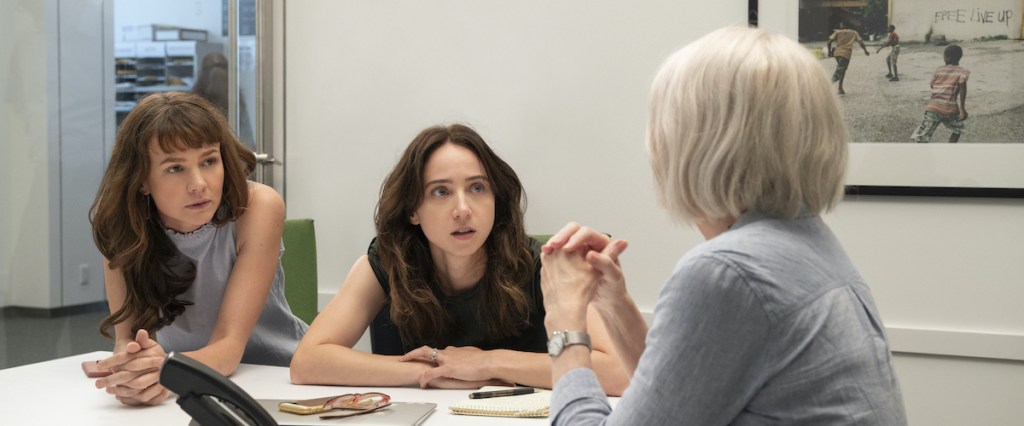
Blonde’s iterations as a novel and a film are all a matter of projection. In choosing to render Monroe a total victim under the guise of critiquing the twin forces of patriarchy and capitalism, the book, in my view, ends up becoming an oppressor; it becomes the toxic water that oppresses, stunts, and drowns out the reality of a person who once existed, denying her control over her own narrative and story. This is all the more important, and all the more baffling, because we live in a post-#MeToo world where agency and the reclamation of power and truth are a core part of women pushing back against sexual harassment and violence, as argued by the movement’s founder, Tarana Burke: ‘There is inherent strength in agency. And #MeToo, in a lot of ways, is about agency. It’s not about giving up your agency, it’s about claiming it’.[4] Blonde was first published in 2000, six years before Burke first used the phrase #MeToo on My Space and a further eleven years before it gained significant global traction after the New York Times broke the story of Harvey Weinstein’s abuse of women in Hollywood. Therefore, the book clearly comes from an earlier time when ‘feminism’ was still a dirty word and stories of sexual violence and harassment were still marginalised. In 2000, perhaps society needed an Homeric story of trauma to act as a sledgehammer for us to wake up culturally and resist the violence of patriarchy, even though stories of sexual violence have long been shared and published. Yet, we are no longer in 2000; from a 2022 perspective, Blonde’s framing of Monroe’s torturous suffering in its obscenity and relentlessness verges on the gratuitously perverse. More than ever, we need testimony and we need story sharing: but a text claiming fictitiousness about a real person who is subjected to an indulgence of abuse and trauma is not the same thing. The biographical film She Said, starring Carey Mulligan and Zoe Kazan as Megan Twohey and Jodi Kantor, the New York Times journalists who broke the Harvey Weinstein revelations, was also released in 2022 and is something of a counterpoint to the release of Blonde. The film doesn’t shy from giving voice to traumatic experiences, including Ashley Judd’s who, notably, plays herself; however, instead of presenting horrific detailed scenes of abuse, the film centres women’s experiences, storytelling and solidarity in challenging gargantuan male power. I would argue that it is a much more important film for exploring the real lives and stories of real people who experienced sexual violence, rather than projecting conjecture and contributing to the oppression of someone who will never have the right to reply.

Am I surprised that Monroe and her story continues to be plagued and harassed by patriarchy (and, yes, I consider Blonde to be a patriarchal novel)? No. I see Blonde and its cinematic iteration in the same vein as the documentary Amy, released in 2015. Neither Marilyn Monroe nor Amy Winehouse are allowed a say on their own story, let alone offered catharsis, redemption or transcendence. Two woman are placed onto a pedestal and then torturously and repeatedly torn down. They are brutalised within and by these texts in a way that I hope audiences find increasingly unacceptable, especially when compared with the adulation and adoration that men like Ayrton Senna in Senna and Kurt Cobain in Montage of Heck have received. It really is a tale as old as patriarchal time.

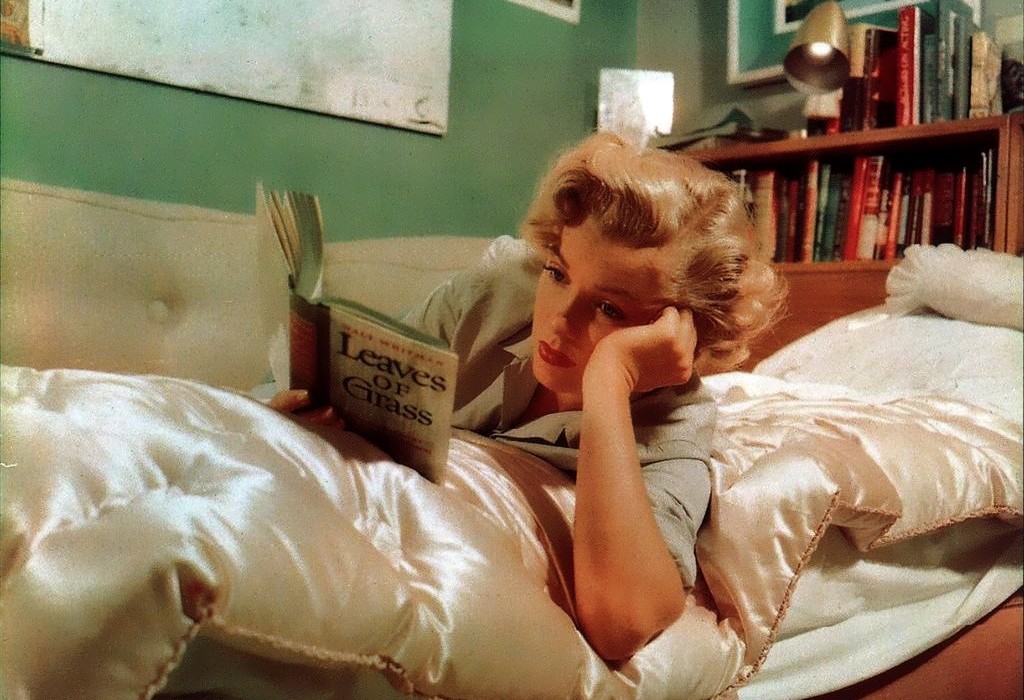
I am not ashamed to admit that when I finished reading Blonde I threw it to the ground, which has only happened one other time in my life (after reading Crime and Punishment, but that’s another story). I will not watch Blonde. Just as I don’t care if there really was a ‘real’ Shakespeare, I don’t care to speculate on ‘who’ the ‘real’ Marilyn Monroe is or was, especially when posited by a film that is problematic for all the reasons stated above and was applauded by the likes of Casey Affleck. Instead, I will re-watch Gentleman Prefer Blondes and Some Like It Hot for the thousandth times; I will recall how when Jane Russell tried to encourage Monroe to join a Bible group, she, fabulously, in turn decided to introduce Russell to Freud; I will enjoy the photographs of Monroe reading Leaves of Grass and Ulysses and leaning over a balcony in New York; I will enjoy the Warhol paintings depicting her; I will thrill at Lana Del Rey’s play with her image in the videos to National Anthem, Paradiso and Candy Necklaces; I will reminisce about the homage to Diamonds Are a Girl’s Best Friend in Noughties teen staple ‘Gossip Girl’ where Monroe was played by Serena Van Der Woodsen AKA Blake Lively. What real joy this woman has brought and the bright, bright shadow she continues to cast. I dedicate the end of this essay to Marilyn, in her own words:

‘When it comes down to it, I let them think what they want. If they care enough to bother with what I do, then I’m already better than them’.


[1] https://www.theguardian.com/film/2022/sep/25/blonde-review-marilyn-monroe-netflix-film-ana-de-armas-andrew-dominik-joyce-carol-oates [accessed 31/05/2023, 15:15]

[2] Blonde, Joyce Carol Oates (London: 4th Estate, 2018), p. i.

[3] https://sites.tufts.edu/english292b/files/2012/01/Barthes-The-Death-of-the-Author.pdf [accessed 31/05/2023, 15:18]

[4] https://www.theguardian.com/world/2018/jan/15/me-too-founder-tarana-burke-women-sexual-assault [accessed 31/05/2023, 15:23]

Pendulum

There isn’t much to say.

There isn’t much to do

between the pendulum-swing

of witchcraft and watercolour.

Tending to our plot

dipping our toes

into the rhythms and melodies

honeyed by memory.

*

Other sweetnesses have been

gardened: mowing, planting

with friends and the bees;

the snails communing in the weeds;

travelling and trusting to the hedgerows of hawthorn,

custodians running and guarding the roads

in a wash of white, with

sprinkled cow parsley waving nearby.

*

Dancing under the yellowing light

of a half-moon waxing with radiance

before rooting into vegetables, trellis and earth;

toasting to rites and riots whilst

casting feathered petals to the wind in future’s honour

my ankles and thighs deep in

shadowy waters of black salmon:

I am careful as I continue to tread softly in blind faith.

The fifth season

‘Three white butterflies to know you’re near…’

‘Grandfather please stand on the shoulders of my father while he’s deep-sea fishing’ – Lana Del Rey, Did you know that there’s a tunnel under Ocean Blvd (2023)

I try to

smile sweetly

at April,

but my teeth

hurt.

I force myself

to consider

the miracle

of primroses

that scatter

the churchyard

wantonly;

but I hanker

for the crows

and their inky capes.

I grab T.S Eliot

in the morning;

pick my skin;

mangle my words;

then accidently

smashed the

almond blossoms

on the floor and

cried.

A month begins

with the

interplay

of shadow and darkness

under relentless

grey; the new

Del Rey album

knows.

I asked to

see, hear and know;

all I received

was the same old puppet

show and I

feel all the

ways I don’t

live up to the sun.

Today, I keep it small:

there’s nothing

much to do

except to give thanks

that I have a plot

safe enough

soft enough

to wait this out;

let woundedness have her moment,

her head between her paws,

her sighs reverberating

off the wardrobe;

compassion whispering reminders

through the blinds,

of the hallowed blue sky

as the wheel

it turns, it turns.

*

Then,

there we were

singing

‘Under the Bridge’

in murmured

unison.

Magnolia! Magnolia!

And our laughter

recalled the

sunbeams.

We sat down

We sat down

to breakfast

on beans and eggs

and I gazed

at the blue

sky, shyly

peeping

through tendrils

and coverlets

of grey.

I thought of the

sweetness of

slow, cold,

void-full

January,

and how

she is

time-dishonoured.

The tentative and loving

bite in her beauty

and patience is

lost

when we

are forced

to rise in

the darkness,

beating our

way though the

shadows and furies

when our bodies,

our souls

ache to awaken

with her.

No wonder

we struggle,

when the

rhythms of

cogs are

venerated, ghosts

of deeper

more sacred

practice,

woefully ignored,

rendering us

ghosts in our

turn.

So I do only

that which is needed,

to suit the

naked limbs

of the trees.

I allow poetry to

pull me

down slowly,

kindly and

passionately

and –

of course! –

there is so much

lusciousness

in January.

She was never

barren,

her darkness

prismatic,

her kisses sent

in hellebore.

With huge love and gratitude to Nikki McKinney at The Bell Jar Flowers for her generous permission to use this photograph as the featured image for this poem. Nikki arranged, designed and provided flowers for my wedding and I never realised how much I cared about these beautiful creations until I met her. She is a true artist. Her work can be found at https://www.thebelljarflowers.co.uk/

Beauty’s beyond

‘My life has been the poem I would have writ,

But I could not both live and utter it’

Henry James Thoreau

And I cried

in the kitchen,

for Beauty’s beyond

me.

I know it

should not

matter

but it

does.

That when

I write and

dance and sing

and feel

that I am

being shut

out of realms

of divinity:

the glassy plains

of the transcendent.

I am Earth-bound,

with a soul

that yearns

to unite with airy loftiness

but stumbles

and mumbles

in the clunk

and failure,

whilst other

gossamer souls

soar and delve

mining and mirroring

the riches of

abundant plenty.

*

He held me

and looked me

straight in the eye.

I realised

that my

art is in

my living:

the bounding

of my heart;

the alchemy

of my emotions;

the boundaries

of my bones;

the glory of

my joyous, shining

belief in the

brilliance and radiance

of connection.

My laughter.

My fury.

My dreams.

My choices.

My desires.

A living breathing

Mythology.

I may not

leave behind

masterpieces,

as I fumble and float forward,

but maybe even

simply

the attempt

is something mythic

something magic

something uncontained.