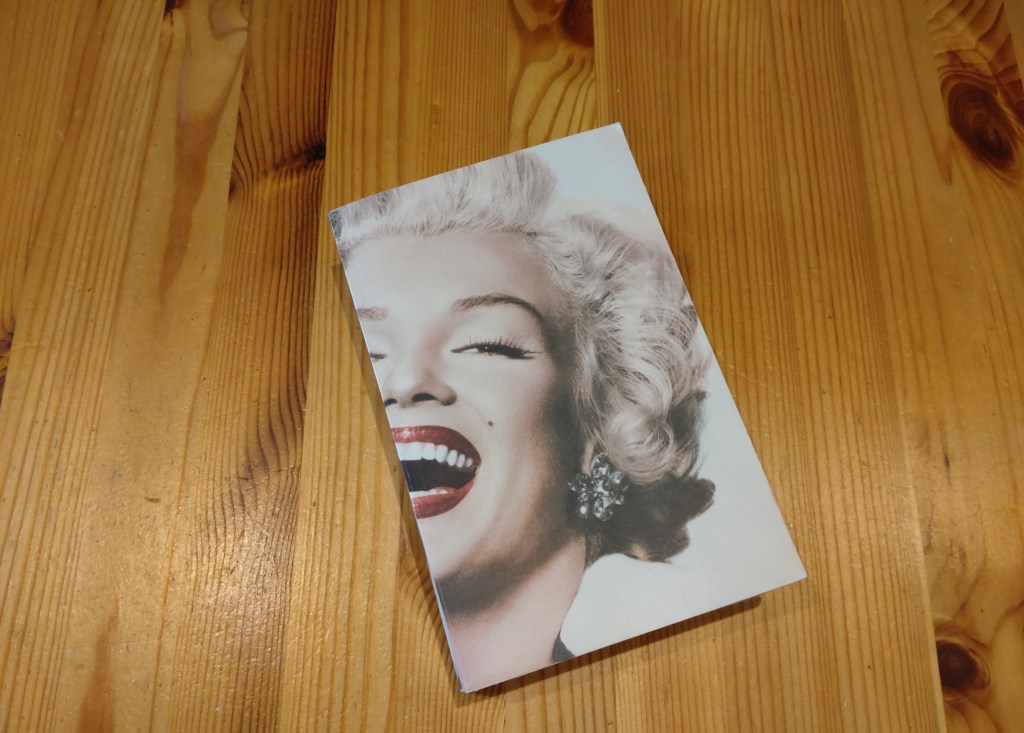
For my GCSE English Speaking and Listening assessment in 2007, the topic I landed upon was Marilyn Monroe. I vaguely remember how it began: ‘What do 20th Century Fox, red lipstick and *something else unremembered* have in common? Marilyn Monroe!’ I then proceeded to give what I’m sure was a very dull chronology of her life that I had lifted from ‘The Assassination of Marilyn Monroe’ by Donald H. Wolfe, which I had borrowed from a public library as part of my research. The choice to commit myself to this topic for an assessment was, with hindsight, a bemusing one: I had never seen a film of hers by that point and the first primitive reference to her I can recall was Geri Halliwell replicating the subway grating moment from The Seven Year Itch in the Spice Girls film ‘Spice World’ in 1997. Comically, during the Speaking and Listening, I even unknowingly mispronounced the name of Monroe’s film-noir Niagara, opting for ‘nia-garra’ over the generally agreed upon phonetic pronunciation ‘nahy-ag-ruh’. Very Alicia Silverston playing Cher Horowitz from Clueless, if I say so myself.
My interest in Marilyn Monroe didn’t end there: I had a Gentlemen Prefer Blondes poster on my bedroom wall; received books about her life and wardrobe for birthdays and Christmas; and I kept a black and white photograph of a still from Some Like It Hot on a wall in many lounges in various rented flats I’ve lived in over the years. A friend asked me once: ‘Why do you like her so much?’ I recall that my answer was somewhat vague: that she’d had a hard life and that ‘people’ had been unkind to her so remembering her was important. I still follow an account on Instagram called @perfectlymarilynmonroe that posts on a daily to weekly basis with lesser-known photographs and stories from Monroe’s life.
Over the past few months, I’ve been trying to wrack my brains as to why I felt passionately enough about Monroe to give a speech about her life at great length in front of a class of my peers. My deep fascination with her has, indeed, waned over the past few years largely without my noticing: emblematic of this is that the said photograph from Some Like It Hot is currently lying in a bag of other old posters, artworks and fragments from my early twenties, gathering dust. What is becoming clearer for me is that Monroe was a representation, as perhaps she was for many people, of some kind of angelic aspirational figure. Whilst being blonde has something of a cultural reputation for being ‘dumb’, I can only recall almost learning to revere blondness, in particular white blondness, both in my peers and in cultural figures. This started both with my first Barbie and my first intrusive worry about my physical appearance when I noticed, aged five, that all of my school friends were blonde and were, I felt intuitively, valued in a slightly different way than I was by parents and teachers. When I decided, slightly questionably, to ‘go blonde’ after a break-up when I was nineteen, I was immediately asked whether people had started responding to me in a ‘different’ way: a slightly coded enquiry, that left me feeling that my physical and sexual currency had somehow been elevated now that my hair colour was no longer its natural tawny (and, yes, I think gorgeous) brown.
Monroe must be our culture’s ultimate archetype of this Aphroditic blonde. In the words of Anthony Burgess, she was an embodiment of ‘divine glamour’: physically unattainably beautiful, precious, witty and fun, whilst also seeming to transcend those humanly qualities into something celestial. Yet, her humanness meant that she never crossed into the realm of the purely and deathly symbolic: she seemed like an irreverent bodily, earthy being, vulnerable but also famously and gloriously comfortable in her own skin, like a cat. I am certain I projected a huge amount of my own adolescent gold onto her, seeing in her the goodness, radiance, beauty and joy that I couldn’t see consciously or couldn’t allow myself to accept in myself. As such, I began to uphold her as a role model I profoundly admired, believing I knew and understood her intimately, bittersweetly displacingknowing and understanding myself, and finding in my adoration a sense of meaning and belonging. I wonder if these feelings rooted for me are/were shared by others who upheld Monroe as a sacred role model. It is perhaps then no surprise or coincidence that my attachment to her has lessened, now, as a result of, amongst other things, therapy and by dedicating myself to practices that cultivate love, compassion and acceptance for myself. I don’t need to idolise someone externally when I have the qualities that I revere in abundance within myself.
As such, we arrive at why I have even been considering this at all. It is undeniable that Monroe has remerged in our public consciousness, famously through Kim Kardashian’s problematic wearing of the ‘Happy Birthday Mr President’ dress at the 2022 Met Gala, the publicity preceding the film Blonde, and the subsequent furore surrounding its release. Towards the end of a term, a pupil at school said to me of Blonde: ‘I read that that film did her dirty’. Nothing screams cultural permeation and significance more than a thirteen-year-old remembering and recounting something they’ve discovered on one of their voyages across the internet. Yes: Monroe is back, and it feels more complicated than ever.
I decided to start reading ‘Blonde’ by Joyce Carol Oates a month or two before the film was released. Even before its Netflix release on 28th September 2022, the film had already drawn a lot of internet attention thanks to both the intriguing promotional stills that featured uncanny representations of Monroe, played by Ana de Armas, and clips of the 14-minute standing ovation the film received at the Venice Film Festival. Once the film was released, however, everyone from the New York Times to the Independent and social media netizens decried it for being exploitative ‘trauma porn’, that capitalised upon speculation and conjecture about Monroe’s life. I particularly respected Mark Kermode’s shrewd framing of the film as a ‘horror film’ and ‘gothic melodrama’, which, in my mind, served to complicate the fact that it was essentially marketed as a biopic, in spite of references to Oates’ novel in the trailers.[1] I noticed that many of the comments and reviews that read as supportive of the film when the backlash kicked off harked back to the novel, almost claiming that because the film was an adaptation from a book, people needed to calm down about how Monroe was represented; that being an adaptation lent the film some kind of legitimacy. This was problematic on a number of different levels that could be the subject of an essay in and of itself. However, what concerned me the most was that people were appealing to the book as a zenith of some kind of authority, when the whole premise of the book in the first place is startlingly thorny.
Aside from the legal abstract that opens the book with the prerequisite publishing and copyright details, and the declaration of this novel as a work of fiction, Oates provides us with a lengthy ‘Author’s Note’ that forms a singularly disorientating read. Here is where the novel begins, before the introduction of any characters, settings or narration. It interweaves a number of bibliographic references to Monroe’s poetry, Monroe biographies, and secondary material reproduced and referenced throughout the novel, which are held in the same breath as assertions of ‘invention’:
‘Blonde is a radically distilled ‘life’ in the form of fiction, and, for all its length, synecdoche is the principle of appropriation […] The historic Marilyn Monroe did keep a journal of sorts and she did write poems, or poem-fragments. Of these, only two lines are included in the final chapter (“Help help!”-); the other poems are invented. Certain of the remarks in the chapter “The Collected Works of Marilyn Monroe” are taken from interviews, other are fictitious […] Biographical facts regarding Marilyn Monroe should be sought not in Blonde, which is not as intended as a historic document, but in biographies of the subject […] Of the books on acting cited and alluded to, The Thinking Body by Mabel Todd, To the Actor by Michael Chekov, and An Actor Prepare and My Life in Art by Constantin Stanislavski are genuine books, while The Actor’s Handbook and the Actor’s Life and The Paradox of Acting are invented’.[2]
From the beginning, Oates immediately seems to perform the bewildering intertwining of fiction and reality: the ‘Author’s Note’ reads as a pre-emptive bombardment, constructing the overarching authorities of fact and fiction that are cast over the novel with the force and momentum of a high-speed train, throwing up questions and complications from the start: what exactly does ‘‘life’ in the form of fiction’ constitute? Is that not what fiction does and has done since its inception? Furthermore, the ‘nothing-to-see-here-officer’ intonation of Oates’ equivocation that the novel is ‘not intended as a historic document’ seems particularly slippery. Thanks to Roland Barthes and others, I have come to understand authorial intention as a concept that forms a contentious and, to put it bluntly, irrelevant focus of enquiry.[3] Whether done performatively or not, statements of intent, and their denial thereof, always raise my hackles: despite its seeming nonchalance, Oates here seems to be attempting to, or performing, the attempt to control the reception of her novel. This is doubly ironic as she follows this assertion with a complicated tangle of references that are both real and entirely made up, yet through the use of formal bibliographic conventions, such as italicisation, do not appear as such. Not to mention the ambiguity of the statement itself: ‘not intended as a historic document’. Not ‘not intended as an accurate history’ but ‘not intended as a historic document’. Which means that a claim is being made here that Blonde, in some way, exists outside of history. I would argue that any document published with an ISBN and with a catalogue record in the British Library constitutes an ‘historic document’: it is of a time and of a place. Whether Oates or Oates-performing-the-author believes it or not, her novel has entered discourse, it has entered consciousness with all of the contextual influences that informed its production and its reception, thus granting it a certain ‘historic’ position, regardless of whether its subject matter actually deals with history. Which the note tells us it does… and doesn’t.
I don’t mind that the novel starts with the ‘author’ running rings around us. I love being thrown into a conundrum which challenges my position as a reader, demanding interrogation and criticality over complacency. The is undeniably the air of the Trickster to the whole thing. However, it wouldn’t be a problem if the book wasn’t about someone who was real and is unable to do what she wants with the narrative: whether to disregard it, ignore it, challenge it or lean into it. And what a narrative it is: Blonde is one of a few books that I have found really excruciating to read: page after page, chapter after chapter of objectification, exploitation and violence. I actually didn’t mind the start of the novel and the mapping out of Norma Jeane’s relationship with her mother; I think it would make a great exercise to draw it into comparison with the start of David Copperfield, which I found equally compelling in the ways in which Dickens too leans into the psychological darkness and torment of an unhappy childhood. However, the rest becomes something of a relentless barrage of pure misery. Why did Marilyn Monroe have to be presented in this way? If this story had to be told, surely a fictional starlet could have been constructed upon which to map Monroe’s story, thereby removing the stickiness of projecting a load of cultural baggage onto someone, without their consent, who really existed.
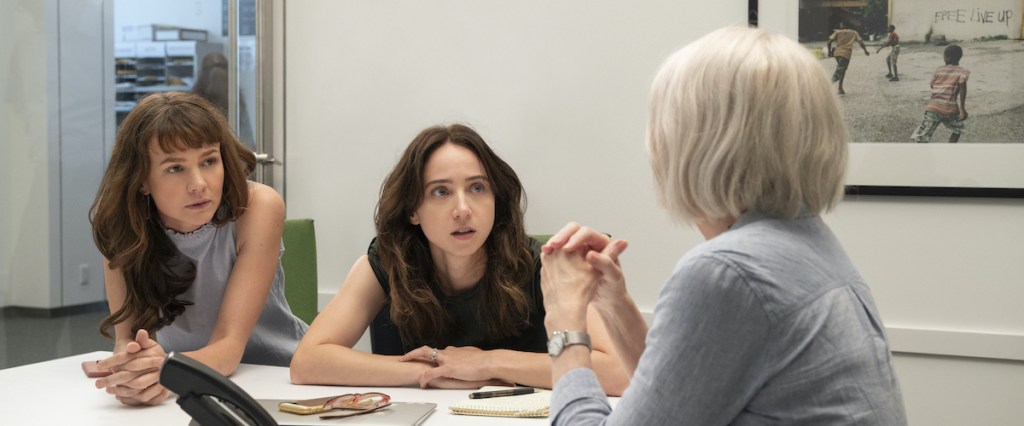
Blonde’s iterations as a novel and a film are all a matter of projection. In choosing to render Monroe a total victim under the guise of critiquing the twin forces of patriarchy and capitalism, the book, in my view, ends up becoming an oppressor; it becomes the toxic water that oppresses, stunts, and drowns out the reality of a person who once existed, denying her control over her own narrative and story. This is all the more important, and all the more baffling, because we live in a post-#MeToo world where agency and the reclamation of power and truth are a core part of women pushing back against sexual harassment and violence, as argued by the movement’s founder, Tarana Burke: ‘There is inherent strength in agency. And #MeToo, in a lot of ways, is about agency. It’s not about giving up your agency, it’s about claiming it’.[4]Blonde was first published in 2000, six years before Burke first used the phrase #MeToo on My Space and a further eleven years before it gained significant global traction after the New York Times broke the story of Harvey Weinstein’s abuse of women in Hollywood. Therefore, the book clearly comes from an earlier time when ‘feminism’ was still a dirty word and stories of sexual violence and harassment were still marginalised. In 2000, perhaps society needed an Homeric story of trauma to act as a sledgehammer for us to wake up culturally and resist the violence of patriarchy, even though stories of sexual violence have long been shared and published. Yet, we are no longer in 2000; from a 2022 perspective, Blonde’s framing of Monroe’s torturous suffering in its obscenity and relentlessness verges on the gratuitously perverse. More than ever, we need testimony and we need story sharing: but a text claiming fictitiousness about a real person who is subjected to an indulgence of abuse and trauma is not the same thing. The biographical film She Said, starring Carey Mulligan and Zoe Kazan as Megan Twohey and Jodi Kantor, the New York Times journalists who broke the Harvey Weinstein revelations, was also released in 2022 and is something of a counterpoint to the release of Blonde. The film doesn’t shy from giving voice to traumatic experiences, including Ashley Judd’s who, notably, plays herself; however, instead of presenting horrific detailed scenes of abuse, the film centres women’s experiences, storytelling and solidarity in challenging gargantuan male power. I would argue that it is a much more important film for exploring the real lives and stories of real people who experienced sexual violence, rather than projecting conjecture and contributing to the oppression of someone who will never have the right to reply.
Am I surprised that Monroe and her story continues to be plagued and harassed by patriarchy (and, yes, I consider Blonde to be a patriarchal novel)? No. I see Blonde and its cinematic iteration in the same vein as the documentary Amy, released in 2015. Neither Marilyn Monroe nor Amy Winehouse are allowed a say on their own story, let alone offered catharsis, redemption or transcendence. Two woman are placed onto a pedestal and then torturously and repeatedly torn down. They are brutalised within and by these texts in a way that I hope audiences find increasingly unacceptable, especially when compared with the adulation and adoration that men like Ayrton Senna in Senna and Kurt Cobain in Montage of Heck have received. It really is a tale as old as patriarchal time.
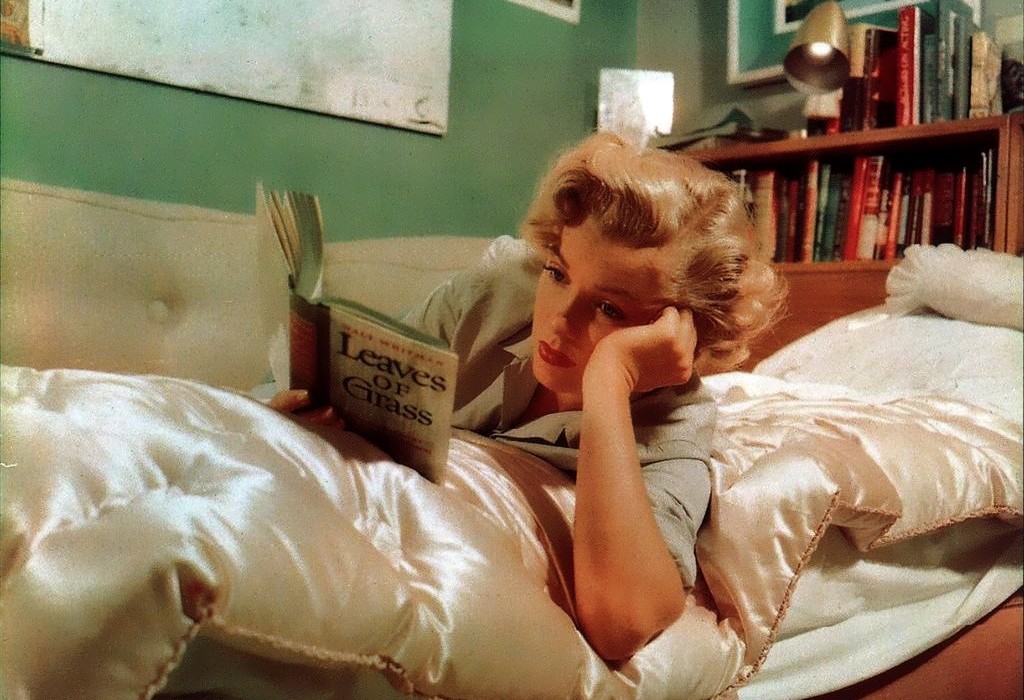
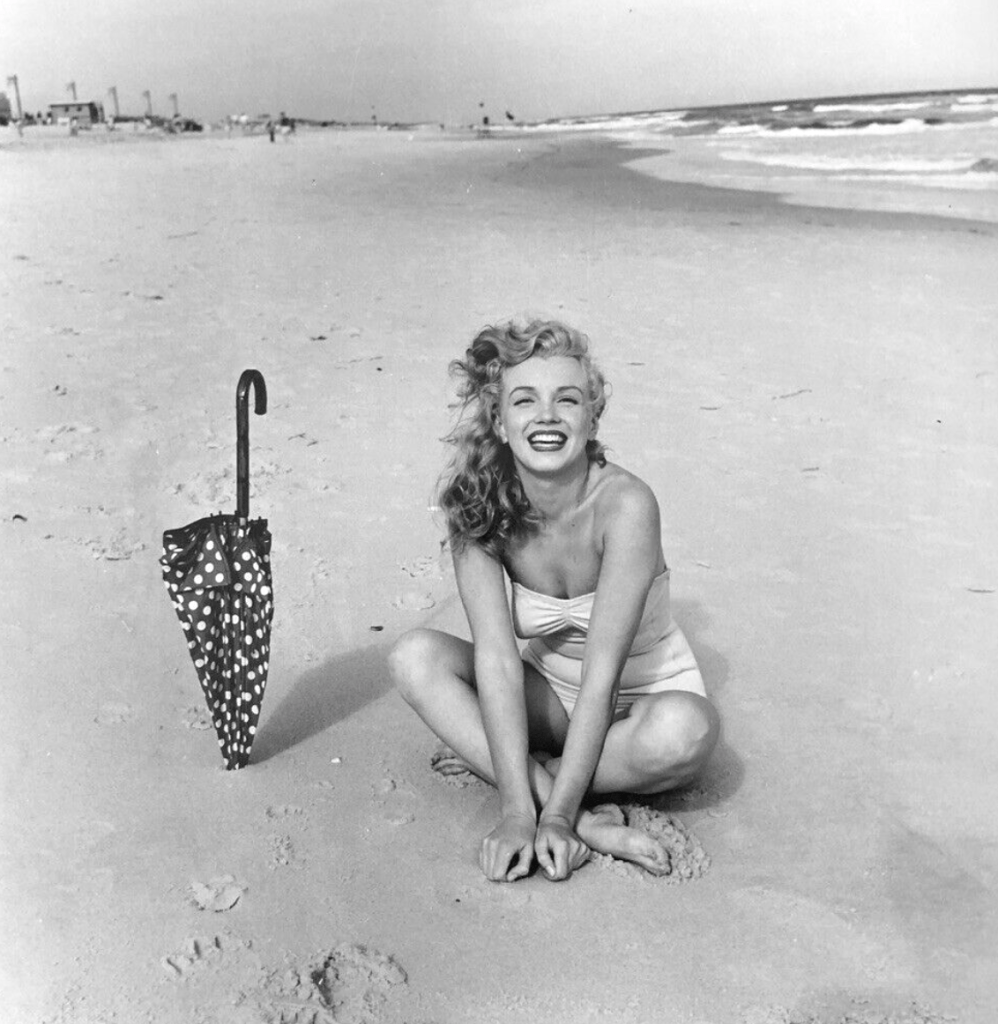
I am not ashamed to admit that when I finished reading Blonde I threw it to the ground, which has only happened one other time in my life (after reading Crime and Punishment, but that’s another story). I will not watch Blonde. Just as I don’t care if there really was a ‘real’ Shakespeare, I don’t care to speculate on ‘who’ the ‘real’ Marilyn Monroe is or was, especially when posited by a film that is problematic for all the reasons stated above and was applauded by the likes of Casey Affleck. Instead, I will re-watch Gentleman Prefer Blondes and Some Like It Hot for the thousandth times; I will recall how when Jane Russell tried to encourage Monroe to join a Bible group, she, fabulously, in turn decided to introduce Russell to Freud; I will enjoy the photographs of Monroe reading Leaves of Grass and Ulysses and leaning over a balcony in New York; I will enjoy the Warhol paintings depicting her; I will thrill at Lana Del Rey’s play with her image in the videos to National Anthem, Paradiso and Candy Necklaces; I will reminisce about the homage to Diamonds Are a Girl’s Best Friend in Noughties teen staple ‘Gossip Girl’ where Monroe was played by Serena Van Der Woodsen AKA Blake Lively. What real joy this woman has brought and the bright, bright shadow she continues to cast. I dedicate the end of this essay to Marilyn, in her own words:
‘When it comes down to it, I let them think what they want. If they care enough to bother with what I do, then I’m already better than them’.
‘Grandfather please stand on the shoulders of my father while he’s deep-sea fishing’ – Lana Del Rey, Did you know that there’s a tunnel under Ocean Blvd (2023)
For many years I shunned the superhero genre. I was, and still am, a huge fan of the Christopher Nolan Batman films but, after the astonishing disappointment that was Zack Snyder’s Man of Steel in 2013, I ignored the glut of superhero films that followed. I still haven’t really forgiven DC for wasting so appallingly the talent and excellence of Amy Adams as Lois Lane. Dry, vacuous, thin writing. Atrocious. Superhero films subsequently defined blockbuster filmmaking in these early decades of the 21st century, and I wanted nothing to do with them.
Enter: Lockdown 2020.
Amongst the numerous personal epiphanies, rediscoveries, explorations and denunciations that this period elicited, one of the most joyful things we did was watch every Marvel Cinematic Universe (MCU) film in order, from Iron Man to Spiderman: Far From Home (disclaimer: The Hulk films aren’t on Disney Plus; we will watch them at some point but I have a hunch that we haven’t missed anything too drastic).
In many ways, I conflated Marvel’s films with the shoddiness of the DC output, and, pre-emptively diagnosed Marvel’s films alongside Nerdwriter’s analysis of the ‘Epidemic of Passable Movies’. Big-budget films that rely so heavily on tropes and cliché that they are tonally unconvincing and annoyingly poor. This isn’t to say that some of Marvel’s films aren’t ‘passable’: Iron Man 2 is crap, Avengers: Age of Ultron is weak and Dr Strange is bland and famously appropriated Eastern traditions and spiritualities for yet another egotistical white man to ‘find himself’. Marvel is also hugely reliant on mythologies of nationhood and capitalism, which underscore every single film. However, there is much to love in this epic serial of films that provided relief from pandemic anxiety. With a plot template that is consistent and hardly deviates from a standard exposition – conflict – climax – resolution structure, these twenty two films and their stories were comforting, relatively thrilling, slightly mindless, and everything that were needed to survive months of quarantine. Like a 21st century reincarnation of Borachio’s Decameron, which, coincidentally, I attempted in Lockdown. I got to the end of the Second Day then promptly gave up: there was only so much wife-stealing, ambiguity around sexual consent and general frustrating buffoonery I could take for one pandemic. I think I’ll just stick to the Pasolini film.
I digress.
Below are some of my thoughts, opinions, loves and obsessions about the twenty-two films we watched:
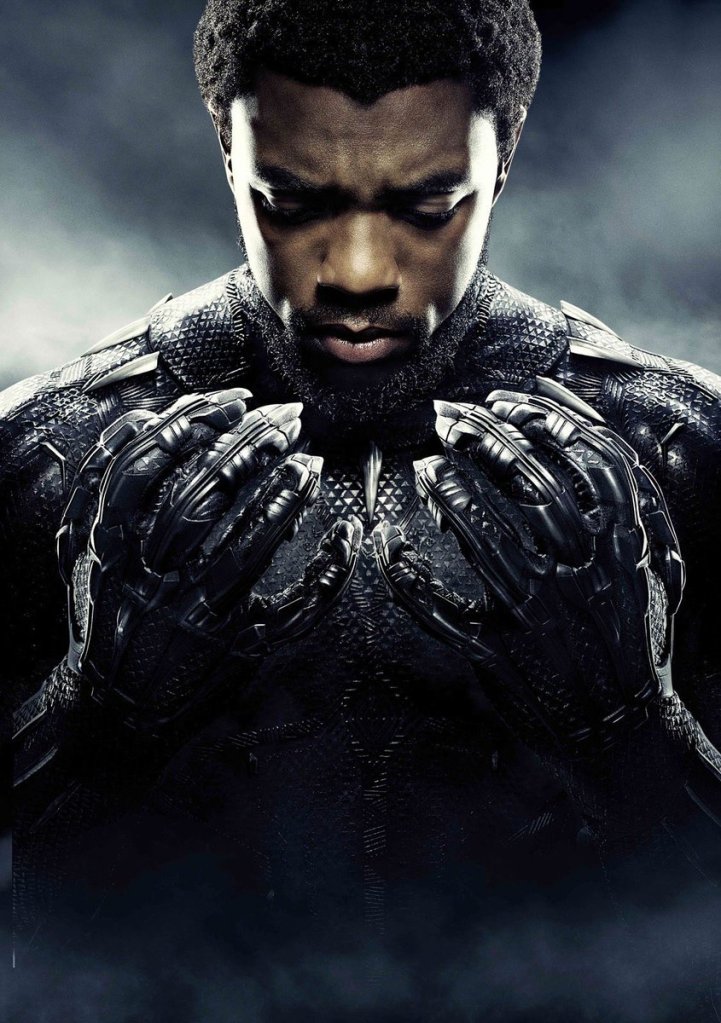
My favourite Avenger is Black Panther and I am devastated about the loss of Chadwick Boseman
It goes without saying that the tragedy of Boseman’s untimely death far eclipses the sadness we might feel as fans of Black Panther who will not see him in the role again. However, we can also acknowledge that Boseman’s performance is nigh-on legendary as T’Challa, and is a gift to cinema. As a character, Black Panther is one of the most powerful, endearing and incandescent Avengers to watch. Thanks to his vibranium suit and his ability to metaphysically connect with his ancestors and forebears, he is formidable and riveting, whilst also demonstrating deep dedication to his family, ancestral traditions in his advocacy and loyalty for Wakanda. Of course, as Emma Dabiri argues in Don’t Touch My Hair, the Marvel vision of African affluence and abundance is problematically neoliberal; however, the significance of seeing an African country and its peoples thriving technologically and financially is a rebuttal to white supremacist stereotypes and depictions of that continent. Boseman helped to forge a path in the representation and celebration of black life, the importance of which cannot be downplayed. The huge emotional and spiritual void his death leaves in this franchise undoubtedly echoes as a modicum of the one he has left in the lives of his loved ones.
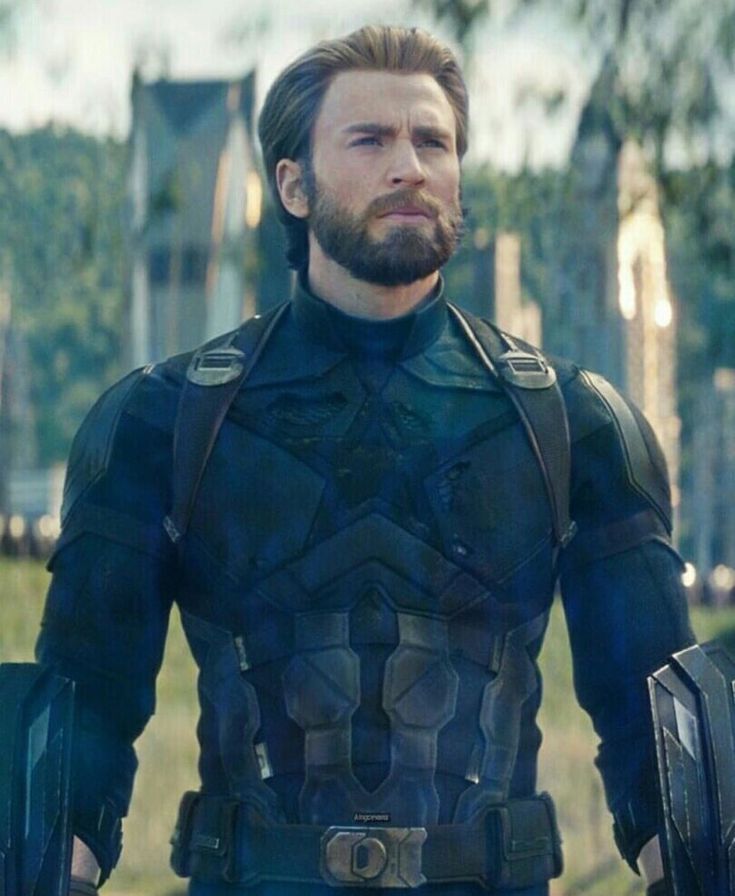
2. My other favourite Avenger is Captain America
I was once unceremoniously dubbed ‘vanilla’ for holding this opinion. I truly don’t care. Whilst Thor and Tony Stark embarked on their redemption arcs, Steve Rodgers was earnest, honest and dignified from Day One. I love to see this in my lead male protagonists once in a while (see my Love Note on Alyosha Karamazov for more). The scene in the lift in Winter Soldier is dramatically excellent and I don’t think any moment in a film has made me so disproportionately excited than when he was able to pick up Thor’s hammer in Endgame. Be in no doubt that I was shrieking ‘I knew it!’ along with Thor. What I love about Captain America is that he is always the first one into a fight and the last to give up on a fight: standing alone, battered and bruised, in front of Thanos in Endgame as the last line of defence for life itself, unwilling to give up, is the perfect encapsulation of who this man is. He never moves from a place of rage, anger or lack: there is no hubris here. Instead, he’s slightly melancholic all the way through, thanks to the loss of love-of-his-life Peggy and his existence as a living anachronism. As a result, he has Frank Ocean sad boy vibes in bucketloads, which I love. Of course, he is by no means perfect: the character’s relationship with American nationalism and militarism is, at times, nauseating. But he is a character who, in spite of this, is endlessly optimistic, never gives in and always tries to do the right thing for as many people as possible. There’s a lot to like there.
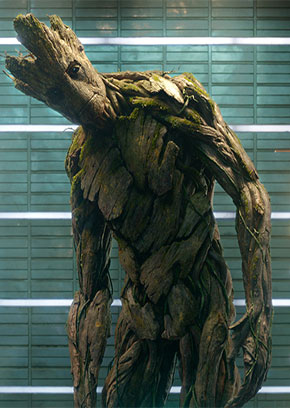
3. One of my future dogs will be called Groot
My favourite tree-esque character since Treebeard (not a tree of course, but an Ent) Groot is everything. I wept bittersweet tears at the end of Guardians of the Galaxy, when he protectively encased his friends in his branches to protect them, whilst suffering fatal damage to himself. Thankfully, his Jesus moment encompasses full resurrection, and we see Groot re-born as a precious and hilarious sapling and an uncannily familiar angsty teen. Always helpful, loving, resolute, and with a particular penchant for aggression when necessary, Groot is a shining star of the supporting cast and I love him, and will name a future puppy dog in his honour. The self-sacrifice ‘We are Groot’ scene at the end of the first Guardians film crystallised for me that this group of characters in this corner of the MCU are in one of my favourite films of the franchise. From the opening strains of Redbone’s ‘Come And Get Your Love’, to when the future Guardians are described as ‘bunch of assholes’, it was obvious that this superhero film was the scrappy, fun, genre-dying franchise sibling that would pave the way for the more experimental likes of Thor: Ragnorok and Tom Holland’s Spiderman.
4. I am conflicted by the up-coming release of Black Widow
It’s taken Marvel far too long to commission films based around the women of the MCU. Captain Marvel is excellent and was a real breath of fresh air after so much machismo and seemingly endless male soul searching throughout these films. There is the indefinitely postponed Black Widow film to watch in some post-pandemic future, but I feel more begrudged by it than completely psyched. Throughout the franchise, Black Widow seems to serve more as a distraction to movie fanboys than to exist as a fully realised character. This isn’t to discredit Black Widow as an idea or Scarlett Johansson’s representation of her: I think she is a poorly written throughout and has not been taken care of properly by the makers of the films. I am frustrated that we will only now get an origins story when we’ve had to witness her endlessly supporting others, her lukewarm love affair with Bruce Banner and the mediocre handling of her death.
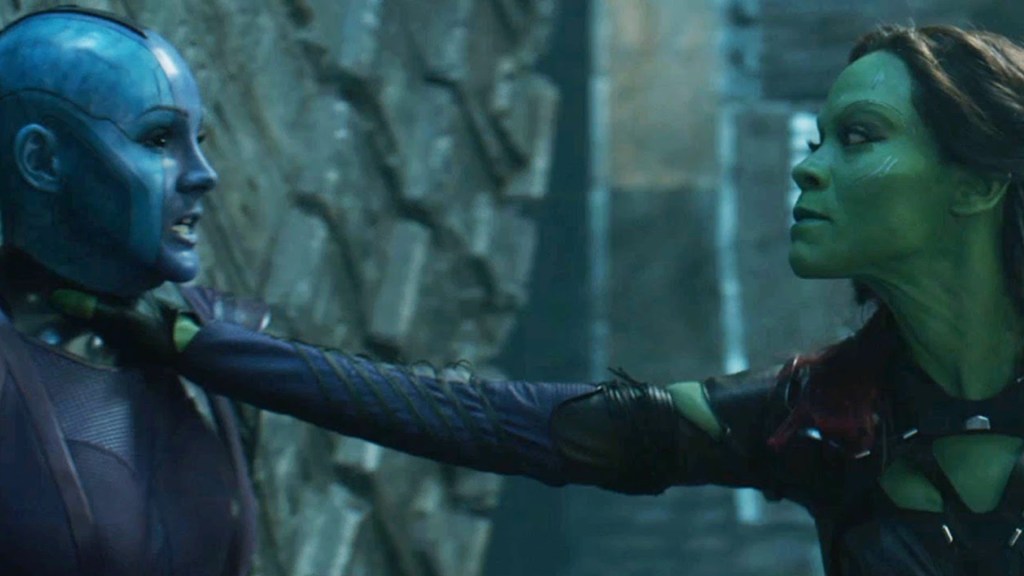
5. We need more Nebula and Gamora
Oh, the joy of seeing sisters on screen. These two characters present the highs and lows of sisterhood unlike few I have seen before. Fighting one another to the death when necessary? Relatable. Becoming the ultimate force to be reckoned with when united for the same cause? Absolutely. These two convey the ridiculous, hilarious and fierce love that can exist between sisters, and we need more of it in film. I hope that the producers and financiers at Marvel will give us more of Nebula and Gamora, who are, in my opinion, two of the most important and essential characters of the whole franchise.



 Harping On