Love Note series – Meg

Meg, Hercules, 1997

Hercules Meg

Hercules really is the unsung hero of the Disney oeuvre (if you excuse the pun). This film is a fun anachronistic re-telling of the Greek myth, which introduces Ancient Greece and its mythology to gospel music, American consumerism (Thebes is the Big Olive and Hercules fronts an Air-Herc mosaic advertising campaign) and Danny DeVito as Philoctetes. It also introduces us to Megara, whose friends call her Meg, or at least they would do if she had any friends.

Have nice day

Now, if you are familiar with the original Greek myth, you will be aware that Hercules actually kills Megara and all of their children when he is driven mad by Hera, thus initiating himself into completing the twelve arduous labours to redeem himself. Disney devolved significantly from the ancient myth, for obvious reasons, and instead of killing Meg off, the animators created a super sassy, fabulous woman who also has her fair share of emotional wounds to negotiate and free herself from. Meg combines witticism and fiery comebacks with deep-rooted pain and vulnerability. Prior to the main action of the film, we learn that she sold her soul to Hades, the god of Death no less, to save the man she loved, who then dumped her for someone else. Ouch. I mean, we’ve all had bad experiences in our love lives, but that is as about as shit as it gets.

Meg Wounded

Meg’s journey, in many ways, sees her learning to open up her heart and allow herself to be emotionally healed enough to accept the love being offered to her by a kind, emotionally available man who really bloody likes her. This may sound a bit patronising, melodramatic or wishy-washy, but is there any arena in human experience that feels as vulnerable and, sometimes, scary as being in a safe, loving relationship, especially when situations you have found yourself in previously left you hurt, distrustful and determined to close yourself off? I’m not sure. Meg is determined to keep up her walls up and her heart closed to Hercules, whose honesty and desire to help other people makes him one of Disney’s most endearing men. Ultimately, Meg proves that she is one of the most fearless Disney women when it comes to love. She throws herself under a column to protect Hercules when he is at his most vulnerable, putting her own life on the line for him; who then puts his life on the line to save her soul from the Underworld.

Now, I’m obviously not suggesting that we all start throwing ourselves under collapsing buildings or finding our way to Hell for the people we love, but if we look through a metaphoric lens here, I think there is very little difference. Healthy, loving relationships, no matter if they’re with a romantic partner, family or friendships, are absolutely worth protecting, require commitment to your own inner work and wellbeing, even if that means dragging yourself through the depth of your own personal hell to deal with issues like trust and intimacy, and embracing your loved ones with an open, accepting and trusting heart. If Meg taught me anything, it was about freeing yourself from the chains of low self-esteem; that the idea of a femme fatale can be a veneer for a huge amount of insecurity and emotional damage; and that allowing yourself to be loved fully by good, kind people around you, is the scariest but life-affirming thing in the world.

Love Note series – Mulan

Mulan, Mulan, 1998

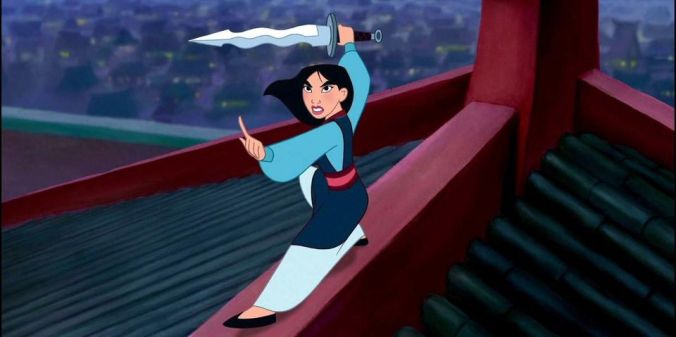
Mulan with shan yu sword

Mulan holds a very special place in my heart. She begins the film as a slightly disorganised, hapless, disgrace (by ancient Chinese standards) and then channels her strength, determination and courage into saving the whole of China from the Huns, both as a soldier and, when she becomes a disgrace again for doing that, in a traditional hanfu dress. Even from a short synopsis, we can see that over the course of the film, Mulan effectively redefines what it means for a woman to bring honour to her family in China, and shows that placing women in arbitrary boxes based on gender and capability is not in the interests of individual women or society as a whole.

Mulan and Little Brother

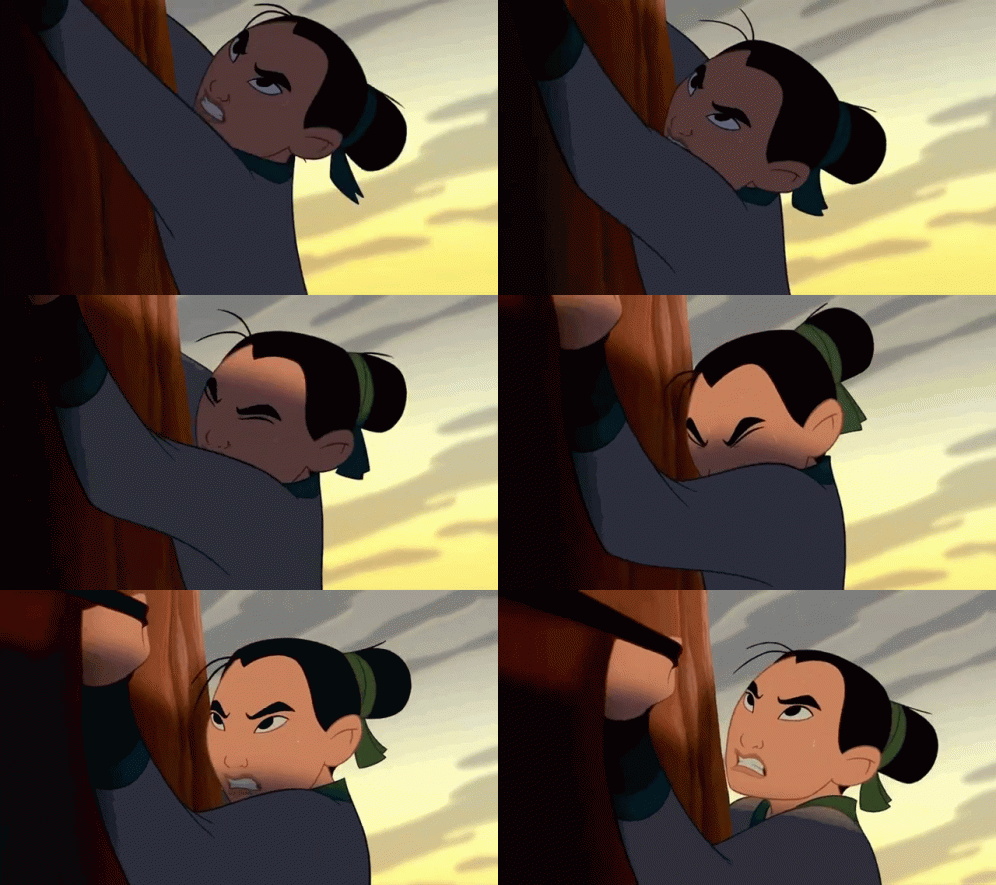
One of the things I love most about Mulan is that she is resourceful, a creative thinker and easily comes up with ideas and solutions to benefit herself and others. Over the course of the film, we see her attach a bone on a stick for her dog Little Brother to chase whilst simultaneously spreading chicken feed; out of her whole army unit, she is the first to understand how to use two weights to climb to the top of a pole and retrieve an arrow; she uses a cannon to trigger an avalanche that destroys the vast majority of the Hun army whilst saving the lives of all of her comrades; and she devises a plan to rescue the Emperor by having her mates drag up. Her ingenuity coupled with the strength and combat skills she acquires (in particular during the song ‘Dark Side of the Moon’ where the main refrain is ‘we are men’, the irony of which is amazing), make Mulan an incredible force to be reckoned with. No wonder she seems so threatening and at odds with the confining moral and social standards that prevail.

Mulan Climbing

Like Pocahontas and Esmeralda, Mulan also conveys incredible emotional sensitivity. She communicates with her dragon guardian Mushu, has a precious relationship with her horse Khan and is a deeply reflective individual. Her greatest desire, apart from saving the life of her father who is too old to fight in a war, is to become comfortable with her own identity. Her journey over the course of the film is to work out how she can be in the world and be comfortable within herself, whilst also serving the needs of her family and making them proud of her. Whilst, as is archetypal, she is met with set-backs and obstructions, where she takes the opportunity to assess what she has done and who she is. Ultimately though, her self-perception and her own sense of failure all fades in the wake of her needing to make a choice to do the brave and right thing, which she almost always does.

When shit hits the fan with Shan Yu and his allies surviving the avalanche and moving to attack the Imperial City, Mulan doesn’t think twice about gathering herself together and going to raise the alarm and fight back. In doing so, she carves out a place for herself and ultimately earns the respect and gratitude of an entire country. As such, Mulan shows us that in spite of the negative voices around us and within us that tell us that we are not good enough, that we don’t belong and that we have nothing to contribute to the world, we should stir up enough courage to carry on anyway. Ultimately we are defined not by who we or others think we are, but by the actions we take and the way we conduct ourselves in the world. If we live by this principle, of trying to be good and doing the best we can no matter whether it’s fighting in a war or feeding some chickens, that is enough. The rest of the world will fall into place around you.

Crowd bwing to Mulan

Love Note series – Pocahontas

Pocahontas, Pocahontas, 1995

download

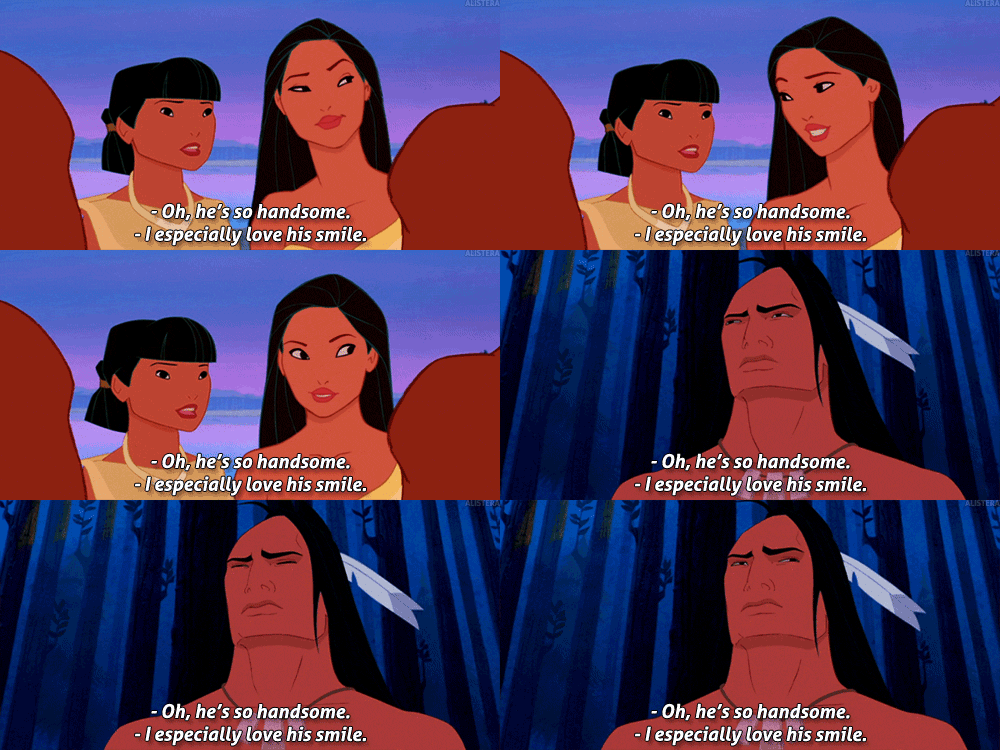
Pocahontas is vastly underrated and one of my all-time favourite Disney films. I was transported from the very opening shots: America, covered in woodland and accompanied by indigenous drumming, makes me think of how truly astounding the continent must have looked and been before the environment and its native people were decimated and destroyed by white European colonial invaders. Pocahontas is not only an incredibly bittersweet interracial love story, but is a strong rebuke to colonialism and a love letter to Native American culture. Indeed, Russell Means, who voiced Pocahontas’s father Chief Powhatan, remarked that this film is the greatest representation of Native American culture and life ever seen in a Hollywood motion picture.[1] The screenwriters’ and animators’ attention to detail is second-to-none: from casting Native American actors, using indigenous language in the script, the inclusion of intricate jewellery and body art down to the positioning of the teepees at the beginning of the film, which all face in the same Eastern direction as they would have done in the seventeenth century, this film gives a sensitive and conscious platform to a beautiful culture. And at the figurehead of it all we have Pocahontas, described by the animators as Disney’s first depiction of a woman, not a teenager, in the animated title role.[2]

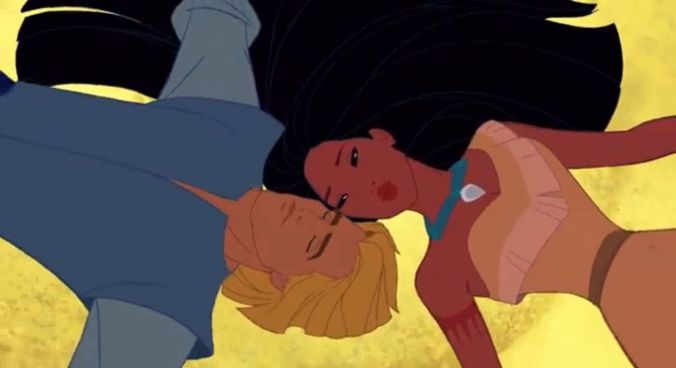
Pocahontas and John SMith

It does seem that Pocahontas operates on a different maturity level to most of the Disney princesses that precede her. I think this may have been because she was an actual historical figure, so extra sensitivity was required in the representation of her and her story, despite the heavy poetic license taken in the film. She risks a lot for the sake of a man she has fallen in love with, but the price for that isn’t losing her voice or developing Stockholm Syndrome (I’m so sorry Beauty and the Beast fans, I still cannot deal with that relationship dynamic!). She is presented as spiritual, closely connected to the animals, plants and people around her, demanding respect for her community whilst showing fascination for John Smith’s. She prevents a war and helps guide both sides to a place of tentative love and acceptance over hatred. And yet, she still manages to keep things light-hearted and sassy, as the situation requires.

Pocahontas lol

I love Pocahontas because she is playful, free-spirited and boundlessly curious. I love her relationship with best friend Nikomma who will happily tell her when she’s being a show off, which reminds me very much of my own relationship with my sister (I’m the show off). Indeed, my sister and I used to pretend to be Pocahontas and Nikomma when we were playing outside in the garden or on the beach (I was Pocahontas and Nicole was Nikomma, naturally). Pocahontas is deeply in tune with nature and her inner world, looking to the plants and animals around her, as well as her dreams for guidance and comfort. Her relationship with Grandmother Willow reminds me of mine and my sister’s relationships with our own beloved Grandma, and I love that she is willing to sit crossed-legged in front of her Elder to ask questions, heed advice and dialogue with her so that she might cultivate her own inner wise Self. Indeed, in many ways Grandmother Willow is Pocahontas’ inner wise Self, it depends on if you believe if she is actually real or just a figment of her imagination.

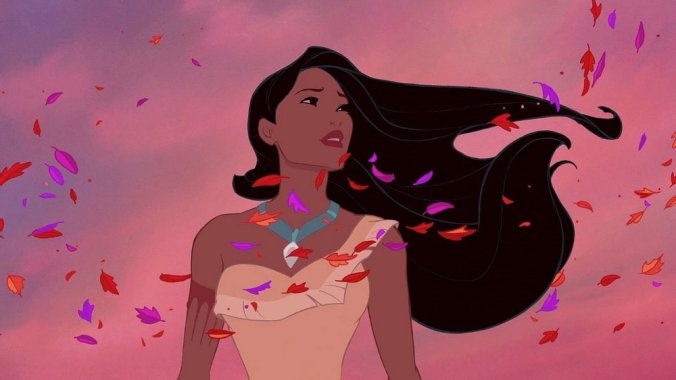
Pocahontas

Nowhere is this exploration of wisdom and connection with the natural world better explored in the film than during the song ‘Colours of the Wind’, written by Alan Menken and Stephen Schwartz. The song is accompanied by some of the most stunning animation that Disney has ever produced, and sees Pocahontas effectively deconstruct racist colonial narratives of who is considered civilized and who is considered savage. It is beautiful because the pithiness of the white colonial small-minded and deeply destructive dualistic ideology is visually dwarfed by the outstanding and overwhelming beauty of the natural world and the deep connection that Pocahontas sings of. My favourite line is ‘Come run through the hidden pine trails of the forest / Come taste the sun-sweet berries of the earth / Come roll in all the riches all around you / And for once, never wonder what they’re worth’. In other words, get over your racist capitalist bullshit John Smith and connect to something more powerful, more beautiful and more unifying.


[1] https://www.youtube.com/watch?v=RoHTikVNvbU [09:19, accessed 2nd July 2019].

[2] https://www.youtube.com/watch?v=RoHTikVNvbU [12:53, accessed 2nd July 2019].

Love Note series – Disney Women (part one, Esmeralda)

Before I went on holiday last week I had a burst of writing energy and, before I knew it, had four posts ready to be published. They are quintessential Harping On taking-silliness-seriously, and I am very excited to provide a little bit of light relief for myself and anyone reading this. I didn’t post last week because I was busy reading, swimming and sunning myself (more thoughts on that coming soon), so I hope that this Love Note series will more than make up for it.

As some of you will know, Disney holds a particularly big place in my heart. Fantasia is one of my top five favourite films of all time; Disney films in general are veritable nostalgia-fests when you need them; they provide the ultimate songbook for shower sing-a-longs; and can be hot topics for debate whenever the situation arises. Deconstructing Disney has long been one of my favourite past times (see here for an example), and I think it is a worthwhile endeavour. Like the fashion industry, such is the Walt Disney company’s power and reach that whatever its commercial and creative decisions, both good and bad, it affects us all even if we don’t care about them. I’d rather keep my eyes and ears open to Disney and what they are doing than to keep myself ignorant.

In light of this, and on a lighter note, I have written my series of blog posts on four of my favourite Disney leading women. They are each inspiring, interesting and courageous in their own ways and have taught me a lot about what it looks like to be a woman with conviction, especially in the face of patriarchal bullshit. I hope you enjoy them!

First up…

Esmeralda, The Hunchback of Notre Dame, 1996

Esmeralda featured image

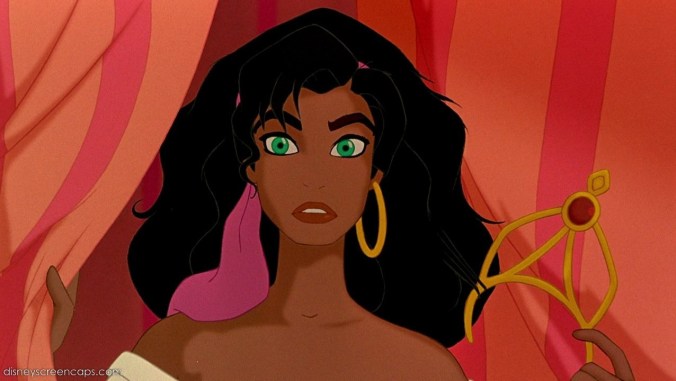
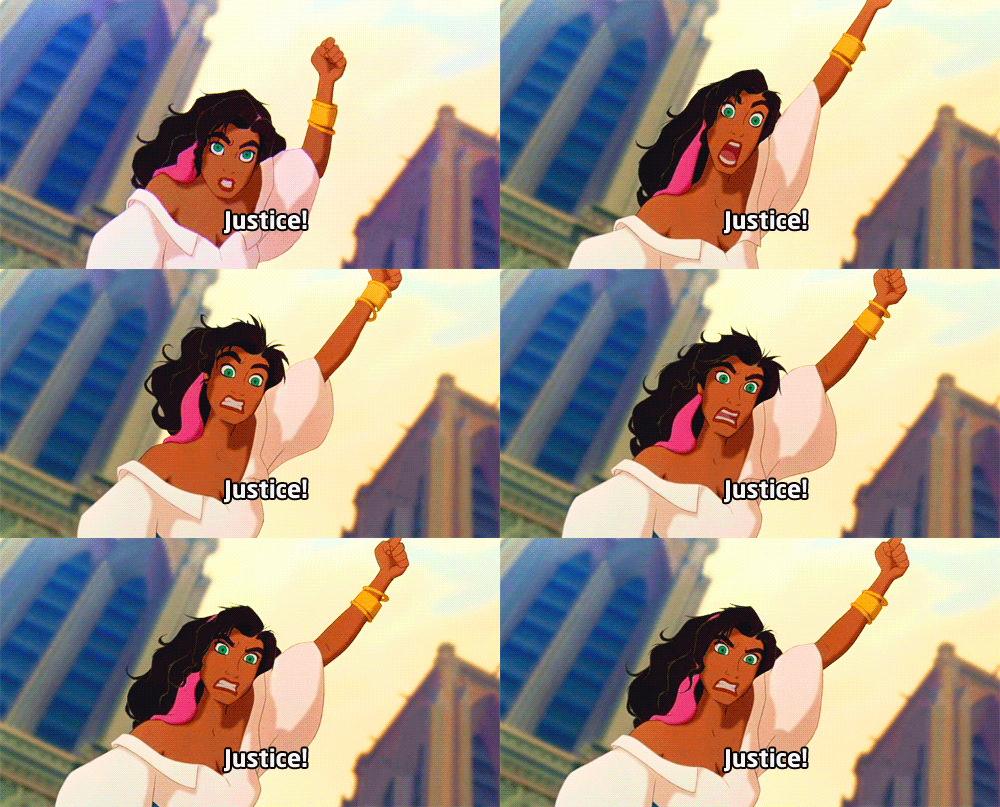
Harping On legend has it that when I met Esmeralda at Disney World on my 5th birthday, I ‘lost my shit’. Esmeralda was very, very important to me. I had two Esmeralda dresses, a Disney’s Hunchback of Notre Dame pencil case, an Esmeralda doll and a tambourine. She was my absolute hero. She stood up to a repressed, privileged prick, Claude Frollo, who spent his entire life and career persecuting Roma gypsies like her, and actively abused and encouraged abuse of Quasimodo, whose mother he kills at the beginning of the film, who then hides behind his rampant sexual desire for her by calling her a witch. Like I said, a prick. She derides Frollo for his cruel treatment of those who are vulnerable and refuses to back down when told to do so. Esmeralda is uncommonly brave, standing up for what is right even though it comes at a great risk to her own personal freedom and safety.

Esmeralda

One of the most moving parts of the whole film comes during her song ‘God Help the Outcasts’, with music by Alan Menken and Stephen Schwartz. Whilst every around her prays for glory, wealth and fame, Esmeralda declares:

‘I ask for nothing, I can get by

I know so many, less lucky than I

Please help my people, the poor and down-trod

I thought we all were children of God’.

Here, she clearly declares that she doesn’t want to ask for anything for herself because she knows of people who are much more desperate and worse off than she is. Esmeralda is selfless in spite of her own hardship, putting the needs, trials and suffering of her community before her own.

What is interesting is that whilst she addresses ‘God’ throughout most of the song, Esmeralda actually begins the song by speaking directly to a statue of Jesus. She demonstrates that in spite of the way she stands up for others and for what she believes in, she has internalised some of the xenophobic elements of medieval Paris, providing the caveat:

‘Yes I know I’m just an outcast

I shouldn’t speak to you

Still, I see your face and wonder

Were you once an outcast too?’

It is a moment of complete vulnerability as she enters a conversation with Jesus and subsequently God, a divine power that is bigger than her and whose help and comfort she needs. By adopting the language of her persecutors, with the label ‘outcast’, it suggests that she holds an internal belief that she is not worthy or good enough for finding refuge in prayer or communicating with God so candidly. However, she then goes on to draw a line of comparison between the two of them, demonstrating a sophisticated knowledge of Christian doctrine by suggesting that because Jesus was also considered an ‘outcast’ in his time, and especially in the run-up to his death, then it must be appropriate for her to speak to him. He was vulnerable, tried to help the needy and stood up to and threatened power structures, just she like she does. It is a beautiful, heartfelt moment, giving us a window into her internalisation of her ‘outcast’ status as a gypsy but also her ability to appeal to that which is vulnerable and considered by society as ‘unworthy’ in others, thus rendering everyone truly equal.

Esmeralda’s kindness and humility, coupled with her fiery resistance, her don’t-give-me-shit attitude towards future honey Phoebus, and her divine friendships with Quasimodo and goat Djali, make her one of Disney’s all-time greats. She is one of the most important and indispensable characters in the story and a true inspiration. She taught me that resisting injustice and standing up for others who are more in need of help than I am requires an immense amount of courage and bravery; never easy to do, but important beyond measure.

Esmeralda and DJali

Love Note – Graphic Novels

The world is full of dark, difficult and complex issues that need to be sensitively and appropriately discussed. War, genocide, abuse, loss and our hopes of building a better life for ourselves are all incredibly difficult conversations that need to take place: but how? Is there are right way to talk about these things? How can we ensure that we get the greatest insight into the emotional and critical upheaval when unimaginable things happen? This is where art and literature have always been important. Film, visual art, poetry and novels have always helped to expand our understanding of what it means to experience life and all of the social, political and archetypal challenges that we face. Representation of experience is crucial in helping us to understand the world around us, but when what we are talking about is so traumatic or challenging, it is even more important to think about how these are presented.

Graphic novels, otherwise known as comics, are an almost niche area of textual production that are, in my opinion, some of the best media for representing conflict and its fallout. Edward Said, in his tribute to Joe Sacco’s Palestine wrote that:

‘In ways that I still find fascinating to decode, comics in their relentless foregrounding […] seemed to say what couldn’t otherwise be said, perhaps what wasn’t permitted to be said or imagined, defying the ordinary processes of thought, which are policed, shaped and re-shaped by all sorts of pedagogical as well as ideological pressures. I knew nothing of this then, but I felt that comics freed me to think and imagine and see differently’.[1]

Graphic novels help us to ‘see differently’ because they are a hybrid form that combines accessible, but no less wonderfully ambiguous and complex, art with punchy storytelling. They give an imaginative and, at times, extremely personal telling of stories, bringing drawings and language into conversation. Fragments of images, language and spatial organisation on a page builds an almost compulsive narrative that can at once expose and explode systemic injustice and power structures (what are complicit with Said’s ‘ordinary processes of thought’), whilst also attempting to make sense of the personal experience within them. I don’t think it’s a coincidence that some of the most famous graphic novels are autobiographical memoirs, which focus on the experience of the individual against the backdrop of something much greater and, oftentimes, misunderstood or difficult to represent. We have two confusing and compelling worlds clashing, the public and the private, and the graphic novel attempts to navigate us through both.

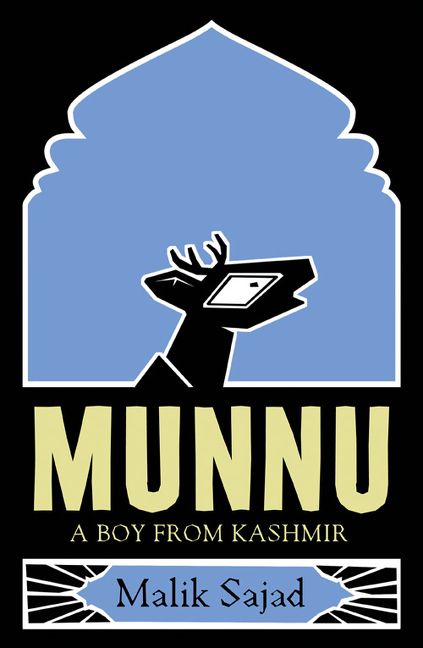
I find reading graphic novels to be an incredibly immersive and compelling experience. I recently finished reading Malik Sajad’s Munnu and had to share my thoughts on this text and some of my other favourite graphic novels. These texts take us to the depths and fringes of human experience, re-write what we think about the world, countries within the world, and the people within them. They blow open preconceptions and stereotypes that we are fed, and my understanding of conflict and world history, is all the more rich and nuanced as a result.

Maus, Art Spiegelman, 1980


Maus


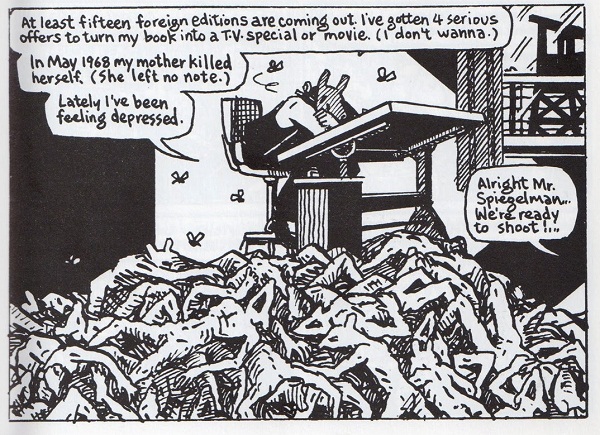
Maus is one of, what I consider to be, the Holy Trinity of graphic novels. It portrays Spiegelman as a young cartoonist, interviewing his father Vladek about his experiences during the Holocaust. The comic charts Vladek’s survival of Nazi atrocities, but also portrays Spiegelman’s oftentimes strained and difficult relationship with his father. The two regularly butt heads in ways family members often do when a deep amount of love and respect is patched over with trauma, neurosis and unrealistic expectations. Notably, the characters in Maus are all presented as animals to represent their different ethnic groups: Jews are depicted as mice, Nazis as Germans and Americans as dogs. One of the panels that stood out most to me is one that presents Spiegelman himself wearing the mask of a mouse, sat at his desk, talking about the opportunities that have come with his novel’s publication. Around him are littered the bodies of Holocaust victims.

maus2

This panel suggests that through the production of Maus, Spiegelman has assumed almost unwanted ambassador status for his presentation of Holocaust testimony. The artificial mouse mask, tied at the back of his head, points to the idea that in the telling of this story, he has almost performed his Jewish identity, and become a spokesperson for Holocaust victims and survivors in the process. He has achieved acclaim and appreciation off the back of so much death and horror, signified by the cadavers gathered around him and his drawing desk, yet still struggles to maintain his sticky relationship with his father. As a result, the dissonance between his success and the emotional burden his success has become weighs heavily on him, entangled as it is with feelings of guilt, misplaced responsibility and fraudulency. The Holocaust is such a difficult and upsetting subject to discuss and represent, and Spiegelman demonstrates great sensitivity and self-awareness in his handling of such a traumatic and barbaric event. The novel is not only a historical document of his own father’s survival, but also provides a platform for conversations about how we successfully represent the un-representable, and all the responsibility that brings.

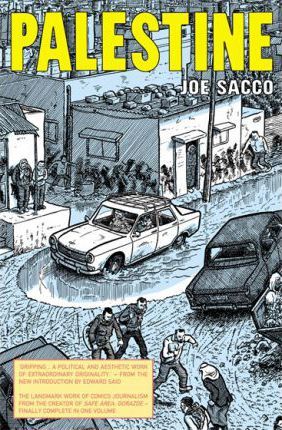
Palestine by Joe Sacco, 1996

palestine cover

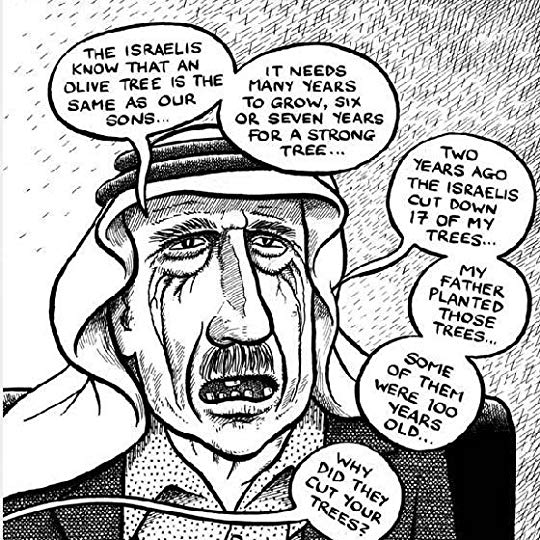
The second graphic novel in the Holy Trinity follows a Joe Sacco, an American journalist, travelling to Palestine and the Gaza Strip to witness and interview oppressed Palestinians during the Intifada. In the West we are given a very limited idea of the history and lived experience of Palestinians under Israeli occupation on the West Bank. This graphic novel has been hugely influential in its multi-dimensional perspective of conflict; and especially those conflicts that receive little traction in the news or are obscured by global and media power players. Sacco gives voices and faces to the seemingly unending hardship on the West Bank and in the Gaza Strip that easily bypasses the consciousness of many in the West. The violence and terror that Palestinian men, women and child experience on a daily basis is front and centre of Sacco’s novel, as he tracks his own journey from bystander and objective interviewer, to witness.


Palestine


Persepolis, Marjane Satrapi, 2000 and 2014

Persepolis cover

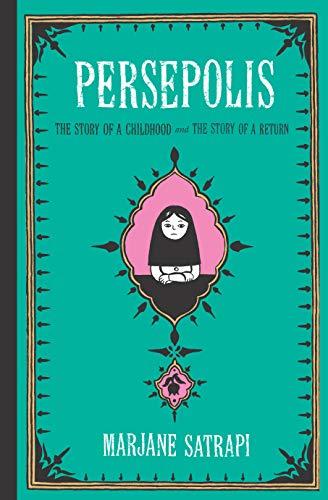
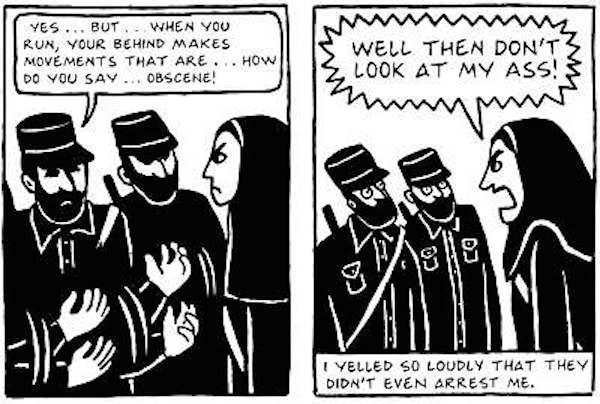
This novel is the third graphic novel in the Holy Trinity. Persepolis blew open what I knew and understood about Iran and Iranian history. As far as I was aware, when I first read this novel in 2010, Iran was a rogue bogeyman country, intent on making nuclear weapons to blow everyone up and destabilise the Middle East permanently, and that was the way things were and the way things always had been. As with my original perceptions of the Palestinian conflict, this graphic novel proved this idea of Iran to be completely limited and short-sighted. Through the story of her family and childhood, Satrapi presents Iran as a vibrant, secular country before the Islamic Revolution, and depicts the horror of war as Iran and neighbouring Iraq are drawn into a deadly conflict. She presents the oppressive practices and rules enforced in school and in public, in particular regarding women’s rights, whilst struggling with her own direction in life, with her time in Europe marred by racism and homelessness.

Persepolis

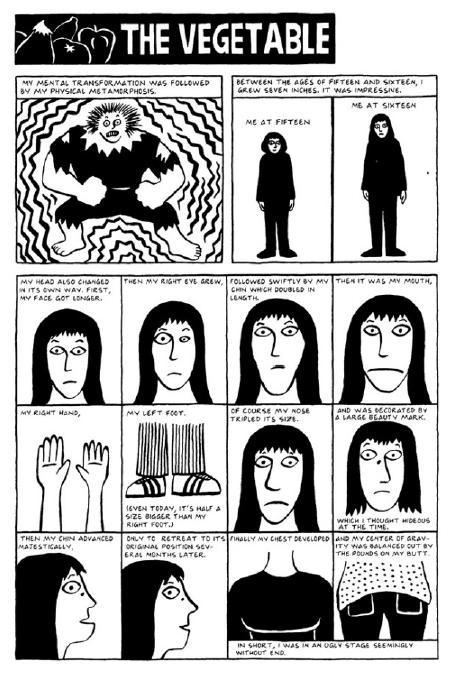
Persepolis is a coming-of-age story like no other, offsetting universal teenage angst and confusion (the start of The Vegetable chapter with panels of Satrapi’s face changing through puberty spoke to me like little else) with religious extremism and Western xenophobic bigotry. The novel provides both creative freedom for Satrapi to explore her own personal story and to shine a critical light on the injustices and pervasive power structures that successfully control people in both the East and West. At the same time, the graphic novel, with its black and white colour scheme and regular panels, successfully conveys the claustrophobia of living in a world where you are penned in by cultural expectations, conflict, bigotry and your own demons.

embodiment-1


Munnu: A Boy from Kashmir, Malik Sajad, 2015

Munnu

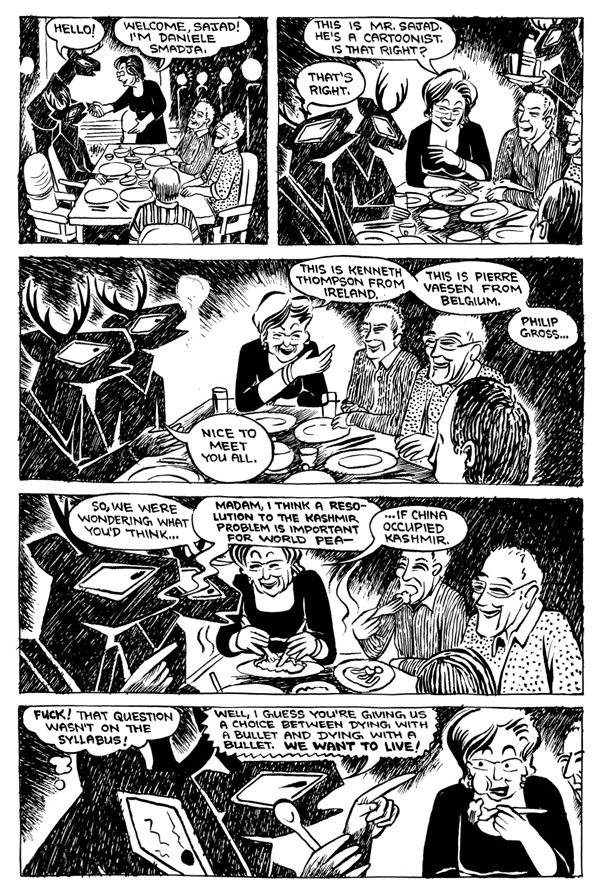
In the tradition of Maus, Persepolis and Palestine, Munnu follows the coming-of-age of the eponymous Munnu, the youngest member of a family living and hailing from war-torn and devastated Kashmir. In a similar vein to Maus, Sajad uses animals, specifically Kashmiri deer, to highlight Kashmiris’ endangered status as a free and independent people. The novel balances the intricacies and tensions surrounding the conflict and hypocrisies between Kashmir and India, Kashmir and Pakistan and amongst Kashmiri resistance groups, whilst also exploring family, existential anxiety and trauma as a result of conflict, and the power of cartoons to grant personal freedom. The final panel is particularly unnerving and unsettling, and I was most touched by young Munnu grappling with his fear of death. Munnu also critiques the West’s seeming inability to comprehend the severity of the conflict in Kashmir and its ineffectiveness in using diplomatic pressure and might to bring about a resolution.  I recently discovered that Munnu has not been published in India, which is very telling about the current tensions unfolding in Kashmir as a result of the occupation and how powerful, and thereby threatening, this graphic novel has been in exposing them.

eu-embed-sajad-malik


Red Rosa: A Graphic Biography of Rosa Luxemburg, Kate Evans, 2015

51DFPaAiudL._SX348_BO1,204,203,200_

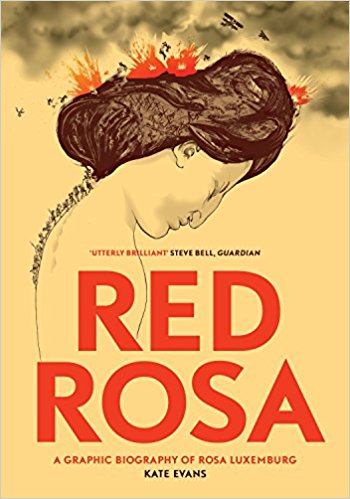
Rosa Luxemburg is a giant of the Left and nowhere else has her life and work been so beautifully presented and so articulately explained than in this graphic novel. Luxemburg’s philosophy that Marx was not beyond criticism, even though she took her political and economic position from his work, is a lesson for us all: nothing is beyond critical interrogation, especially the people we most admire and whose thinking has been the most influential for us. The concise and accessible exploration of Luxemburg’s philosophy includes her radical pacifism: my favourite panel coming with Luxemburg’s response to the First World War: head bowed, she is disturbed and weighed down by the destruction and wanton chaos of a war that will end nowhere and will result in the deaths of millions of working class people. Evans also gives us an insight into Luxemburg’s personal life, the incredible obstacles she overcame to become a writer and political leader, and her relationships with close friends, family and lovers along the way. This graphic novel, and its subject matter in Luxemburg, is absolutely inspiring.

RedRosa_extract_TheNation_img


Other graphic novels to explore:

Dragonslippers: This is what an abusive relationship looks like, Rosalind B. Penfold, 2006

Diary of a Teenage Girl, Phoebe Gloenecker, 2002

Threads: From the Refugee Crisis, Kate Evans, 2017

Tamara Drewe, Posy Simmonds, 2007


[1] Homage to Joe Sacco, http://journeyofideasacross.hkw.de/anti-narratives-and-beyond/edward-w-said.html [accessed 22/05/2019].

Love Note – Mustang

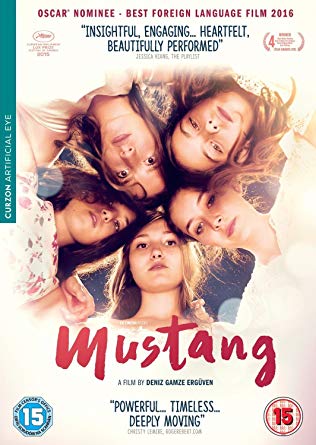
Sisterhood truly is the most potent, inspiring and exasperating relationship: where grievous bodily harm can magically turn into profound silliness, which can turn into deceptive and mysterious thefts of anything from books and clothes to biscuits, which can turn into profound existential bonding conversations about love, life and the Real Housewives (substitute RH with your mutual sisterly trash). Jane Austen knew it with Pride and Prejudice and Sense and Sensibility; Louisa May Alcott knew it with Little Women; Phoebe Waller-Bridge knew it with Fleabag; and Deniz Gamze Ergüven absolutely knew it with Mustang. I re-watched Mustang a couple of weeks ago and it is still one of the most compelling and emotionally charged films about sisterhood I have come across.

The plot revolves around five sisters: Sonay, Selma, Ece, Nur and Lale, and told largely through the point of view of Lale, the youngest. The sisters live with their ultra-conservative grandmother and uncle in a small village in northern Turkey. One day, after Lale tearfully says goodbye to her teacher who is moving to Istanbul, the sisters go to the beach with some male friends and play in the water. They are spotted and reported to their guardians, who effectively turn their house into a prison and arrange marriages for the girls. It is at times devastating, brilliantly funny and an incitement to free spiritedness in all teenage girls, especially when confronted with the deepest and darkest patriarchal forces.

And those patriarchal forces are well and truly horrifying. One of the scenes seared into my memory is at the wedding, where the girls’ uncle, Erol, who has proven himself to be aggressive and violent not only with the girls but with their grandmother (his mother), stands drunkenly and happily in the middle of the dancefloor, eyes closed, firing his gun into the air. Where the girls had at first been dancing, they cower around him, clamping their hands to their ears as he shoots and shoots. When I first watched the film, I thought to myself ‘Why on earth is he happy? Why is he celebrating?’ He cares nothing for the girls beyond keeping their virginity intact and, with hideous irony, it is heavily suggested that he sexually abuses two of them. Maybe he is just happy that they are no longer his responsibility and that he’d fulfilled some kind of patriarchal role in getting them married off? I think this is part of the way there: in this scene, ultimately, Erol is relishing his power. He is the one with his hand on the trigger, asserting and revelling in his dominance over the lives and fortunes of his nieces. It is sickening and infuriating to watch.

Additionally, watching Lale learn how to drive holds such urgency and pathos. Selma tells her that she was unable to escape because she couldn’t drive and Lale refuses for that to become her reality too. She tries and fails and tries again to learn how to drive, enlisting the help of truck driver Yassin, even though she is easily only 11 or 12 years old. Driving is a right we so take for granted in the UK, but is a fundamentally powerful means of power and control in religious and conservative countries. The importance of women being allowed to drive in countries like Saudi Arabia is all the more pertinent after watching a film like Mustang.

Amongst the hellish religious conservatism that the film actively exposes and challenges, we see the enduring and undimming power and pleasures of sisterhood, in all its multi-faceted manifestations. Indeed, the gentle intermingling of relatively light-hearted sisterly dramas with the devastating cultural power dynamics is what makes this film at once irreverent and tragic. We see the sisters defending one another from beatings; breaking out of the house to attend a women-only football match, then gossiping and messing around in their bedroom. One sister tells of how she radically subverts the injustice and intrusion of virginity tests by partaking in anal sex to prevent ‘losing her virginity’, before later on warning another sister that she’ll rip her head off if she steals her clothes again. As such, the film perfectly balances the magically mundane sisterly qualms and quarrels with the bigger, scarier patriarchal violence that determines their freedom and their happiness.

In this, I think the film goes a step further than Jeffrey Eugenides and Sofia Coppola’s The Virgin Suicides: the Lisbon sisters are only ever a mystical figment of the young boys’ suburban imagination, never fully realised as ostensible young women with desires, quirks, tempers or interests, Lux being, perhaps, the exception. Mustang shows that coursing underneath all of the patriarchal violence, double standards and unfairness of being a young woman living under religious conservatism, is the understanding, camaraderie and mutual struggle of being a girl and having female siblings. It is both heart-warming and heart-wrenching and speaks to anyone who has had a sister who has driven them absolutely mad but who will stand shoulder-to-shoulder with them through whatever chaos comes their way, patriarchal or otherwise.

81+T5SU2JGL._SY445_

Dior: Designer of Dreams

On Friday 5th April, I trundled down to London to visit two very excellent friends. We have partaken in a number of cultural weekends in the capital over the past few years, with trips to see the Savage Beauty exhibition at the Victoria and Albert Museum, The Vulgar: Fashion Redefined at the Barbican, the Vogue 100 exhibition at the National Portrait Gallery, the West End production of Tennessee Williams’s Cat on a Hot Tin Roof starring Sienna Miller and Jack O’Connell (where somehow we managed to get seats in a box, very jammy), amongst many other lovely, fun activities. This weekend was in every way just as lovely: in spite of a sketchy visit to a fancy restaurant off Regent’s Street where we were made to feel like actual scum, we shopped in Arket, visited the new Archlight cinema in Battersea, drank all the Taddy Lager at a Samuel Smith’s next to Liberty’s and spotted BBC Middle East correspondent Jeremy Bowen at Denmark Hill station and started smirking at him by accident. He definitely thought we were insane. The highlight of the trip, however, amongst all the other loveliness, was our visit to the Dior: Designer of Dreams exhibition at the Victoria and Albert Museum.

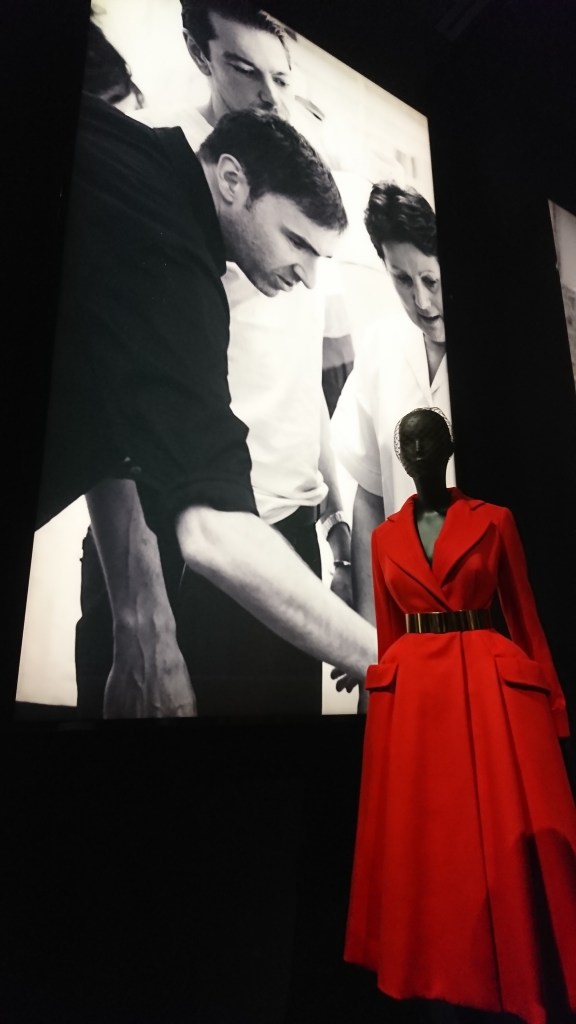
My first academic introduction to Dior came through the documentary, Dior and I: a fly-on-the-wall film that followed Belgian designer Raf Simons as he took up the mantle of creative director in 2012. I had been aware of John Galliano’s tenure, largely thanks to Lily Cole who was a veritable goddess in his designs, but had little actual passion for the house of Dior beyond that. I have a penchant for the theatrical in fashion, but I was more into Alexander McQueen, Vivienne Westwood and Marc Jacobs at Louis Vuitton at the time. Galliano was famously fired from Dior after an anti-Semitic rant outside a café in Paris, and this created a space at Dior for something new and different. The film introduced us to Raf Simons, with his refreshingly modern aesthetic and his endearing emotionality. Reading from Christian Dior’s autobiography and discussing art, it became clear that Dior was on the cusp of being reimagined for a new generation. I fell for the brand then and there.

Raf

I came to learn from Dior: Designer of Dreams that the fact that there is even a house of Dior is nigh-on miraculous. Christian Dior founded the label in 1947, creating the ‘New Look’: he divined an ultra-feminine silhouette, re-introducing women to sensuality after the austerity, deprivation and destruction that encompassed life during the Second World War. In no more than ten years, he built a booming, globally successful fashion house, placing his love for women at the very heart of his work. He introduced the H line, the Bar jacket and many other ingeniously crafted designs to emphasise curves, create drama and indelibly flatter. Tragically, he died in 1957; but in the short but very sweet time he had, he laid the foundations for one of the best-loved fashion houses of all time.

I believe the key to Dior’s success in his lifetime and beyond can be attributed to his commitment to women. Indeed, he seems to have dedicated his whole sartorial life to making women look and feel beautiful. He said:

‘Deep in every heart slumbers a dream, and the couturier knows it: every woman is a princess’.

It is one thing for men to say that they love and support women, but it is almost overwhelming how much Christian Dior repeatedly practiced and demonstrated that love through his creations. He knew how to make women feel special through the alchemical combination of silhouette, colour and craftsmanship. He in no way objectified women: instead, he placed womanhood and femininity on a pedestal to be absolutely adored. I used to be very sceptical of traditional notions of femininity: I’ve read my Judith Butler, I understand that gender is performance in many ways. However, where so much disrespect and abject hatred of women and their bodies has been witnessed and experienced throughout history, for a man to be so readily loving and devoted to women, is amazing. Similarly, I do not subscribe to monarchy or regal inequality in any way, but I think the reference to princess-hood can be read more archetypally. His work helps to bring women back to the sense of their own worthiness: that, yes, each one of us is unique and special, with dreams and ambitions, and a powerful capacity for conscientiousness, compassion, joy and love. All of these things make us inherently beautiful. I know a lot of women, including myself, have a hard time believing that, but Christian Dior is here to remind us, in a sartorial, fashionable way, that it is truly is the case.

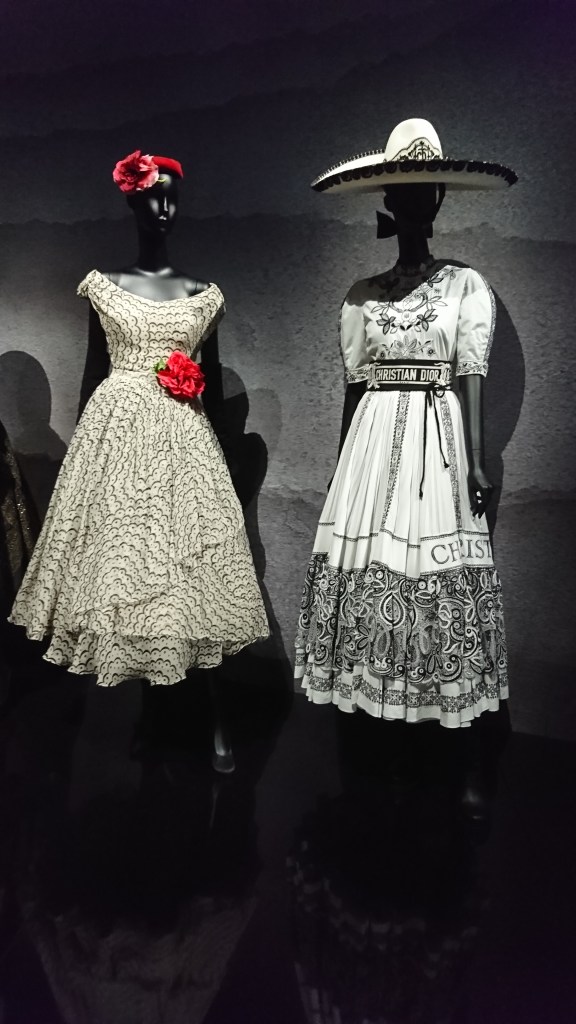
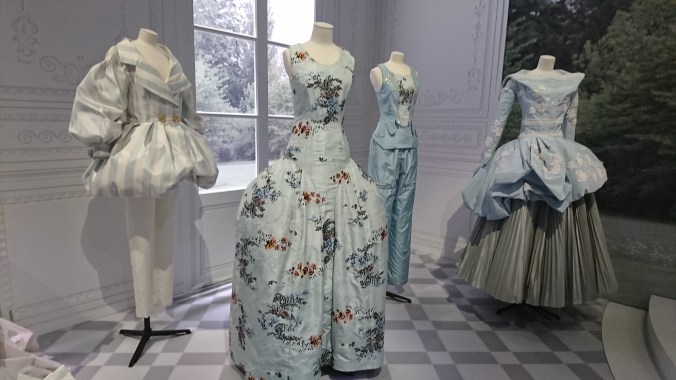
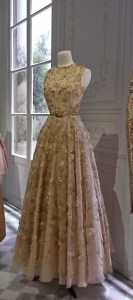
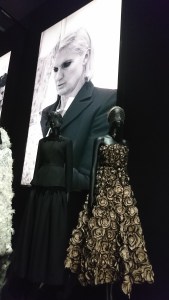
Christian Dior’s legacy has been kept intact thanks to a line of wonderful designers who placed women and what women want at the core of their work. Everyone, from Yves Saint Laurent to Maria Grazia Chiuri, have adhered to his silhouettes and inspirations, but subtly and ingeniously regenerated and refreshed them for each generation of women that passed their way. The exhibition presented and reflected this fact beautifully, placing pieces from all of Dior’s eras next to one another: for example, these two dresses from 1953 and 2019:

Mexican Dior

Both of these dresses nod to Dior’s interest in Mexican art and sartorial sensibility, speaking to each other across the years.[1] Although the Dior logo splashed across the dress on the right is a dead giveaway that it is a 21st century piece, they could both feasibly have come from the same collection. Similarly, the 18th century-inspired collections exhibit both continuity within the house of Dior and their individual designer’s unique perspective and flair:

18th century Diors

On the far left we have Gianfranco Ferré’s imagining of an 18th century coat, followed by Raf Simon’s cornflower blue dress with drop-waist hip emphasis; then we have another Raf Simons creation, this time a two-piece of intricately embroidered top with combat trousers; and finally a theatrical John Galliano dress with a billowing top and voluminous pleated skirt. All of the pieces are intrinsically Dior and could have walked down the runway in exactly the same show. But, we are also introduced to the subtle modernity of Simons, somehow taking an archaic hip style and making it contemporary and cool; the free-spirited proportion-play of Gianfranco Ferré; and the drama and craftsmanship of Galliano. The accusation has been levelled (at Simons in particular) that these collections for Dior are archivist; however, we can see clearly how the directors have honoured the history and mystique of the house whilst also exploring their own creative interests and personal aesthetics. It makes the collections personal but also part of a fluid, historical whole.

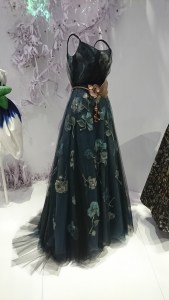
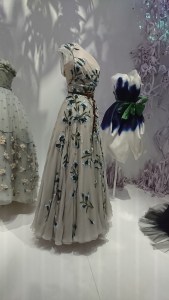
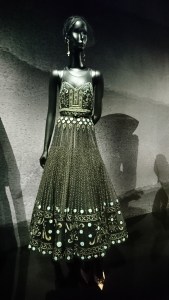
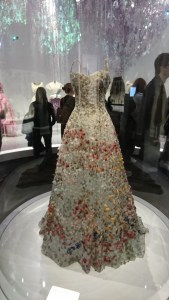
I will always have the softest of soft spots for Raf Simons because his work is just so polished, interesting and fun; but this exhibition formally introduced me to the work of Maria Grazia Chiuri. Up until now, I have reservedly watched Chiuri’s tenure blossom with popularity from afar. I was not convinced that slapping ‘We should all be feminists’ and ‘Why have there been no great women artists’ onto T-shirts to be sold for hundreds of pounds was particularly intersectional. I am still absolutely sure that capitalising on a buoyant new wave of feminism for commercial gain whilst reinforcing exclusivity and hierarchy is not how I want my intersectional feminism to look. However, this exhibition taught me that this woman bloody well knows how to make fabulous clothing. We wandered around the exhibition, pointing to one exquisite dress after another, exclaiming ‘I want that. I want that. I want that’, most of them originating from her sketchbook. Chiuri’s silhouettes are not as avant-garde as a Galliano, nor are they as refined and modern as a Simons, but they are dreamy beyond belief. Deceptively simple forms make way for frothy, fairytale content: her dresses become canvases for beautiful entwining flowers, embroidered constellations, elegant tulle and third eyes.

MGC3MGC2MGC5MGC6

MGC1MGC4MGC8MGC7

I have a newfound respect for what Chiuri is accomplishing at Dior. Namely, creating exceptionally designed clothing, luxurious without being fussy, whilst also, with those clean and elegant lines, very wearable. I would opt for any of these dresses in a heartbeat (please sartorial gods, please).

Without spoiling the exhibition too much for those who are still to visit, the final room was quite literally breathtaking. We audibly gasped and gaped at the twinkling ballroom setting we found ourselves in, debating whether or not we’d overreacted to the splendour on show. The gasps and squeals that came behind us as others entered the room confirmed not. The whole effect was magical: the glittering dresses, the rosy lighting, the cavernous space, everything. Time permitting, we could have sat in that room for ages just absorbing it all.

Dior: Designer of Dreams was another triumph for the Victoria and Albert museum. The layout and story of the exhibition is pitch perfect, demonstrating seamlessly the historical threads of the fashion house, as well as showcasing the individual contributions of the creative directors. The exhibition is a tribute to everyone who has been involved with the house: from Christian Dior himself and his creative directors, to the petit mains creating the designs at the atelier and the women chosen to represent the brand (it features dresses worn by Natalie Portman, Charlize Theron, Rihanna and Lupita Nyong’o). It celebrates womanhood, femininity and the princess within each woman, and the paradox that is a success built upon a winning and delicate combination of history and modernity. Needless to say, if you can get to it, go.


[1] What was also brilliant was that the curators had taken great pains to stress the pitfalls and damage of cultural appropriation, highlighting the ways in which Grazia Chiuri in particular sought practical help and input from Mexican women in the production and presentation of her Mexican-inspired collection.

World Book Day 2019

I have always loved World Book Day. At school, I loved receiving a book token and legging it to Waterstones to buy something new to read. I explicitly remember Roald Dahl’s ‘George’s Marvellous Medicine’ and Jacqueline Wilson’s ‘Lizzy Zip-Mouth’ being two of my World Book Day purchases, which I re-read about twenty times each.

You guys: World Book Day is not just for childhood, it’s for life. I continue to enjoy World Book Day because it gives me an excuse to happily blither on about books for a whole 24 hours (not that I ever really needed an excuse but, you know). Reading is such an incredible, immersive pastime, a treat for the imagination and important means of acquiring vocabulary in childhood. It is also so important to help explore the limits of language and to challenge our preconceptions about race, gender, age and sexuality. I think we should all be encouraged to read as much as possible. I know that our lives are so busy and we’re all perpetually tired, but I try to follow my Dad’s example: he will not end the day without reading, even if it’s just one page of a book. Not only does this help me wind down after a day of work, it means that I create distance between myself and my screens and helps to take me somewhere beyond my busy, chattering brain.

In light of World Book Day, I wanted to share with you some books that I really think you need to know about:

The books I have just finished

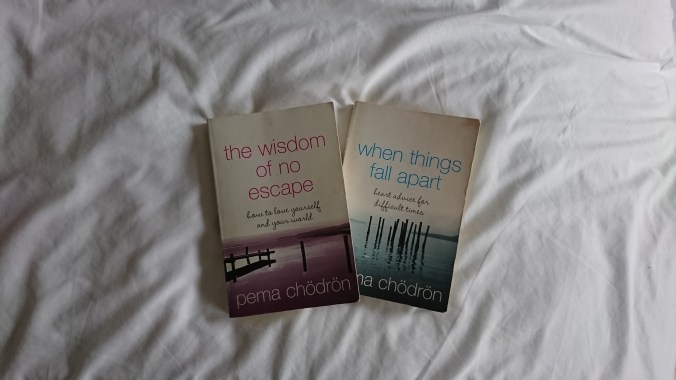
The Wisdom of No Escape and When Things Fall Apart both by Pema Chodron

Pema Chodron

I have always been interested in spirituality and these books, written by Buddhist nun Pema Chodron, introduce basic concepts of the Buddhist dharmas in an accessible, relatable way. They have become a go-to for me when I feel anxious, uncertain and groundless. Every single word of these books is steeped in wisdom: I almost wish I could have eaten them so that I could digest it all properly. I have enjoyed learning about Tonglen meditation, which is a practice that involves breathing into anxiety, uncertainty, fear and anger etc. and breathing out clarity, spaciousness and peace for yourself and behalf of everyone else who is suffering. With Chodron’s help (and that of another great Buddhist friend) I have learnt how to embrace the impermanence that characterises life, making our relationships all the more precious; and the importance of compassion, non-judgement and moving from a place of loving-kindness. I saw on Twitter recently someone’s opinion that ‘being kind’ is a wishy-washy, beige way of living life: after a read of Chodron’s work, however, I couldn’t disagree more. I have come to realise that there is perhaps nothing more radical or fearless than accepting egolessness and consciously moving from a place of joy, compassion and care for the world and everyone else in it.

The book I am currently reading

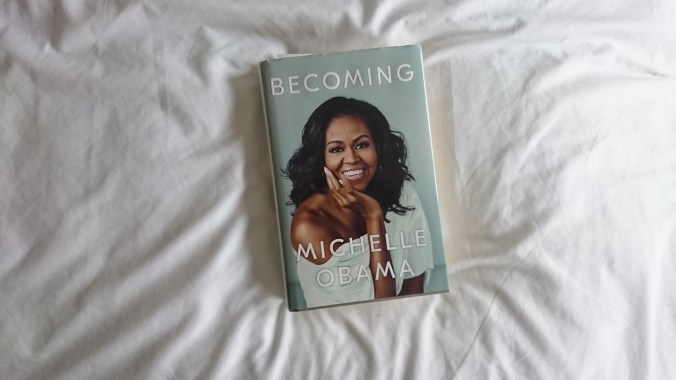
Becoming by Michelle Obama

Michelle Obama

I am half way through the former First Lady’s memoir and I am enjoying it immensely. Her story is compelling and characterised by a complex mixture of personal drive, determination and striving, whilst juggling her African American heritage with the white patriarchal power structures of Ivy League universities and law firms. Race is central to the book, as Obama recounts the frustration of the lack of opportunity afforded to her talented, smart grandfather and uncles and her own frustration of being caught between not being black enough (a cousin/classmate asks her early on why she ‘talks like a white girl’) and not being white enough (she finds herself outnumbered by predominantly white men at Princeton, Harvard and in the law firm Sidley and Austin). As such, it is a really important read that directly challenges the unthinking white privilege of many of the readers who are likely to pick up her tome. Obama also gives us a tour of her treasured friendships, her family and, of course, her relationship with Barack Obama. I know I get mushy really easily but, seriously, their story is bloody romantic. I know that she opens up about marriage counselling later on in the book, and I am very much looking forward to reading a refreshingly un-Disney account of what it really takes to be in a long-term relationship. And Trump. I can’t wait to see what she’s written about him.

The book everyone should read

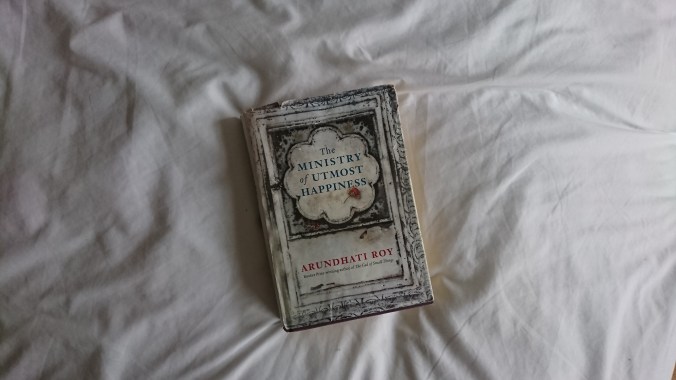
The Ministry of Utmost Happiness by Arundhati Roy

Arundhati Roy

This book is beautiful but was definitely a tricky one to get into at first. After 100 pages I was still not finding myself suitably immersed, which is a testament to how brilliantly challenging this book is. I persevered because I am slightly loathe to leave a book I’ve started reading unread, and was so glad I did. 100 pages in, and after a lengthy and hilarious description of various groups of people protesting various political and religious in a central Delhi square, I was swept away. The novel features a myriad of interesting characters, but centres on Anjum, a transgender hijra living in a cemetery in the heart of Delhi. Infused with Urdu poetry, political satire and witticisms, Roy’s novel investigates love, conflict and chaos in the colourful and brutal Indian capital, through the life of an extraordinary character. Reading this novel feels all the more pertinent now that tensions are once again flaring up over the region of Kashmir, which features heavily in the novel’s second half. I learnt so much about Indian culture and politics in this book, in particular regarding the country’s Muslim population, and was entranced by the unfolding drama and Roy’s bewitching prose. As such, I would recommend this novel time and time again.

 The books I’m going to read next

This is both my most and least favourite predicament: I have easily 50 books on my shelf that are lined up for reading and I get choice paralysis every time I need to decide what to read next. The main contenders include:

Milkman by Sarah Burns

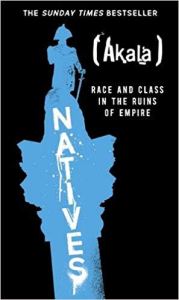
Natives by Akala

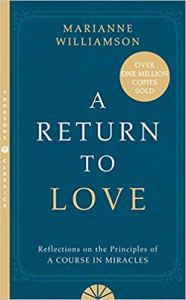
A Return to Love by Marianne Williamson (really interesting that she is running for the Democratic nomination in the 2020 US election)

War and Peace by Leo Tolstoy

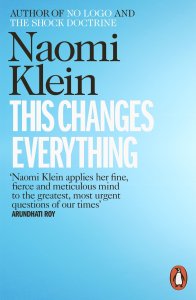
This Changes Everything by Naomi Klein

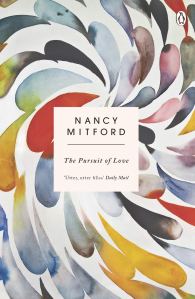
The Pursuit of Love by Nancy Mitford

Milkman AkalaMarianneWar and PeaceNaomi againNancy Mitford

New Zealand: podcasts we listened to

I have come to the podcast game very late indeed. Friends have been recommending podcasts for years and years but I just never got involved. Whenever a cultural phenomenon or ‘thing’ has been hyped up and managed to pass you by, which for me also includes watching Jumanji, Jurassic Park, Breaking Bad and listening to any albums by The Arctic Monkeys, it’s hard to motivate yourself to get on the band wagon. Feminist friends and film buffs have linked me all sorts, yet I have remained a stick in the mud and never got round to listening to any of them. Apparently, however, it took the prospect of four 11 hour flights and six weeks of driving around New Zealand in a campervan to get me out of the gate. Armed with my recommendations and CastBox newly downloaded onto my phone, I sunk my teeth into the following shows:

My Dad Wrote a Porno

My Dad Wrote a Porno

I did not know what I was getting myself into with this podcast, except that it had caused the friend who recommended it to keel over with laughter whilst out on a run. It is potentially the weirdest concept ever: Jamie Morton reads out the erotic novel Belinda Blinked, written by his dad under the pseudonym ‘Rocky Flintstone’. Alice Levine and James Cooper critique, comment and cringe along as we are dragged through the absurdly lascivious world of Belinda Blumenthal, the sales director and sexual maven of Steele’s Pots and Pans. Any lingering Freudian weirdness- that of a son reading his dad’s erotic constructions- is soon eclipsed by the novel’s monumental and unintentional hilarity: it is unpredictable, graphic and glorious. Part erotic novel, part business manual, part prolonged plotless and syntactically challenged sexual insanity and part fake news in its explorations of the female anatomy (Peter Rouse did not grab Belinda by the cervix to pleasure her), Belinda Blinked had us hooked from the beginning. Even when vivid images of men in black thongs, breasts hanging like pomegranates and the most perverse tombola ever conceived left us feeling, quite frankly, nauseous, no journey across the South Island of New Zealand felt complete without finding out what madness was going to happen next. Driving, cooking and breathing were all compromised whilst listening to My Dad Wrote A Porno but it is certainly one of the most entertaining, if questionable, cultural productions I have decided to commit to.

Serial logo

Serial

About four episodes into Serial, we made the executive decision to stop listening to it. I have finished the podcast since returning to the UK, so I feel equipped to talk about it, but whilst in New Zealand, it had to be put aside. Listening to Serial was unsettling and jarring. On a surface level, hearing the gruesome details of the murder of Hae Min Lee was practically guaranteed to freak us out when we were camping alone in some secluded woods outside Rotorua. However, what unnerved me about Serial was not just the story that was being offered, but how it was being offered and why it was being offered at all.

Serial has been hailed as a cultural achievement for marrying investigative journalism with podcasting, bringing both to an enraptured mainstream audience. It has also been met with heavy criticism for its ethical ambivalence, using the murder of a young woman as entertainment and instigating listeners to turn into would-be detectives to pick holes in the court case against Adnan Syed. It is worth remembering that Hae Min Lee’s family have been extremely critical of the podcast in this regard, saying that ‘unlike those who learn about this case on the internet, we sat and watched every day of both trials – so many witnesses, so much evidence’, and for whom the whole experience of the case being resurrected through Serial has evidently been traumatising.[1] I think what is important about this quote, in addition to the enormous emotional distress that Lee’s family continues to experience, is the reference to all the witnesses and evidence that the family came into contact with. The problem with Serial is that so much of the information that viewers receive is secondary, so we are relying entirely on the honesty and integrity of Sarah Koenig to tell the story.

This becomes problematic when we know that Serial’s main intention is to entertain, not inform: Ira Glass, one of the producers of the show, described the aim of the podcast as: ‘We want to give you the same experience you get from a great HBO or Netflix series, where you get caught up with the characters and the thing unfolds week after week, but with a true story, and no pictures. Like House of Cards, but you can enjoy it while you’re driving’.[2] The aim of the show was to create a compulsive listening experience, in the same vein as House of Cards, Stranger Things, Orange is the New Black and any of the other shows that are uploaded to be binged on. This means, therefore, that it has been constructed in a certain way to keep us involved and on edge: important details and evidence can potentially be withheld or strung out to help build tension; Koenig’s own doubts become our doubts because she is leading us through evidence that we have no access to; and with its cliff hangers and teasers, it certainly does leave you perversely wanting more. It was so unnerving to listen to because I didn’t trust the facts because Koenig didn’t trust them, but also because I didn’t trust Koenig. I kept asking myself why she was doing this, what was the whole point? We receive the story as secondary information, yet Koenig acknowledges herself in an episode called ‘Rumors’ that some of the calls she gets from the public after the podcast’s broadcast were secondary information, and so inherently untrustworthy. It begs the question: how much of the entire podcast is actually reliable?

The main argument in favour of Serial would be that it has helped advance Adnan Syed’s journey to overturn his conviction; giving a man who has always professed his innocence impetus and evidence to appeal, thanks to public exposure and interest in the inadequacies of his defence and the case made by the prosecution. The shortcomings of the American legal system are laid out for us and it’s only right that an innocent man shouldn’t be condemned to live his life behind bars. It’s hard to argue with this; however, my problem with Serial is, again, to do with its process. In my opinion, one of the most revealing moments was when right at the end, we learn that Syed writes a letter to Koenig from prison, outlining how the whole experience of talking to her has disrupted the emotional equilibrium he has established living his life in prison. He writes that he has become anxious and afraid of judgment, and he’s looking forward to the whole experience being over. If the argument is made that Serial has helped Syed in any way, close attention has to be paid to this letter. The podcast has been emotionally damaging for Hae Min Lee’s family to live with, but this moment suggests that it has been emotionally damaging for Adnan Syed too.

Serial is an interesting listening experience and I’m glad I returned to it once we were back in the UK. However, I think we have to be very careful with real life stories, in particular those involving murder, that we don’t just consume them for entertainment. In the aforementioned quote, Ira Glass describes the people involved as ‘characters’, even though they are not imaginative abstractions. They are real people who live with the reality of what happened in 1999 and with the reality of wannabe detectives attempting to work out their lives for them on the internet. We might think we know everything about this case as a result of listening to the podcast, but I think it is ultimately untrustworthy, and needs to be regarded with a healthy degree of scepticism.

The Guilty Feminist

The Guilty Feminist

There are many aspects of this podcast that I love. Not least, it has introduced me to absolutely hilarious female comics that I had somehow spent my whole life not knowing about, for example Dana Alexander, Bisha K Ali, Desiree Burch and Sindhu Vee. In addition, any show that invites Gemma Arterton as a guest to talk about sexism within the film industry is on the right track: that woman is a much underappreciated theatrical and feminist icon whom I have loved unwaveringly since her seminal performance as Tess Durbeyfield in Tess of the D’Urbervilles. The Guilty Feminist is really great at making feminists feel better about our inconsistencies. In particular, the podcast provides a space for women to acknowledge that, against our better judgement, we can and do align ourselves with various sexist and patriarchal standards that we have been conditioned our entire lives to adhere to. In particular, this can revolve around the way we look, our expectations of men and how we perceive and judge other women. It is non-judgemental about this, making a point to laugh and make light of our ridiculous double standards. In doing so, the podcast encourages women to show the same empathy and compassion we hold for other women and their struggles, with our own internal contradictions and patriarchal anxieties. It is fun, funny and I’m not going to stop listening to it any time soon.

Perhaps my only criticism would be that at times, the podcast doesn’t want to be radical enough. I very much enjoy the focus it brings to women’s charities, youth campaigns, the burden of emotional labour etc. However, the outlook isn’t, at times, the transformational approach to feminism that I subscribe to. This manifests at times in the economic discussions that take place, which predominantly revolve around the pay gap. In one episode, entitled ‘It’s a Man’s World’, the argument was made that to help companies understand the value of women, feminists needs to adopt the language of economics to make our case of being ‘economically viable’ more convincing. I take issue with this because the language of economics is ultimately patriarchal. If it wasn’t, we wouldn’t be in a situation where women are generally paid less, are told that tampons are luxuries or suffer the most at the hands of austerity thanks to cuts to local services, childcare and crisis centres. Furthermore, whilst many women raise awareness of these issues through writing, speaking or on their political platforms, women seem to be consistently absent from the actual conversations and decision-making. If we were to use the language of economics to make ourselves more palatable to men, we would be using the language of patriarchy to get onto a better footing within the patriarchy. If we want to remove patriarchal structures, which extends to racial structures too, we need to change the language that props the entire system up.

Ultimately, however, the podcast is a great comforting and affirming endeavour. Women put a lot of pressure on themselves to be perfect (and I definitely include myself in that) and this podcast strips these unachievable and unrealistic expectations away. I think both women and men will be all the better for listening and engaging with it.

I would like to thank Char Bender, Mark Beer and Jess Action for their excellent recommendations. I’m finally catching up with you guys.

[1] ‘Serial case: victim’s family offers rare statement before hearing resumes’ [accessed 12:59, 12th June 2018] https://www.theguardian.com/tv-and-radio/2016/feb/07/serial-case-hae-min-lee-statement-adnan-syed-hearing-baltimore

[2]This American Life channels True Detective in popular new podcast’ [accessed 18:49, 14th June 2018] https://www.motherjones.com/media/2014/09/ira-glass-sarah-koenig-julie-snyder-serial-podcast-this-american-life/

In defence of ‘mother!’

WARNING: contains spoilers

Earlier this year, the infamous Razzie awards- the annual mock awards show that coincides with the Academy Awards- announced nominations for the year’s worst films. As per usual, and quite rightly so, there was space in the nominations for the likes of the Transformers, Fifty Shades and Pirates of the Caribbean franchises. This list, however, also saw the questionable inclusion of Darren Aronofsky’s ‘mother!’, a film that is a far cry from the vapid, passable films it shares company with. The nominations the film received for Worst Film, Worst Actress, Worst Actor and Worst Director come off the back of a deluge of criticism that the film received upon its release. The Razzies as an awards show aren’t designed to be taken too seriously; but they indicate that an almost general consensus has been reached that this film is a pretentious, soupy shock-fest of little substance and poor performances.[1]  In tabloid magazines, such as Grazia, Jennifer Lawrence has been ordained with a certified career blip because the film did not reach the box office heights she is used to with the likes of The Hunger Games and X-Men. In addition, the relationship between Lawrence and Aronofsky, which developed and then fell apart after filming, also became offal for the entertainment press. [2] In the meantime, ‘mother!’ was downplayed and over looked by critics, awards bodies and guilds, with the challenging issues that the film raises seemingly ignored.

This is not the first time that a dark, challenging female-centric film has failed to be acknowledged by the cultural establishment, for example Lynne Ramsay’s We Need to Talk About Kevin starring Tilda Swinton, or Lars Von Trier’s Melancholia and Nymphomaniac led by Kirsten Dunst and Charlotte Gainsbourg respectively. Some might argue that we don’t need to worry about this, because the likes of the Academy Awards, BAFTAs and Golden Globes aren’t necessarily worth respecting as they are so ‘weirdly subjective’ anyway, in the words of Cate Blanchett. These awards bodies only acknowledge films released at a specific time of the year, and only seem to celebrate films that reaffirm the Hollywood, film-making dream, rather than challenge it: see the recent successes of Argo, The Artist, La La Land, Birdman etc. Yet, when complex films about women are in such short supply, it is frustrating that brutal, stonking, belters of films are pushed to the fringes of small arthouse cinemas. Where are the column inches for Marielle Heller’s Diary of a Teenage Girl, Andrea Arnold’s American Honey or Sean Baker’s The Florida Project? I am not arguing that ‘mother!’ needs to be universally liked. The fact that it has managed to both enthral and revile audiences is, in my opinion, much to its credit; any film that rattles people to a state of unrest on either end of the enjoyment spectrum suggests that it is worth paying attention to. However, I would like to make the case that far from being the shambles that many critics and commentators would have us think, ‘mother!’ was one of the best films last year, shockingly timely and, in the opinion of Mark Kermode, a film that will ‘impress’ the further away you get from the initial ‘oppressive’ experience of viewing it.[3]

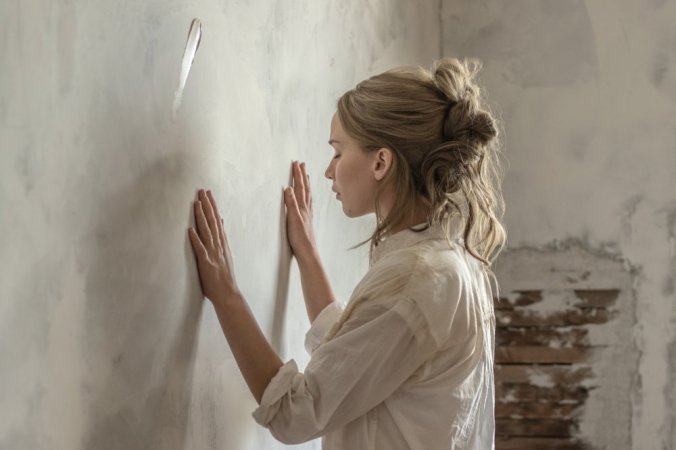
mother!’ offers so many different readings, but I think the most significant is the film’s critique of the concept of the female muse. Jennifer Lawrence’s character, ‘Mother’, is constantly referred to as the ‘inspiration’ for ‘Him’, Javier Bardem’s egocentric writer. This is because her time is consumed with nurturing their house and home. She is referred to as ‘inspiration’ again by ‘Him’s’ publicist, the ‘Herald’ played brilliantly by Kristen Wiig, and then by the multitude of people who come into their house before all hell breaks loose. I argue that it’s the treatment of ‘Mother’ as this symbolic, abstract figure that enables the violence brought upon her by everyone in the house. The arguably mild micro-aggression displayed by ‘Him’ at the beginning of the film, such as his constantly inviting all and sundry into their home, not listening to ‘Mother’ and making a mess and expecting ‘Mother’ to clean it all up, paves the way for others to do so, and worse. This manifests when ‘Him’ and his ‘guests’ ignore her, in particular when two slam themselves repeatedly on the sink and rip it off the wall and when strangers begin to paint her walls a different colour; when a male stranger propositions ‘Mother’, he refuses to take no for an answer then calls her a ‘cunt’(a scene practically lifted from the Everyday Sexism blog or the Bye Felipe Instagram account); and when the braying crowd, who have killed her baby, start to violently beat her up and only stop when ‘Him’ tells them to. The idea of a woman serving passively as ‘inspiration’, as a beautiful muse, feeds the idea that women, particularly when confined to a domestic space, do not have subjectivity. Instead, they are vessels and symbols for men to fetishize in the name of creativity. It is the denial of a whole, complex personhood that results in a woman becoming a patriarchal doormat. Not being listened to may seem like a simple annoyance, but the more people ignore her, the more danger ‘Mother’ is in. She is drowned out by the throngs of people who invade the home, before being owned, used and abused by them all. The ringleader appears in the form of ‘Him’.

Nowhere is this seen better than when ‘Mother’ is breastfeeding her newborn son in a boarded up room that keeps the intruding guests out. In a film of claustrophobic close-ups, the shots of ‘Mother’ and her suckling baby feel softer, calmer and intimate whilst the bond between mother and child begins to strengthen. All the while, however, ‘Him’ looms in the background, watching them unblinking, unflinching, determined to show the child off to a hallway teeming with his ‘guests’. He does not care that ‘Mother’ has only just given birth, he does not care that she wants to keep the child safe and out of sight, he does not care that she wants to nourish and sustain him; he only wants to feed his own ego and vanity. In the end, he waits and watches with frightening menace, taking his opportunity to take the child from her when she inadvertently falls asleep. His entitlement can only come from viewing his wife as unequal to him: she is at times revered as a vague yet divine source of inspiration, but this also makes her vulnerable to whatever violent and aggressive whims and desires he is able to act upon her and her body.
mother-2017-005-jennifer-lawrence-hands-wall

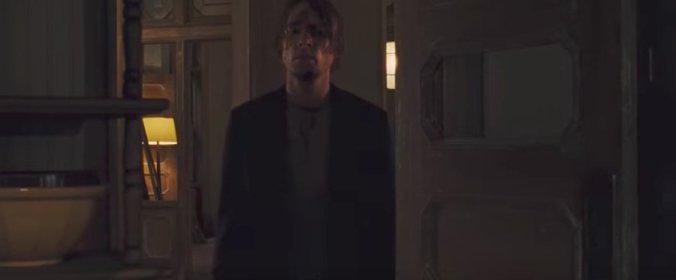
As a result, ‘mother! is an explicit warning of the danger posed to women who are reduced to an abstract, symbolic concept instead of respected as multi-faceted, interior beings with their own thoughts, ideas and desires. The ‘muse’ figure is essentially a dehumanised figure and the consequences for the woman, as shown in this film, are nightmarish. The final twist of the knife comes at the end of the film, where the narrative circles back to its opening scene. Instead, however, of Jennifer Lawrence’s ‘Mother’, calling ‘Baby?’ to ‘Him’, it’s a new incarnation of a different woman in the exact same position. It suggests that this whole torturous experience is undeniably about to happen all over again. It would appear that men like ‘Him’ always have a second chance, they are redeemable. Women, on the other hand, do not have this privilege, but are merely inspirational fodder to be exploited again and again, one after the other from the patriarchal conveyer belt. Of all the characters in the film, the one who seems to understand this the most is the scene-stealing Domhnall Gleeson’s ‘Oldest Son’. In a frantic scene, ‘Oldest Son’ kills his younger brother in a fit of rage because he doesn’t believe that anyone in his family genuinely loves or values him, asking ‘Mother’ if she understands.  Later on, he returns to ‘Mother’ alone in the house and tells her, ‘You do understand. Good luck’.[4] This tense, quiet scene foreshadows all of the horror to come and the ‘luck’ ‘Mother’ will need to navigate through it. Additionally, it is immediately of no comfort that ‘Him’ appears to enfold ‘Mother’ in his arms; she is undoubtedly within the belly of the beast, deep in the clutches of her abuser.
domhnall gleeson

Whilst the film’s violence has been condemned by many, it is the rejection of a woman as a dispensable image to inspire men that feels so timely. Within Western art, women have all too often played the role of a figurative muse for men, with horrible consequences for their emotional wellbeing. You just have to look to the experiences of Elizabeth Siddal, Edie Sedgwick, Marianne Faithfull, Amelie Gautreau and Uma Thurman, who all suffered from the acute power imbalance at play with the men who ‘revered’ them and for whom they provided some sort of ‘inspiration’. Importantly, this film marginally pre-dates the allegations reported against Harvey Weinstein, and the increased, renewed scrutiny of men like Woody Allen, Roman Polanski, Quentin Tarantino, Louis CK and many others who work in the creative industries and have allegedly abused women. With the subsequent #MeToo and Time’s Up movements that have flourished in the wake of these allegations, the production of art will undeniably have to change. Women can no longer be used as mere muses and inspirations for writers and directors. What is ironic, however, is that such a reading of progressiveness can be taken from ‘mother!’ when Darren Aronofsky has come under criticism for his allegedly manipulative and ‘abusive’ practices: his direction triggered a well-documented panic attack from Lawrence during the process of filming, he banned bottled water from the set of Noah (2014)which led to Emma Watson falling ill, something he recommended she should ‘use for the scene’, and allegedly separated Natalie Portman and Mila Kunis to play them off one another during the filming of Black Swan (2010).[5] It is wildly frustrating that a film that critiques the patriarchal disposal of women in the name of creativity, is allegedly practised by the film’s very director.

It is also as a result of this that we have to be careful about completely embracing the film’s apparent environmental agenda. Aronofsky said himself ‘I want to make a film about Mother Nature. I wanted to make a film from her perspective’, and it is an interpretation that has been picked up by Mark Kermode and Naomi Klein. [6] Aronofsky believes he has made a film that presents ‘Mother Nature’, through allegory, suffering the horrors that human beings reap on the natural world, i.e. her. Whilst I am in favour of more texts that critique environmental destruction, climate change and take aim at the over consumption of selfish, ignorant human beings, using the figure of ‘Mother Nature’ to do this is unhelpful and dangerous. ‘Mother Nature’ is perhaps the most mythologised, idealised version of femininity ever thought up. She is a ‘mother’, she ‘brings life’ and she is ‘cruel’, all stereotypes constructed about/for women that are projected onto the natural world. ‘Mother Nature’ is, ultimately, a vacant, arbitrary symbol, representing bags of patriarchal dogma and we need to be critical of that. What is frustrating is that reading the Earth as a woman feeds into the problematic negation of subjectivity that the film does so well to portray. Indeed, focusing on a figurative ‘Mother Nature’ undercuts all the work ‘mother!’ does to critique the presentation of women as abstraction. It is so ironic yet, perhaps, unsurprising that Aronofsky, given his dodgy history of abusive practice towards his actresses and partners, encourages us to think of Earth embodied as a woman. This should serve as an enormous reminder to us that we must not limit our interpretations of texts to whatever the writer/director may or may not have intended.

In its presentation of the danger posed to female muses, ‘mother!’ is radical and unflinching. Art, in all its forms, is barbaric if it is leeched from or comes at the expense of the subjectivity and personhood of those close to the artist. Importantly, Aronofsky is not exempt from this and we must approach his diagnosis of his film as about ‘Mother Nature’ with a large, healthy amount of critical scepticism and a copy of Roland Barthes’s ‘Death of the Author’. Nevertheless, ‘mother!’ is an important film because it does so much to highlight that this construct of the ‘female muse’ is a dehumanising, unsustainable abuse of power. It is a performative, disorientating film that bombards the senses with unrelenting noise and visual horror, but that does not mean that it is a mess that lacks any political awareness. I would encourage as many people as possible to steel up some nerves, get a bottle of gin ready for the credits and watch this film. It deserves to be given some critical attention because its presentation of gendered power imbalance in art is so unfettered, so immersive and so appropriate in this era of #TimesUp. It reminds us that film should not just be reassuring, escapism; we need films that challenge us, hold up a mirror to the dynamics at play in the world around us and to give us the impetus to ask one of the most important questions of all: ‘what are we going to do about it?’.

[1] ‘Film Review: mother! is a pretentious mess’ http://www.bbc.com/culture/story/20170914-film-review-mother-is-a-pretentious-mess

[2] ‘Jennifer Lawrence set to end things with Darren Aronofsky?’, Grazia, https://graziadaily.co.uk/celebrity/news/jennifer-lawrence-set-end-things-darren-aronofsky/

[3] Kermode and Mayo’s Film Review, BBC Radio Five Live http://www.bbc.co.uk/programmes/p05g6x9d

[4] https://www.youtube.com/watch?v=-vhra0KrIfs [accessed 28th May 2018].
[5] ‘Why Do We Let “Genius” Directors Get Away With Abusive Behavior?’, https://www.buzzfeed.com/imransiddiquee/hollywood-abusive-auteur-problem?utm_term=.bj3Gjm8QO#.hjrxNYnr3,  Imran Siddiquee, Buzzfeed [Posted on 25th October 2017, at 11:55 pm]; ‘Emma Watson fell ill on Noah set after Darren Aronofsky banned bottled water’, https://www.theguardian.com/film/2014/feb/17/emma-watson-noah-darren-aronofsky-banned-bottle-water, Ben Child, The Guardian, [Posted on 17 February 2014, at 12.48 GMT]; ‘5 Things You Didn’t Know About Natalie Portman’, https://www.vogue.com/article/5-things-you-didnt-know-about-natalie-portman, Maria Ward, Vogue [Posted on 20th August 2016 at 11:00].
[6] Naomi Klein contacted Aronofsky to note how ironic it was that the film was released whilst Hurricane Irma left a trail of devastation in the Caribbean and on the mainland USA. Also note later on Jennifer Lawrence’s description of her breakdown due to her immersion in the scene being ‘too much’, compared to Aronofsky’s satisfaction with the events that occurred during filming.  https://www.youtube.com/watch?v=pyZVUC5jeVw&t=162s [1:13, accessed 8th March 2018].