A case for Lockwood and Dean in Emerald Fennell’s new adaptation of ‘Wuthering Heights’

As it does for many students, the third year of my university degree course entailed an extended independent project: a culmination of two and a half years building academic expertise in research, negotiating criticism and secondary material, deep and thoughtful analysis of language all framed within the construction of an elegant yet convincing argument. Whilst my department opted for a 7000-word long essay over a dissertation of 12,000-15,000 words (with one staff member morbidly commenting that they didn’t want to give students ‘too much rope with which to hang themselves’) it was still a rigorous task that began with a scintillating and frightening proposition: what on earth to write about?

Making any kind of decision for me initiates a period of profound reflection and soul-searching: I spent my early twenties distracting myself and others no-end with ‘Which Disney princess are you?’ Buzzfeed quizzes (answer: Pocahontas), and making a collage ‘All About Me’ at work a few years ago triggered something of an existential crisis. Before eventually deciding to write my long essay on the concept of ‘nothing’ in the elegiac and ekphrastic poem ‘Phantom’ by Don Paterson, a topic I picked the day before the deadline for submitting the topic, I was in torment trying to work out what I wanted to write about. I landed on a number of different options which, compounding my own purgatorial sense of ‘who am I and what shall I write about?’, were batted away by various academics.

These included one idea I had about the number three appearing in folklore (I still don’t understand the reservation about that one; Freud’s ‘Theme of the Three Caskets’ was going to anchor the thing, and my subsequent interest in Jungian analysis would open up my ideas in numerous different ways). Similarly, and most relevant for this essay, was an idea I had about cinematic adaptations of ‘Wuthering Heights’, and why, in my opinion, they never seemed to work. Another tutor dissuaded me from this task, citing either Queenie Leavis or Virginia Woolf in an attempt to communicate his perception that this topic was somewhat juvenile and I should do something more mature.

With the news that Emerald Fennell is writing, producing and directing a new adaptation of Wuthering Heights, which started production in 2025, I have decided to return to my juvenile project. Instead, however, of performing a deep-dive into the adaptations that have come before, I will consider what I hope will emerge in this new adaptation. There has already been plenty of comment and controversy surrounding the casting of her adaptation – Margot Robbie and Jacob Elordi would certainly not have been my choices for Cathy and Heathcliff, and I think many others agree – but I want to focus more on what I hope to see: which characters will be given prominence, will all of the idiosyncrasies, physical violences and clipped unhinged moments of the novel – biting, blows, ravings, hair-pullings – be woven in?

The first place to start was with re-reading the novel, which I did in the summer of 2024 in the waning months of pregnancy. The last time I read Wuthering Heights was when I was eighteen and studying it alongside Milton’s Paradise Lost and Webster’s The White Devil for A-Level. Back then, Gothic themes were prevalent not just in my studies but in noughties teenage culture at large, with the figure of the vampire in particular famously resurging in the Twilight novels and subsequent films, weekly doses of The Vampire Diaries on ITV2 and its spin-off The Originals, and True Blood for a more risqué proponent of the genre. The Noughties vampire craze is certainly something worth exploring in and of itself, and whilst I wasn’t the most adamant Twi-hard, I was certainly enamoured with the Gothic’s propensity for danger and romance. Wuthering Heights was no exception, with the emotional melodrama from all and sundry, the family saga and the theatricality of the various settings, from the Yorkshire moors to the two homesteads of Wuthering Heights and Thrushcross Grange. These are all, undoubtedly, kindling for the teenage imagination, which became ever so apparent upon returning to the text as a heavily pregnant 32 year-old woman. I am curious to see if Fennell’s new adaptation will ring in a new wave of Gothic story-telling, perhaps already begun with the re-make of Nosferatu and Ryan Coogler’s Sinners, and what that will tell us about the cultural moment in which we find ourselves.

Wuthering Heights remains a vivid and dramatic novel, with every character demonstrating a degree of emotional dysregulation, impetuousness and violence; characters I raged alongside as a teenager but now seem astonishingly unhinged in that unnerving, hopeless, hilarious and deeply endearing way that adolescents often are. This is because much of the action is being played out by just them: teenagers. As adaptations of The Great Gatsby are in danger of following Nick’s cue and romanticising its protagonist and anti-hero Jay Gatsby, adaptors of Wuthering Heights are in danger of imbuing this novel, and its key protagonists Catherine Earnshaw and Heathcliff, with a sage maturity that is not adolescent when it really should be.

After all, this novel does not start with the mad entanglements and upheavals of the Earnshaws, Lintons and Heathcliffs, with the relationship between Catherine Earnshaw and Heathcliff in particular eclipsing most of the rest of the novel’s drama in our collective imagination. The novel, in my mind, starts at ‘the sea-coast’ with a pompous, avoidantly attached man who shrinks ‘icily into [himself] like a snail’ when the girl onto whom he has heaped attention starts to return his affection, causing her to ‘doubt her own senses’ and leave with her mother.[1] In the aftermath, and fancying himself a misanthrope who wants to remove himself from society, he decamps to Yorkshire and arrogantly plunges himself into the company of Mr Heathcliff, his new landlord. It is through him, Mr Lockwood, that Nelly Dean’s history of the families of Wuthering Heights and Thrushcross Grange emerges.

Adaptation, like translation, is an art form in and of itself, and it is inevitable that changes and modifications to a literary text are made when it is fashioned from, in the case of Wuthering Heights, a novel into a film or television screenplay. The end goal cannot be to lean into translating the novel too literally for the screen; however, the success of the novel, I argue, relies as much upon its structure as it does on its characterisation, and to do away with any sense of framed narrative, the sense of a story-within-a-story that is created through the use of Lockwood and Dean, erroneously indulges and intensifies the most melodramatic parts of the work. I want to see an adaptation of Wuthering Heights that makes much of these two and the containment they provide. For, in my mind, Wuthering Heights is not a psychological novel, even though the psychology of the characters is absolutely central to the development of the plot, with trauma, addiction, grief, abuse and emotional breakdown all exhibited. Without minimising the severity of any of these, I still see Wuthering Heights as Gothic adolescent drama; what elevates it to greatness as a novel is through its considered structure, the theatrical blocking of various scenes – the various entrances and exits of characters between rooms and locations reads almost like a play – and the way in which Bronte skilfully maps pathos onto a most singular and evocative environment: the Yorkshire moors. Personally, I am thrilled that we are not in the heads of Catherine Earnshaw, Heathcliff, Hindley, Catherine Linton and Linton Heathcliff and whoever else. These characters are so erratic, dogmatic, cruel and selfish that we absolutely need distance from them. Bronte’s genius is that she gives us two characters, Lockwood and Dean, who are two imperfect filters for the chaos and sheer ridiculousness of the rest of the characters: they make Catherine, Heathcliff and Hindley et al. bearable, but they do not hold a sense of moral superiority over them.

Primarily, far from being a vacant empty vessel of character into whom the story is poured, as one might argue Captain Walton is in Mary Shelley’s Frankenstein, Lockwood is consistently presented as creepy, malevolent, egotistical and, yes, ridiculous. He presumes to visit Heathcliff at the start of the novel and before much happens gets into a scrap with some dogs after ‘winking and making faces at them’, driving the bitch, and seeming matriarch of the pack, to break into ‘a fury’, leaping onto him and inciting the others to ‘assault’ his ‘heels and coat-laps’, thus requiring him to fend them off with a poker before calling for help.[2] Here, Bronte presents a scene of buffoonery that is also laced with something sinister, as buffoonery often is: Lockwood offers no culpability, explaining his decision to make faces, which caused the ruckus, with an entitled degree of passivity – ‘I unfortunately indulged’ – as though it wasn’t completely his fault for winding them up. As such, within the first couple of pages, our narrator is presented as a ghosting fuckboy who wantonly upsets women, and I like to think of the bitch as some retributive symbol for the girl he messed about at the seaside.[3] Bronte continues her characterisation of Lockwood as a man who is conceited towards the workers at Thrushcross Grange, affronted as he is by prescribed mealtimes (‘a matronly lady taken as a fixture along with the house, could not, or would not comprehend my request that I might be served at five’) and a ‘servant-girl’ cleaning a fireplace and ‘raising an infernal dusk’; and who takes a predatory interest in young Catherine who he describes as ‘scarcely past girlhood’ but who is physically ‘irresistible’ and ‘exquisite’.[4] Indeed, later on in the novel he pursues his interest in young Catherine indirectly, revealing to us that he ‘should like to know [the] history’ of ‘that pretty girl-widow’ and remonstrances himself with regards to her personality: that he should ‘beware of the fascination that lurks in Catherine Heathcliff’s brilliant eyes. I should be in a curious taking if I surrendered my heart to that young person, and the daughter turned out a second edition of the mother!’[5] Here, we see one of the many instances that Bronte provides of his predatory and wolfish behaviour, with repeated reflections that dwell on her physical appearance and his consistent overestimation of his own desirability.  

As such, we can see that Lockwood is as dogmatic and deluded as many of the other characters. I would argue that his name also reflects this, with the image of ‘lock’ hinting that there is something extremely limited and limiting in his social ineptitude, that his perspective is unmoving and even, perhaps, that there is something in his nature that is controlling and desires to dominate, something that Heathcliff appears to be drawn to in the first chapter, loosening up and relaxing into ‘a grin’ as he does when Lockwood threaten to enact violence on the dogs: ‘If I had been [bitten], I would have set my signet on the biter’.[6] It is this fixedness that ultimately makes him the perfect character to dream Cathy’s visitation in Chapter 3: he is outsider enough to be unfamiliar with the family history and, thereby, experiences the full terror of the ghostly child at the window, and his cynicism and pragmatism about the presence of a ghost or a spirit, even in the dream realm, makes it all the more believable that the past has an almost supernatural presence in the lives of the living at Wuthering Heights. Lockwood is perplexed and perturbed at Heathcliff’s sobbing and crying out for Cathy, remarking that ‘there was such anguish in the gush of grief that accompanied this raving, that my compassion made me overlook its folly, and I drew off, half angry to have listened at all, and vexed at having related my ridiculous nightmare, since it produced that agony’.[7] He is convinced that nothing actually happened, with his reference to Heathcliff’s ‘folly’ and ‘raving’, clearly showing his belief that Heathcliff is acting irrationally and is annoyed at himself for having stoked it by relaying his dream. He doesn’t want to feed the psychodrama that is playing out in front of him and promptly leaves, taking us with him, and is drawn into it only in so much as he feels embarrassed and guilty by, what he perceives to be, Heathcliff’s extreme emotional response and the part he played in exacerbating it. In a novel teeming with emotional outbursts, we need Lockwood as this container of the chaos, and I think an adaptation’s success relies on it too.

Of course, Lockwood is not alone in his containment of the drama: Bronte teams him up with Nelly Dean in the relay of the tale, thus ensuring the essential distance we feel from the emotional tumult. These two characters become ‘companionable’, not only in the way in which they spend time almost cosied up storytelling together in the novel, but through Bronte’s use of them to construct and elevate the drama of the novel itself.[8] They are essential. Like Lockwood, Bronte presents Nelly as removed enough from the action and entanglements of the main characters by tracking her movements beyond the others, but she is inherently bound up with them too and is, thereby, able to deliver and weigh in on the emotional upheaval, because it is partly hers too. This is most evident in the scene in Chapter 17 where Doctor Kenneth relays Hindley’s death to her and knows that she’ll need to ‘nip up the corner of [her] apron’ for the tears that will come, which they do. He reflects that Hindley died ‘barely twenty-seven […] that’s your own age; who would have thought you were born in one year?’ To which Nelly responds that ‘ancient associations lingered’ around her ‘heart’ and she ‘sat down in the porch, and wept as for a blood relation’.[9] This scene reminds us that Nelly is relatively young and not the matronly or even crone-like figure that she has embodied in the cinematic imagination. Whilst she tends to Cathy, Heathcliff and Hindley as almost a nurse when they are young, for example when they all fall ill with measles, we are reminded of the fact that she is practically one of them by Bronte not only having her describe how she played with them before Heathcliff’s arrival, but in the way in which she describes joining in with Hindley’s campaign of physical violence towards Heathcliff when he has been admitted to the household, revealing that she ‘plagued and went on with him shamefully’ along with Hindley, and subjected him to ‘pinches’. [10] This has led to some critics, for example the academics on the ‘In Our Time’ episode on the novel to somewhat simplistically label her narration as ‘unreliable’, which is, in my mind, a moot point.[11] Reliability, I would argue, is not something that we should be aiming for or looking for, especially from a first-person narrator, as though there is some ultimate truth to be found. Furthermore, what is so mysterious and evocative about this novel is that we don’t really ever see the full drama play out: we mostly hear about it through recounts of events from dishevelled and upset characters. The energy, however, is conducted through Nelly, who Bronte brings close enough to the core of the drama for them to be somewhat enveloped by the emotion, and at times becomes an active participant and instigator, but who is still able to contain the drama as a whole.

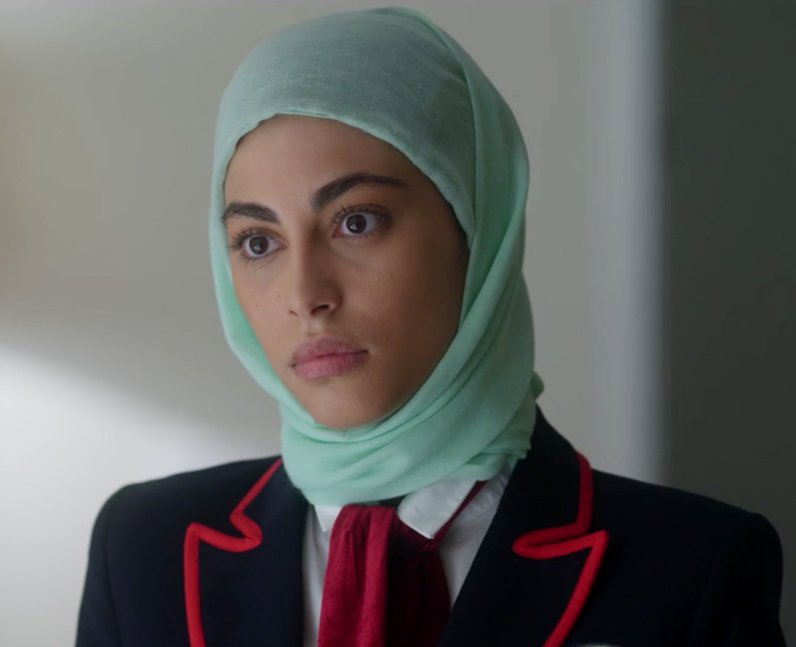
In all likelihood, Fennell’s adaptation will centre on Cathy and Heathcliff, indeed most of the press attention has already fixated on them. As a culture, we are strangely obsessed with their story, fascinated as we are with their wildness, their desire for the disintegration of their physical boundaries to become one ego (‘I am Heathcliff’) which, I reiterate, is a movingly adolescent perception of love and relationships.[12] This, in spite of the fact that Cathy dies around half way through the novel, and we spend as much time, if not more, with her daughter. As a side note, the opportunity to explore doubling and doppelgangers is ripe here, and I think that David Lynch could have made a very curious and provocative adaption of Bronte’s work. I really hope that Fennell uses the gifts of Lockwood and Nelly Dean to contain and conduct the narrative. Looking at the cast list, I am heartened and excited to see Hong Chau playing Nelly Dean, with a younger version of the character being played by Vy Nguyen. This is a casting choice that suggests that Fennell is offering a truly reimagined Nelly, taking us away from the staid matrons of old to give us a more dynamic character who more accurately reflects Nelly in the novel: a peer of the main protagonists alongside whom she effectively grows up.

There is no sign of a Lockwood yet; we can but hope.   


[1] Wuthering Heights, Emily Bronte (London: Penguin 1985), p. 48.

[2] Ibid, p. 49.

[3] https://www.urbandictionary.com/define.php?term=fuck%20boy accessed 15:03, 10/05/2025.

[4] Ibid, p.51; 53.

[5] Ibid, p. 74; p.191.

[6] Ibid, p. 49.

[7] Ibid, pp.71-71.

[8] Ibid, p.76.

[9] Ibid, p.220.

[10] Ibid, pp.78-79.

[11] https://www.bbc.co.uk/sounds/play/b095ptt5, 20:10 [accessed 14:50, 10/05/2025].

[12] Ibid, p.122.

‘Saltburn’: A delicious and disturbing British classic

Warning: Spoilers for ‘Saltburn’ ahead

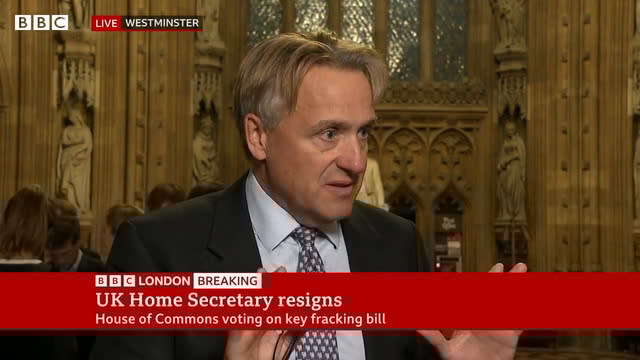
On the 19th October 2022, a vote on fracking in the Houses of Parliament descended into chaos. The Conservatives’ Liz Truss, who would go on to become Britain’s shortest-lived Prime Minister, had intended to use the vote as a ‘confidence measure’ and had ordered a three-line whip for her own party to reject the Labour motion, at the risk of her own government collapsing.[1] Long-accustomed the British have become to an overarching sense of political chaos and turmoil post-2016[2]; yet, the scenes that unfolded that night stand out as particularly tumultuous and, indeed, farcical, which was evidenced by the anger of Conservative MPs regarding the handling of the vote. Backbencher Charles Walker gave an extraordinary interview with the BBC in its wake, demonstrating his anger and derision with the parliamentary Conservative Party not only in the handling of the vote, but in their orchestration of Truss’ ascension to the leadership, and thereby Prime Ministership, as a whole:

              ‘This whole affair is inexcusable [sic.] it is just a pitiful reflection on the Conservative parliamentary party at every level […] this is an absolute disgrace. As a Tory MP of seventeen years who has never been a minister, who has got on with it loyally most of the time, I think it is a shambles and a disgrace. I think it is utterly appalling. I am livid and, you know, I really shouldn’t say this, but I hope all those people who put Liz Truss in Number 10, I hope it was worth it. I hope it was worth it for the ministerial red box, I hope it was worth it to sit around the Cabinet table because the damage they have done to our party is extraordinary […] I have had enough of talentless people putting their tick in the right box not because it’s in the national interest but because it is in their own personal interest to achieve ministerial position’.[3]

Since its modern inception after the 1832 Reform Act that extended voting rights in Britain, the Conservative Party, also known as the Tory Party, has championed the interests of law and order, landed interests, trade and national identity. It has also had a concerted paternalism about it; a sense that the people of the party were in some way born to rule as ‘the political arm of the rich and powerful’ with so many Tory MPs and Prime Minsters hailing from extremely wealthy backgrounds, predominantly attending private schools and Oxbridge.[4] I visited Oxford in January 2024 and found the place oozing with this bizarre sense of tradition and self-congratulatory prestige, not least when our tour guide described the seemingly endless stand-offs between the students of the university and the townsfolk, who, for a few hundred years, seemed perpetually embroiled in a class-turf war. I came away thinking that the University of Oxford was a natural Tory breeding ground; with the arcane rules, rituals and traditions, its exploding coffers and pervasive sense of superiority, it’s hard to imagine anyone coming up with any new ideas there.[5] It may be first in the Time Higher Education World University Rankings, it may have a ‘Gold’ rating in ‘Teaching Excellence Framework’, whatever these arbitrary ratings actually mean, but in a place where the statue of Cecil Rhodes continues to cast a violent colonial gaze over all who pass in the vicinity of Oriel College, with nothing more than an explanatory plaque to problematise his presence, it would appear that conservatism, tradition and entitlement still hold sway here.[6]

Charles Walker MP did not go to the University of Oxford. He was educated privately, like many Tory MPs, but then unlike many of his colleagues, he chose to study at the University of Oregon instead of pursuing the proverbial Oxbridge route. However, his analysis of his own political party, seething and scathing in equal measure, is also illuminating, with his admonition that he has ‘had enough of talentless people’ standing out as particularly pertinent. He seems entirely fed up with members of his party who have made self-motivated political decisions to increase their own reach and power, choosing to court favour with the weathercock of the day over a greater sense of collective good; people who prioritise themselves but ultimately have no real vision, plan or, seemingly, basic ideology that  serves as their driving force, flip-flopping their way through their political careers and the UK’s subsequent political hellscape. 

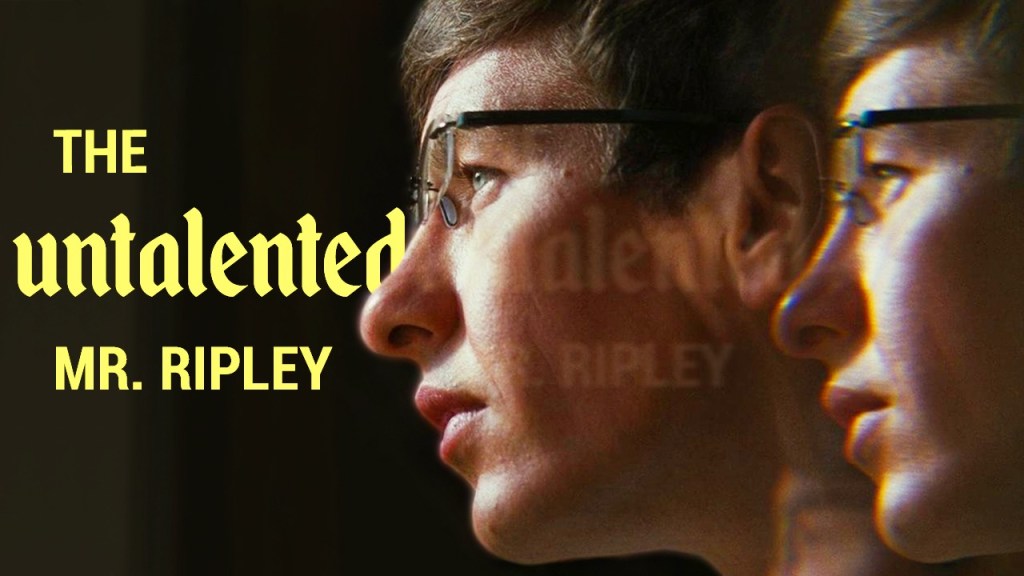
And, thus, we come to Emerald Fennell’s Saltburn, the director herself an alumnus of the University of Oxford.  Saltburn is film that people have, seemingly, come to love to hate and that, I argue, has suffered some misunderstanding. There have been many accusations levelled at it, the most pervasive being that ‘it doesn’t mean anything’, or that it was trying to be another film but didn’t quite get there (‘the implied film is better than the actual one’), or that it’s symptomatic of film’s dance with death via social media. As someone who has, despite my Derridean critical education, often sought out the ‘meaning’ of texts, even if it’s just being secure in what I think a text means, I was pleasantly surprised to realise that I was not one of this group challenging Saltburn for not meaning enough, or anything at all. I observed that the film nodded to eat-the-rich films like Parasite, with references to moths and images of critters that bejewelled the end credits; yet, despite these nods, it did not feel like this was the overarching idea of the film. However, this is clearly what many people wanted and have since imposed on it. One of my favourite video essayists, Broey Deschanel, analysed Saltburn in direct comparison with The Talented Mr Ripley, arguing very astutely that Ripley’s interrogation of class is far superior to Saltburn’s, and that Matt Damon’s portrayal of Tom Ripley as both maniacal and wounded juxtaposed with the grotesque entitlement of Jude Law’s Dickie Greenleaf forms one of the key dramatic tensions of the film that cements this class analysis. I think, however, that she actually hit the nail on the head with the title of her video to describe Saltburn as a wholeand, perhaps, its main character Oliver Quick played by Barry Keoghan: ‘The Untalented Mr Ripley’. Untalented indeed. That may just be exactly the point that people are looking for: this film is about Charles Walker’s ‘talentless people’.

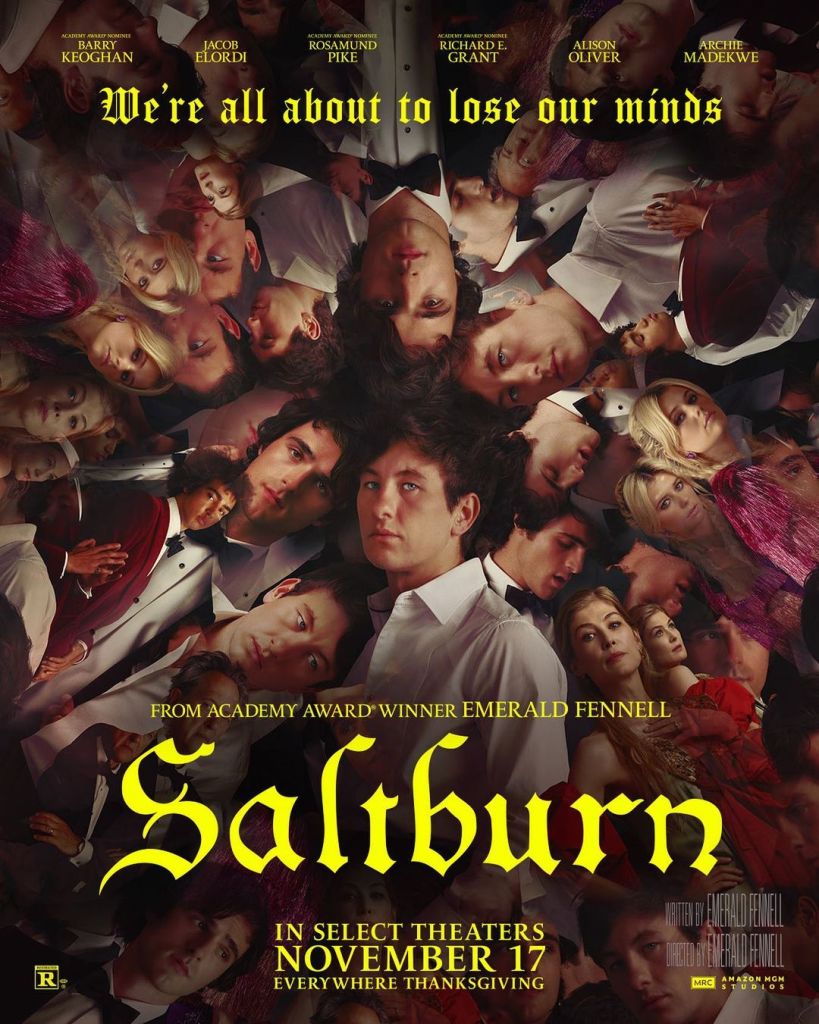
For me, Saltburn is a quintessentially British film about the state of Britain, walking in the footsteps of Trainspotting, Billy Elliott, I, Daniel Blake and others. One of the film’s promotional posters reads: ‘We’re all about to lose our minds’. Anyone recovering from what we have observed and experienced as an electorate in Britain, particularly in the wake of 2016, could be forgiven for thinking: ‘Yes, quite’. Former BBC Political Editor Laura Kuenssberg, in my mind not an entirely unproblematic journalist, made a comprehensive documentary charting the tumultuous succession of crisis-ridden Tory governments in the years following the referendum to leave the EU and it makes for ‘gruesome’ watching in the words of journalist Rebecca Nicholson.[7] Called ‘Laura Kuenssberg: State of Chaos’, the series walks us through the fallout of Britain’s vote to leave the EU.[8] Despite living through it and witnessing all the twists and turns, there is something mind-blowing about seeing the true scale of upheaval mapped out for us, with commentary from civil servants, politicians and journalists who navigated it and orchestrated it. We see five Prime Ministers change hands (David Cameron, Theresa May, Boris Johnson, Liz Truss, Rishi Sunak); back-stabbing and in-fighting within the government in the midst of Brexit negotiations; Boris Johnson’s illegal proroguing of Parliament, which I referenced in this essay; the shambolic handling of the Covid-19 pandemic in the UK, including the Partygate scandal that undermined social distancing measures and the extortionate contracts given to Tory grandees and connections who offered dysfunctional track and trace systems and PPE in exchange for millions of pounds; the sinister rise and fall of unelected officials like Dominic Cummings who was given so much power by Boris Johnson that he was able to stage his own press conference in the rose garden of Downing Street to defend his behaviour in the Barnard Castle debacle; the collapse of the Liz Truss government after 45 days against the backdrop of the country’s longest-reigning monarch passing away; the ascension of Rishi Sunak, seen as a ‘safer pair of hands’ than the volatile Boris Johnson but who was the architect of one of the most ridiculous pandemic schemes ‘Eat Out To Help Out’ which helped to drive up new Covid-19 infections.[9] In short, it is has been an unbelievable, disorientating time in British political history.

Whilst many people have wanted Saltburn to be a searing critique of class inequality that skewers the rich, I think this film, whether it meant to or not, exposes two big political archetypes that have been and continue to be extremely prevalent in British politics and culture more generally, as outlined above: primarily, the rotting, ineffective ideologically conservative ruling class who for so long have extracted wealth and wallowed around in it, whilst believing in their God-given right to lord themselves over others but ultimately do nothing and have nothing to offer society; secondly, the middle class aspirers we can’t help but look to to dismantle class inequality who seemingly just want to, and eventually become, what we thought they wanted to rip down. This is a film about talentless, self-interested people who want to maintain their power; in many ways, it is a satire of the maddening and chaotic state of British party politics.

Much of the discourse online around this film conveys the sense that people wanted this to be a film about class war. What we got instead was a somewhat trashy film that enjoyed rollicking around in its own sense of scandal. The film seemed to achieve this, partially, through its apparent enjoyment of irreverently wallowing in the mess, sensuality and abjectness of the human body: we have the iconic ‘bathwater’ scene, where Keoghan’s Oliver Quick slurps up Felix’s used bathwater into which he has just ejaculated; the cunnilingus scene where Oliver goes down on Ventia whilst she’s mid-way through her period, the grave scene, Oliver Quick’s antler outfit to name just a few. There seemed to be little political messaging lurking in the background beyond the fact that these scenes were meant to be provocative and shocking, which left some reviewers like they had been ‘shoehorned’ in to redeem the plot.[10] However, for me at least, there is something delightfully trashy about them; and I don’t mean that in a way to disparage the film. I mean ‘trashy’ with the same sort of respect and affection I hold for shows like ‘Gossip Girl’ and ‘The Real Housewives’ franchises. Throughout the film, the characters thrive in their relentless gossiping about other characters and these shadowy, shocking scenes have managed to cultivate the same kind of discourse around the film itself; a discourse tinged with delicious salaciousness. Additionally, it is reminiscent of the British’s suspicions, long held, that some members of the privileged upper classes have involved themselves with these kinds of shenanigans, despite their crisp and staid appearances. Are the actions depicted in Saltburn anymore scandalous than 2015’s ‘Piggate’ allegations? A scandal fuelled and propagated by Lord Michael Ashcroft in what appeared to be a stab of revenge at then-Prime Minister and current Foreign Secretary Lord David Cameron, who he claimed got up to all sorts of licentious porcine activities as a member of the mysterious Piers Gaveston Society at the University of, you guessed it, Oxford.[11]

As such, Saltburn’s trashiness (again, I want to emphasise that I do not use this term in a way to undermine or disparage the film!) gives way to the first political archetype; many of these characters are facsimiles of upper class people who are relatively two-dimensional but who relish in the power and prestige of their ancestry, their landed wealth and their proximity to those they hold close and delight in savaging. This is famously evident in Rosamund Pike’s character Elspeth who delights as much in gossiping about other people as she does in covering up the fact that she has been gossiping about other people. She casually reprimands Farleigh for telling Oliver that ‘we were just talking about you’, which, indeed, they had, by telling him without missing a beat that he makes up ‘the most awful things’ and that ‘of course we weren’t’. They are a group of people who don’t actually want to immerse themselves in critical, intellectual inquiry but would rather stew in their fantasies and speculations about other people’s lives, which Elspeth, again, cements when she quips later on in the film that Pulp’s song ‘Common People’ could not have been about her because the young woman depicted in the song ‘came with a thirst for knowledge’ but she ‘never wanted to know anything’. The limited knowledge of Liverpool they display in their first dialogue about Oliver is a good demonstration of this: Liverpool has long been a city that has attracted snobbery and condescension throughout the UK, with everything from the Scouse accent, fashion and beauty trends and implied poverty of its inhabitants offered up to ridicule and dismissal in equal measure. Elspeth and her friend Poor Dear Pamela draw on typically classist stereotypes about the city in their speculation about Oliver’s upbringing, for example imagining Oliver’s hometown Prescot on Merseyside as ‘some awful slum’, and with Pamela asserting that ‘I think that’s actually rather normal when you’re poor; when you’re poor that sort of thing happens a little more’ when Elspeth ravenously chews over the image of Oliver putting his fingers down his alcoholic mother’s throat to make her sick. The family delightfully indulges in both pity and scorn for Oliver that fuels their own sense of civilised superiority, choosing to lean into macabre fantasises about his poverty to cushion and closet themselves quite happily within their privilege.

However, it is this that makes them vulnerable. Whilst the film tracks each individual Catton being picked off by Oliver, the Cattons clearly play the same game, with the weakest link in their midst subjected to the same scorn, ridicule and exclusion. Primarily, when Poor Dear Pamela, who morosely tells Oliver at dinner that ‘Daddy always said I’d end up at the bottom of the Thames’ does go on to die, Elspeth’s wickedly dark response is that ‘[Pamela]’d do anything for attention’. Then, once he too has outstayed his welcome, Farleigh is ejected from Saltburn without ceremony. There is no loyalty among the upper echelons at Saltburn, and this is something we have seen played out politically in the current government, with the endless leaks, scheming and backstabbing that have entailed Tory party politics, particularly post-2016. This has been born out of a political culture of self-aggrandizing, which Charles Walker highlighted with such vehemence in 2022, but was also raised by the outgoing MP for Maidenhead and former Prime Minister Theresa May herself in her final speech to Parliament on the 24th May 2024 before its dissolution in the wake of the up-coming General Election. Whilst almost endearingly referring to her ‘place in history’ as the only MP for Maidenhead as a result of her holding of the post of MP there for 27 years, which charts the establishment of the constituency to its boundary changes in 2024, more than, perhaps, her more historical tenure as a Brexit Prime Minister, May was also critical of self-serving politicians. Not only did she make light of being in government and members of her own side not voting with her on three separate occasions, but she emphasised the role and responsibility of MPs to represent constituents, with her worry that ‘there are too many people in politics who think it is about them, their ambitions, their careers and not the people they serve […] their job here is not to advance themselves but to serve the people who elected them’.[12] Here, she is speaking of the same genre of ‘talentless’ people who prioritise their own politicking over a sense of humility in their service on behalf of their constituency. We know that in Saltburn the natural conclusion of so much selfishness and self-investment is implosion and a group of people rotting from within, with, of course, a little help from Oliver Quick. Yet, the delight with which they rip into their social inferiors and one another to maintain their own position points to a self-inflicted form of violence that marks their own undoing. We will have to see if such a political culture the Tories have exhibited over the past few years will ring in their own death knells of being in government, which only Thursday 4th July 2024 will reveal.

This leads to my second British political archetype that Saltburn demonstrates: the pretender. In this, we have the character Oliver Quick, who delivers the twist that isn’t a twist: whilst peddling the story of being a disadvantaged, impoverished student from Merseyside to ingratiate himself with Felix Catton, he actually hails from a comfortable middle-class home. Like many people who have benefitted from privilege and wealth, Oliver leans on a narrative of working-class hardship and meritocratic achievement to make himself an object of sympathy, with his Merseyside upbringing a particularly astute geographical choice on the part of Fennell thanks to its working class heritage.[13] Many people watching the film felt that this ‘twist’ lacked punch, but, if you have been paying attention to British politics, there is something purposefully unsurprising about it. He used this tactic because it works, has worked and is commonplace in modern British politics. In Britain, many politicians have used working class allusions in their self-fashioning to make themselves more appealing and sympathetic in the eyes of the electorate. We have seen this even in the names that politicians opt to use for themselves, with former Prime Minister Anthony Charles Lynton Blair opting for ‘Tony’; former Chancellor of the Exchequer Gideon Oliver Osborne opting for ‘George’ and former Prime Minister Alexander Boris de Pfeffel Johnson opting for ‘Boris’ as three standout examples. All attended private school and all, you guessed it again, attended the University of Oxford. What these examples also convey is that this happens across the British political spectrum; whilst many would question Tony Blair’s left-wing credentials, particularly in light of Margaret Thatcher referring to him as one of her biggest achievements, the fact that he used the optics of a working-class name to mask his privilege to leverage support is significant.[14] Crucially, especially when this tactic is used by politicians on the Left, there is the real threat of upper middle class politicians using the power they have garnered from appealing to working class voters to then ‘ape the aristocracy in their modes of life’, becoming what they have sought to resist and neglecting those who put them there, something Marx and Engels keenly observed particularly in the English middle classes: ‘By this means the middle class roused the working classes to help them in 1832 when they wanted the Reform Bill, and, having got a Reform Bill for themselves, have ever since refused one to the classes—nay, in 1848, actually stood arrayed against them armed with special constable staves’.[15]

And is Oliver Quick anything other than an ‘ape’ of the aristocracy? Throughout the film, we see him aping the role of a working class student at Oxford, aping Felix Catton as their friendship grows, symbolised through the strategic use of a Jack Wills hoody (a signifier of an attempted to nod to the British gentry, if there ever was one), aping the ‘Brideshead Revisited’ chic of black tie whilst at Saltburn, aping a Ripley-esque psychopathic figure when really he is just as talentless, selfish and whiney as the rest of them. It is in this that critics’ comparison to Ripley doesn’t quite hold water for me; the psychological manipulative mastery of Ripley comes up against the cynical apery of Oliver Quick, making these two characters very unalike and doing very different things. Time will tell if Labour’s latest pretender, in the form of Kier Starmer, will emerge victorious in the up-coming General Election. His name evokes the founder of the Labour party Kier Hardie and he has already harked back to his father’s humble working-class occupation as a toolmaker on the campaign trail. This, despite his own selective grammar school education before his attendance at the University of Leeds and postgraduate study at, here it comes again, the University of Oxford. Starmer has a history of socialist activism, and yet has clearly manoeuvred the Labour party away from the Left and into a more Centre position, verging on centre-right, as the party of Tory voters who are sick of Rishi Sunak but not as extreme as to vote for Reform UK. With a huge focus on defence and immigration, and watering down environmental policy, the Labour party is clearly aping the traditional policy areas of the Tories, which is evident in their increasing popularity outside progressive urban strongholds, where their vote share in recent local elections decreased.[16]  Labour’s apery is also evident in Laura Kuenssberg’s observation that the unfolding so-called ‘purge’ of left-wing influence in the Labour party, in particular in regards to the treatment of veteran MP Diane Abbott, ‘stands in awkward contrast to the way a string of Tories, including Natalie Elphicke, Dan Poulter and Mark Logan, have been welcomed into Labour with open arms in recent weeks’.[17] So far, so Oliver Quick: the backstabbing akin to the Tories, as previously discussed, and the cynical embrace of right-wing idealogues in an attempt to woo voters appears as a bid to obtain power at any price, thus leaving a particularly sour taste in the mouth. How can a party that has its roots in the socialist tradition now find itself as an attractive prospect for disaffected Tories? Precisely because under Kier Starmer, the party has become so adept at aping the Tories. At this point, it feels like a Labour victory in July, a victory so many on the Left have yearned for over the past 14 years, will be as thrilling and as sickening as Oliver Quick’s naked dance through the cavernous, empty halls of Saltburn: Starmer’s own dance down the corridors of Downing Street may feel equally as fabulous after 14 years of opposition, but also equally as hollow.

Saltburn is not what many people clearly wanted it to be: it is a trashy, scandalous, cynical piece of film-making that more than offering a critique of Britain’s class system serves to satirise it. Those who wanted something akin to Parasite or The Talented Mr Ripley are, I am sure, disappointed. But for me, Saltburn reflected the confounded state of British politics; the unbelievable, disturbing, riveting hilarious horror of the state of our democracy. It is rare for me to adopt the lens of ‘Britishness’ when writing a critical essay (I worry that it veers me towards some sense of nationalism of which I am very wary). Yet, for me, this is exactly what this film is about. ‘I don’t know what’s OK anymore’, a friend said as we left the cinema hooting and quaking in equal measure after a group trip to see the film. If this doesn’t perfectly capture the impact of a political system presided over by ever so many talentless people, then I don’t know what does.


[1] https://www.theguardian.com/politics/2022/oct/19/crunch-commons-vote-on-fracking-descends-into-farce [accessed 08:23, 2nd March 2024].

[2] ‘Laura Kuenssberg: State of Chaos’ BBC iPlayer https://www.bbc.co.uk/iplayer/episodes/m001qgww/laura-kuenssberg-state-of-chaos

[3] https://www.bbc.co.uk/news/av/uk-politics-63320605 [accessed 08:36, 16th March 2024].

[4] Chavs, Owen Jones (London: Verso, 2012), p.40.

[5] https://www.theguardian.com/education/2018/may/28/oxford-and-cambridge-university-colleges-hold-21bn-in-riches [accessed 08:22, 16th March 2024].

[6] https://www.ox.ac.uk/sites/files/oxford/Oxford%20University%20Financial%20Statements%202022-23.pdf [accessed 08:29, 16th March 2024]; https://www.bbc.co.uk/news/uk-england-oxfordshire-58885181 [accessed 08:29, 16th March 2024].

[7] https://www.theguardian.com/tv-and-radio/2023/sep/11/laura-kuenssberg-state-of-chaos-review-full-of-extraordinary-revelations-if-you-can-bear-to-watch [accessed 17th March 2024, 09:03].

[8] https://www.bbc.co.uk/iplayer/episodes/m001qgww/laura-kuenssberg-state-of-chaos [accessed 17th March 2024, 09:10].

[9] https://warwick.ac.uk/fac/soc/economics/research/centres/cage/news/30-10-20-eat_out_to_help_out_scheme_drove_new_covid_19_infections_up_by_between_8_and_17_new_research_finds/ [accessed 17th March 2024, 09:32].

[10] https://www.bfi.org.uk/sight-and-sound/reviews/saltburn-ostentatious-black-comedy-designed-shock [accessed 28th April 2024, 11:29].

[11] https://time.com/4043311/david-cameron-pig-gate-scandal/ [accessed 28th April 2024, 12:42].

[12] https://www.youtube.com/watch?v=-_xZrdoP5rQ&ab_channel=PoliticsJOE [accessed 31st May 2024, 15:04).

[13] https://www.newstatesman.com/politics/society/2022/04/a-quarter-of-britons-paid-100000-or-more-identify-as-working-class [accessed 1st June 2024, 13:14].

[14] In 2002, twelve years after Margaret Thatcher left office, she was asked at a dinner what was  her  greatest  achievement.  Thatcher  replied:  “Tony  Blair  and  New  Labour.  We forced our opponents to change their minds.”  (Conor Burns, April 11, 2008) https://economicsociology.org/2018/03/19/thatcherisms-greatest-achievement/ [accessed 1st June 2024, 15:55].

[15] Marx and Engels Collected Works, Volume 13 (pp.663-665), Progress Publishers, Moscow 1980 https://marxengels.public-archive.net/en/ME1912en.html#N464 [accessed 1st June 2024, 13:42].

[16] https://www.theguardian.com/politics/article/2024/may/03/labour-celebrates-victories-but-loses-ground-in-urban-and-heavily-muslim-areas [accessed 1st June 2024, 15:07].

[17] https://www.bbc.co.uk/news/articles/c7220exjzvno [accessed 1st June 2024, 15:12].

Why I won’t be watching ‘Blonde’

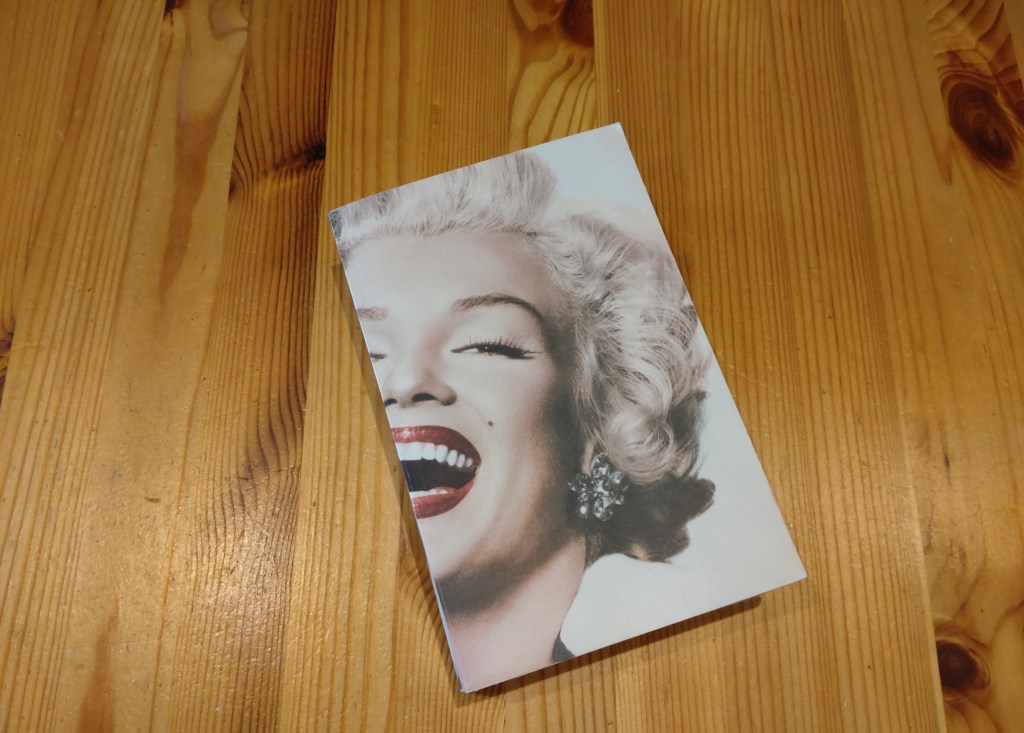
For my GCSE English Speaking and Listening assessment in 2007, the topic I landed upon was Marilyn Monroe. I vaguely remember how it began: ‘What do 20th Century Fox, red lipstick and *something else unremembered* have in common? Marilyn Monroe!’ I then proceeded to give what I’m sure was a very dull chronology of her life that I had lifted from ‘The Assassination of Marilyn Monroe’ by Donald H. Wolfe, which I had borrowed from a public library as part of my research. The choice to commit myself to this topic for an assessment was, with hindsight, a bemusing one: I had never seen a film of hers by that point and the first primitive reference to her I can recall was Geri Halliwell replicating the subway grating moment from The Seven Year Itch in the Spice Girls film ‘Spice World’ in 1997. Comically, during the Speaking and Listening, I even unknowingly mispronounced the name of Monroe’s film-noir Niagara, opting for ‘nia-garra’ over the generally agreed upon phonetic pronunciation ‘nahy-ag-ruh’. Very Alicia Silverston playing Cher Horowitz from Clueless, if I say so myself.

My interest in Marilyn Monroe didn’t end there: I had a Gentlemen Prefer Blondes poster on my bedroom wall; received books about her life and wardrobe for birthdays and Christmas; and I kept a black and white photograph of a still from Some Like It Hot on a wall in many lounges in various rented flats I’ve lived in over the years. A friend asked me once: ‘Why do you like her so much?’ I recall that my answer was somewhat vague: that she’d had a hard life and that ‘people’ had been unkind to her so remembering her was important. I still follow an account on Instagram called @perfectlymarilynmonroe that posts on a daily to weekly basis with lesser-known photographs and stories from Monroe’s life.

Over the past few months, I’ve been trying to wrack my brains as to why I felt passionately enough about Monroe to give a speech about her life at great length in front of a class of my peers. My deep fascination with her has, indeed, waned over the past few years largely without my noticing: emblematic of this is that the said photograph from Some Like It Hot is currently lying in a bag of other old posters, artworks and fragments from my early twenties, gathering dust. What is becoming clearer for me is that Monroe was a representation, as perhaps she was for many people, of some kind of angelic aspirational figure. Whilst being blonde has something of a cultural reputation for being ‘dumb’, I can only recall almost learning to revere blondness, in particular white blondness, both in my peers and in cultural figures. This started both with my first Barbie and my first intrusive worry about my physical appearance when I noticed, aged five, that all of my school friends were blonde and were, I felt intuitively, valued in a slightly different way than I was by parents and teachers. When I decided, slightly questionably, to ‘go blonde’ after a break-up when I was nineteen, I was immediately asked whether people had started responding to me in a ‘different’ way: a slightly coded enquiry, that left me feeling that my physical and sexual currency had somehow been elevated now that my hair colour was no longer its natural tawny (and, yes, I think gorgeous) brown. 

Monroe must be our culture’s ultimate archetype of this Aphroditic blonde. In the words of Anthony Burgess, she was an embodiment of ‘divine glamour’: physically unattainably beautiful, precious, witty and fun, whilst also seeming to transcend those humanly qualities into something celestial. Yet, her humanness meant that she never crossed into the realm of the purely and deathly symbolic: she seemed like an irreverent bodily, earthy being, vulnerable but also famously and gloriously comfortable in her own skin, like a cat. I am certain I projected a huge amount of my own adolescent gold onto her, seeing in her the goodness, radiance, beauty and joy that I couldn’t see consciously or couldn’t allow myself to accept in myself. As such, I began to uphold her as a role model I profoundly admired, believing I knew and understood her intimately, bittersweetly displacingknowing and understanding myself, and finding in my adoration a sense of meaning and belonging. I wonder if these feelings rooted for me are/were shared by others who upheld Monroe as a sacred role model. It is perhaps then no surprise or coincidence that my attachment to her has lessened, now, as a result of, amongst other things, therapy and by dedicating myself to practices that cultivate love, compassion and acceptance for myself. I don’t need to idolise someone externally when I have the qualities that I revere in abundance within myself.

As such, we arrive at why I have even been considering this at all. It is undeniable that Monroe has remerged in our public consciousness, famously through Kim Kardashian’s problematic wearing of the ‘Happy Birthday Mr President’ dress at the 2022 Met Gala, the publicity preceding the film Blonde, and the subsequent furore surrounding its release. Towards the end of a term, a pupil at school said to me of Blonde: ‘I read that that film did her dirty’. Nothing screams cultural permeation and significance more than a thirteen-year-old remembering and recounting something they’ve discovered on one of their voyages across the internet. Yes: Monroe is back, and it feels more complicated than ever.

I decided to start reading ‘Blonde’ by Joyce Carol Oates a month or two before the film was released. Even before its Netflix release on 28th September 2022, the film had already drawn a lot of internet attention thanks to both the intriguing promotional stills that featured uncanny representations of Monroe, played by Ana de Armas, and clips of the 14-minute standing ovation the film received at the Venice Film Festival. Once the film was released, however, everyone from the New York Times to the Independent and social media netizens decried it for being exploitative ‘trauma porn’, that capitalised upon speculation and conjecture about Monroe’s life. I particularly respected Mark Kermode’s shrewd framing of the film as a ‘horror film’ and ‘gothic melodrama’, which, in my mind, served to complicate the fact that it was essentially marketed as a biopic, in spite of references to Oates’ novel in the trailers.[1] I noticed that many of the comments and reviews that read as supportive of the film when the backlash kicked off harked back to the novel, almost claiming that because the film was an adaptation from a book, people needed to calm down about how Monroe was represented; that being an adaptation lent the film some kind of legitimacy. This was problematic on a number of different levels that could be the subject of an essay in and of itself. However, what concerned me the most was that people were appealing to the book as a zenith of some kind of authority, when the whole premise of the book in the first place is startlingly thorny.

Aside from the legal abstract that opens the book with the prerequisite publishing and copyright details, and the declaration of this novel as a work of fiction, Oates provides us with a lengthy ‘Author’s Note’ that forms a singularly disorientating read. Here is where the novel begins, before the introduction of any characters, settings or narration. It interweaves a number of bibliographic references to Monroe’s poetry, Monroe biographies, and secondary material reproduced and referenced throughout the novel, which are held in the same breath as assertions of ‘invention’:

Blonde is a radically distilled ‘life’ in the form of fiction, and, for all its length, synecdoche is the principle of appropriation […] The historic Marilyn Monroe did keep a journal of sorts and she did write poems, or poem-fragments. Of these, only two lines are included in the final chapter (“Help help!”-); the other poems are invented. Certain of the remarks in the chapter “The Collected Works of Marilyn Monroe” are taken from interviews, other are fictitious […] Biographical facts regarding Marilyn Monroe should be sought not in Blonde, which is not as intended as a historic document, but in biographies of the subject […] Of the books on acting cited and alluded to, The Thinking Body by Mabel Todd, To the Actor by Michael Chekov, and An Actor Prepare and My Life in Art  by Constantin Stanislavski are genuine books, while The Actor’s Handbook and the Actor’s Life and The Paradox of Acting are invented’.[2]

From the beginning, Oates immediately seems to perform the bewildering intertwining of fiction and reality: the ‘Author’s Note’ reads as a pre-emptive bombardment, constructing the overarching authorities of fact and fiction that are cast over the novel with the force and momentum of a high-speed train, throwing up questions and complications from the start: what exactly does ‘‘life’ in the form of fiction’ constitute? Is that not what fiction does and has done since its inception? Furthermore, the ‘nothing-to-see-here-officer’ intonation of Oates’ equivocation that the novel is ‘not intended as a historic document’ seems particularly slippery. Thanks to Roland Barthes and others, I have come to understand authorial intention as a concept that forms a contentious and, to put it bluntly, irrelevant focus of enquiry.[3] Whether done performatively or not, statements of intent, and their denial thereof, always raise my hackles: despite its seeming nonchalance, Oates here seems to be attempting to, or performing, the attempt to control the reception of her novel. This is doubly ironic as she follows this assertion with a complicated tangle of references that are both real and entirely made up, yet through the use of formal bibliographic conventions, such as italicisation, do not appear as such. Not to mention the ambiguity of the statement itself: ‘not intended as a historic document’. Not ‘not intended as an accurate history’ but ‘not intended as a historic document’. Which means that a claim is being made here that Blonde, in some way, exists outside of history. I would argue that any document published with an ISBN and with a catalogue record in the British Library constitutes an ‘historic document’: it is of a time and of a place. Whether Oates or Oates-performing-the-author believes it or not, her novel has entered discourse, it has entered consciousness with all of the contextual influences that informed its production and its reception, thus granting it a certain ‘historic’ position, regardless of whether its subject matter actually deals with history. Which the note tells us it does… and doesn’t.

I don’t mind that the novel starts with the ‘author’ running rings around us. I love being thrown into a conundrum which challenges my position as a reader, demanding interrogation and criticality over complacency. The is undeniably the air of the Trickster to the whole thing. However, it wouldn’t be a problem if the book wasn’t about someone who was real and is unable to do what she wants with the narrative: whether to disregard it, ignore it, challenge it or lean into it. And what a narrative it is: Blonde is one of a few books that I have found really excruciating to read: page after page, chapter after chapter of objectification, exploitation and violence. I actually didn’t mind the start of the novel and the mapping out of Norma Jeane’s relationship with her mother; I think it would make a great exercise to draw it into comparison with the start of David Copperfield, which I found equally compelling in the ways in which Dickens too leans into the psychological darkness and torment of an unhappy childhood. However, the rest becomes something of a relentless barrage of pure misery. Why did Marilyn Monroe have to be presented in this way? If this story had to be told, surely a fictional starlet could have been constructed upon which to map Monroe’s story, thereby removing the stickiness of projecting a load of cultural baggage onto someone, without their consent, who really existed.

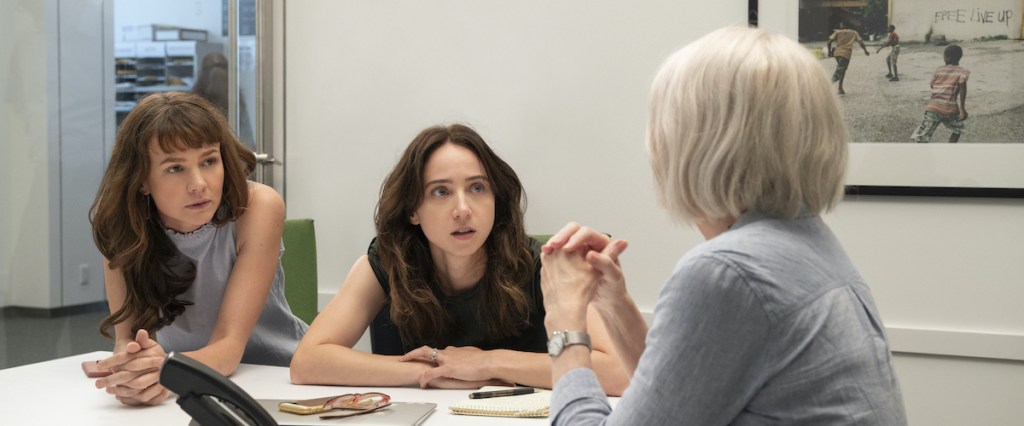
Blonde’s iterations as a novel and a film are all a matter of projection. In choosing to render Monroe a total victim under the guise of critiquing the twin forces of patriarchy and capitalism, the book, in my view, ends up becoming an oppressor; it becomes the toxic water that oppresses, stunts, and drowns out the reality of a person who once existed, denying her control over her own narrative and story. This is all the more important, and all the more baffling, because we live in a post-#MeToo world where agency and the reclamation of power and truth are a core part of women pushing back against sexual harassment and violence, as argued by the movement’s founder, Tarana Burke: ‘There is inherent strength in agency. And #MeToo, in a lot of ways, is about agency. It’s not about giving up your agency, it’s about claiming it’.[4] Blonde was first published in 2000, six years before Burke first used the phrase #MeToo on My Space and a further eleven years before it gained significant global traction after the New York Times broke the story of Harvey Weinstein’s abuse of women in Hollywood. Therefore, the book clearly comes from an earlier time when ‘feminism’ was still a dirty word and stories of sexual violence and harassment were still marginalised. In 2000, perhaps society needed an Homeric story of trauma to act as a sledgehammer for us to wake up culturally and resist the violence of patriarchy, even though stories of sexual violence have long been shared and published. Yet, we are no longer in 2000; from a 2022 perspective, Blonde’s framing of Monroe’s torturous suffering in its obscenity and relentlessness verges on the gratuitously perverse. More than ever, we need testimony and we need story sharing: but a text claiming fictitiousness about a real person who is subjected to an indulgence of abuse and trauma is not the same thing. The biographical film She Said, starring Carey Mulligan and Zoe Kazan as Megan Twohey and Jodi Kantor, the New York Times journalists who broke the Harvey Weinstein revelations, was also released in 2022 and is something of a counterpoint to the release of Blonde. The film doesn’t shy from giving voice to traumatic experiences, including Ashley Judd’s who, notably, plays herself; however, instead of presenting horrific detailed scenes of abuse, the film centres women’s experiences, storytelling and solidarity in challenging gargantuan male power. I would argue that it is a much more important film for exploring the real lives and stories of real people who experienced sexual violence, rather than projecting conjecture and contributing to the oppression of someone who will never have the right to reply.

Am I surprised that Monroe and her story continues to be plagued and harassed by patriarchy (and, yes, I consider Blonde to be a patriarchal novel)? No. I see Blonde and its cinematic iteration in the same vein as the documentary Amy, released in 2015. Neither Marilyn Monroe nor Amy Winehouse are allowed a say on their own story, let alone offered catharsis, redemption or transcendence. Two woman are placed onto a pedestal and then torturously and repeatedly torn down. They are brutalised within and by these texts in a way that I hope audiences find increasingly unacceptable, especially when compared with the adulation and adoration that men like Ayrton Senna in Senna and Kurt Cobain in Montage of Heck have received. It really is a tale as old as patriarchal time.

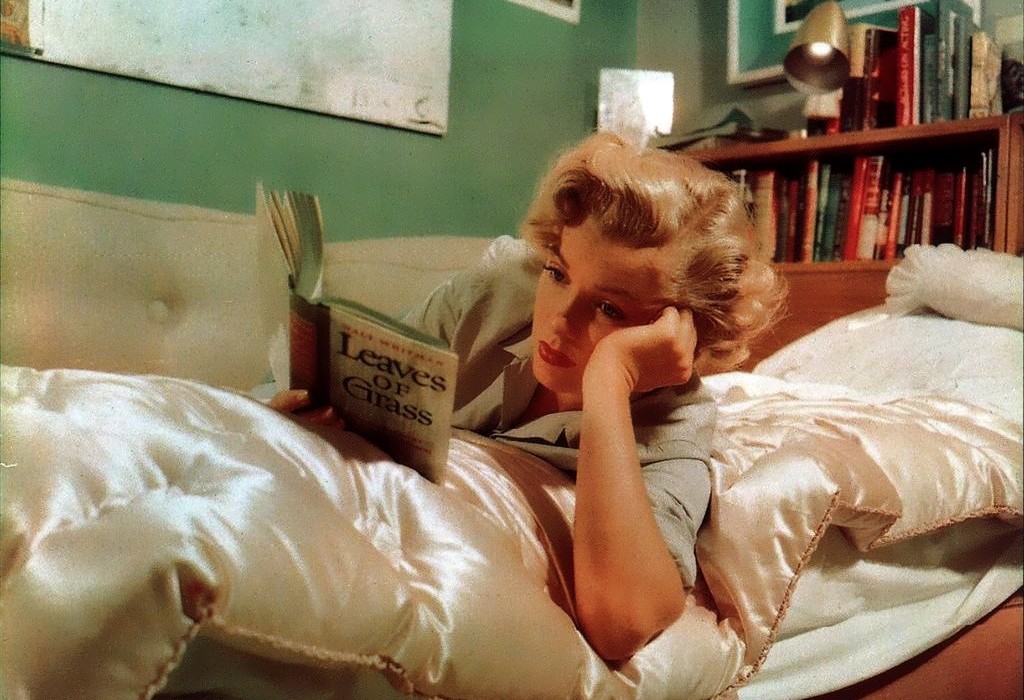
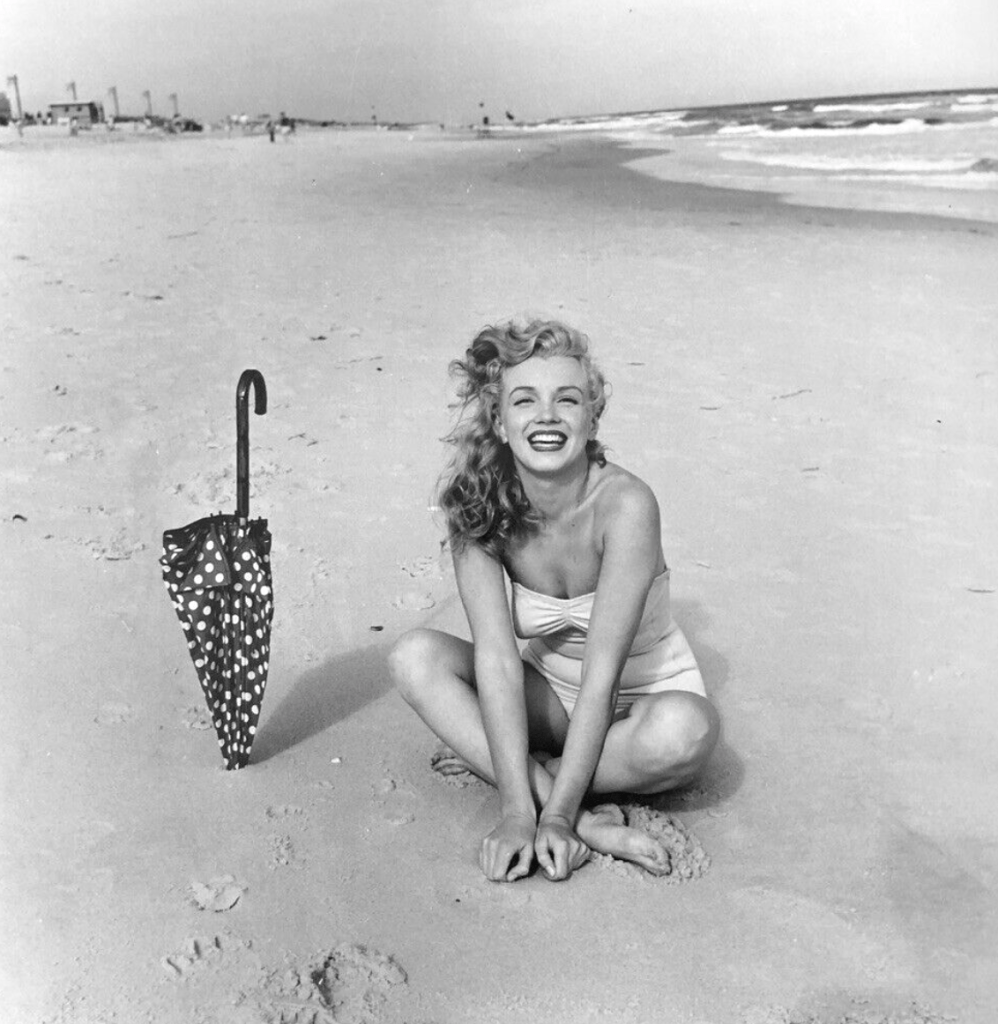
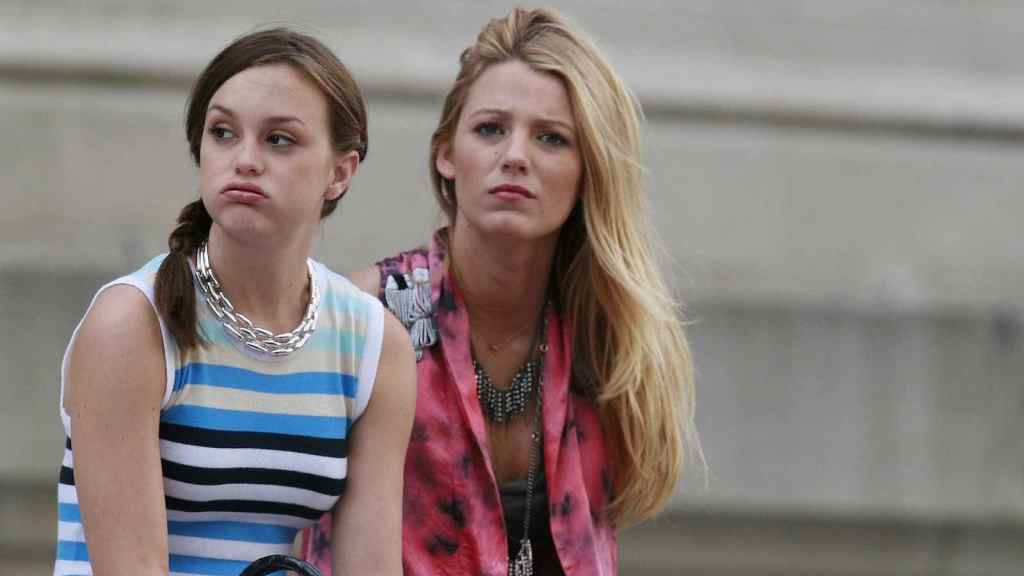
I am not ashamed to admit that when I finished reading Blonde I threw it to the ground, which has only happened one other time in my life (after reading Crime and Punishment, but that’s another story). I will not watch Blonde. Just as I don’t care if there really was a ‘real’ Shakespeare, I don’t care to speculate on ‘who’ the ‘real’ Marilyn Monroe is or was, especially when posited by a film that is problematic for all the reasons stated above and was applauded by the likes of Casey Affleck. Instead, I will re-watch Gentleman Prefer Blondes and Some Like It Hot for the thousandth times; I will recall how when Jane Russell tried to encourage Monroe to join a Bible group, she, fabulously, in turn decided to introduce Russell to Freud; I will enjoy the photographs of Monroe reading Leaves of Grass and Ulysses and leaning over a balcony in New York; I will enjoy the Warhol paintings depicting her; I will thrill at Lana Del Rey’s play with her image in the videos to National Anthem, Paradiso and Candy Necklaces; I will reminisce about the homage to Diamonds Are a Girl’s Best Friend in Noughties teen staple ‘Gossip Girl’ where Monroe was played by Serena Van Der Woodsen AKA Blake Lively. What real joy this woman has brought and the bright, bright shadow she continues to cast. I dedicate the end of this essay to Marilyn, in her own words:

‘When it comes down to it, I let them think what they want. If they care enough to bother with what I do, then I’m already better than them’.


[1] https://www.theguardian.com/film/2022/sep/25/blonde-review-marilyn-monroe-netflix-film-ana-de-armas-andrew-dominik-joyce-carol-oates [accessed 31/05/2023, 15:15]

[2] Blonde, Joyce Carol Oates (London: 4th Estate, 2018), p. i.

[3] https://sites.tufts.edu/english292b/files/2012/01/Barthes-The-Death-of-the-Author.pdf [accessed 31/05/2023, 15:18]

[4] https://www.theguardian.com/world/2018/jan/15/me-too-founder-tarana-burke-women-sexual-assault [accessed 31/05/2023, 15:23]

An Unexpected Journey: Re-watching ‘The Hobbit’ trilogy

“I don’t think I know your name.’

‘Yes, yes my dear sir and I do know your name Mr. Bilbo Baggins. And you do know my name, though you don’t remember that I belong to it. I am Gandalf, and Gandalf means me.”

Whilst J.R.R Tolkien’s The Hobbit was famously written, in the first instance, for said writer’s children, it has been famously described as being ‘a children’s book’, a coded criticism in many respects, meaning that because it has been marketed for primarily children, it is devoid of substance, nuance and meaning that more intelligent and world-wise adults are able to discern.[1] It is for that reason that my first opinion of Peter Jackson’s three films of the same name, released in 2012, 2013 and 2014, was low and, as I discovered recently, severely limited. I remember vividly, going to the cinema to see ‘An Unexpected Journey’ at the ripe age of 20, immediately welling up at the ‘Concerning Hobbits’ refrain that accompanied the film’s opening titles, before launching into an internal criticism of everything I perceived to by divergent from the original text. ‘How could a short book, for children, be strung out into three long films’, was my main point of contention. Oh the irony, when I had spent the past couple of years challenging the sanctity of texts so voraciously, unable to witness the way in which I was clinging so unconsciously to this one! This essay is in part a mea culpa but also a celebration of what I now regard to be a film that bridged The Hobbit to the rest of Tolkein’s legendarium with, perhaps, more consciousness and success than by Tolkien himself.

This is not to say that The Hobbit films were and are perfect. Even after my most recent re-watch, there are still some significant issues that have persisted over time: the films have the visual aspect of a video game, thanks to the choice to film using 3D Red Epic Cameras at 48 frames per second. Where so much of the deeply immersive storytelling in The Lord of The Rings films was borne from the physical prosthetic, make-up, costuming and set-design work, so successful in that they enabled audiences to feel as though the characters, races and cultures of Middle Earth were in some way real, the reliance on technology and digital design in The Hobbit creates more of a visual and, hence, emotional distance from the characters and the world they inhabit. This is not to say that video games are not deeply immersive, they evidently are and this is because we are able to take action and actively inhabit those worlds.[2] In the medium of film, however, where we are able to become engrossed in the worlds of films, we are, whilst observers and critics too, experientially more passive and in a position of surrender to the camera. No amount of good acting or writing in The Hobbit films allows them to land with as much impact as Jackson’s predecessors as a result of this overemphasis of a frame ratio and visual effects that take from the story more than they give. This was and still is, with all the merit I would give Jackson for experimenting with this cinematic technology, disappointing.

Equally disappointing are the ‘wink-wink-nudge-nudge’ moments of shoehorned nostalgia, for example when the One Ring falls onto Bilbo’s finger in the exact same way it falls on Frodo’s in The Fellowship of the Ring. Furthermore, I think the relationship between Tauriel and Kili is hopelessly contrived and whilst I am appreciative of the filmmakers’ efforts to include a female character, where there are a grand total of zero in the book, it is somewhat frustrating that her only narrative significance revolves around an ill-fated and yet remarkably lacklustre romance plot.    

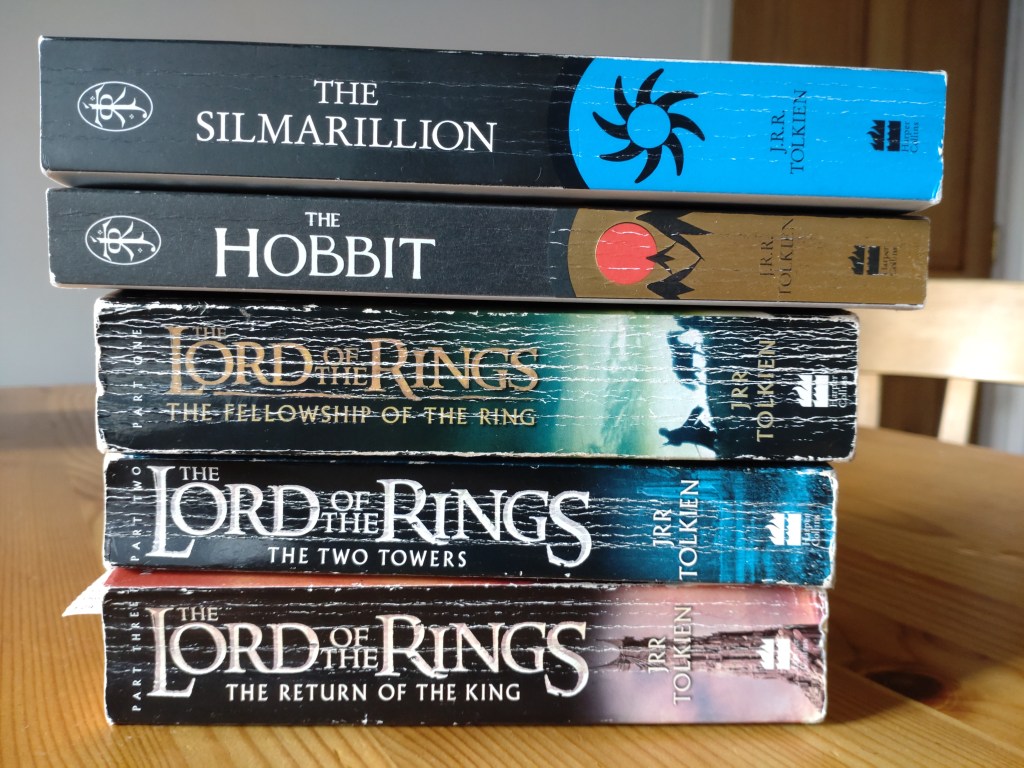
Yet, from this re-watch, I was able to discern that Jackson put in more work than I previously was even aware of to expand The Hobbit story into its rightful context within Tolkien’s mythology, in particular in its temporal position as a precursor to The Lord of The Rings. It is in this where I think The Hobbit films showcase some narrative brilliance on the part of its director. My opinion of this was enabled by my reading of The Silmarillion last year, a dense and remarkably realised mythology of the First Age of Middle Earth that Tolkien wrote prior to and, perhaps according to Christopher Tolkien, concurrently with The Hobbit in the 1930s. In a letter, Tolkien wrote that ‘The Hobbit was not intended to have anything to do with [The Silmarillion] […] It has no necessary connexion with the ‘mythology’, but naturally became attracted towards this dominant construction in my mind, causing the tale to become larger and more heroic as it proceeded’.[3]He suggests here that the progressive adventurous sensibility of The Hobbit came about in its tangential relationship with The Silmarillion: almost that The Hobbit couldn’t help but become more epic as a result of its exposure, in his imagination and writing, to the truly sweeping and awesome aspect of The Silmarillion. However, he is clear that there was no over-lap between the two: however much The Hobbit was influenced by The Silmarillion in terms of narrative grandiosity, the narratives themselves were quite separate. Only in Tolkien’s own retrospect and re-jigging post-Hobbit and aided by The Lord of The Rings do we see an intersection begin to merge between what were previously disparate texts.[4] It is here where I argue Jackson, with the benefit of Tolkien’s retrospect and the extensive appendices that accompany the legendarium, was able to successfully bridge some of the gaps left behind by Tolkien’s source texts. In short, Jackson and his team did their research, it shows, and The Hobbit films deserve much more credit than I believe they have received for this.

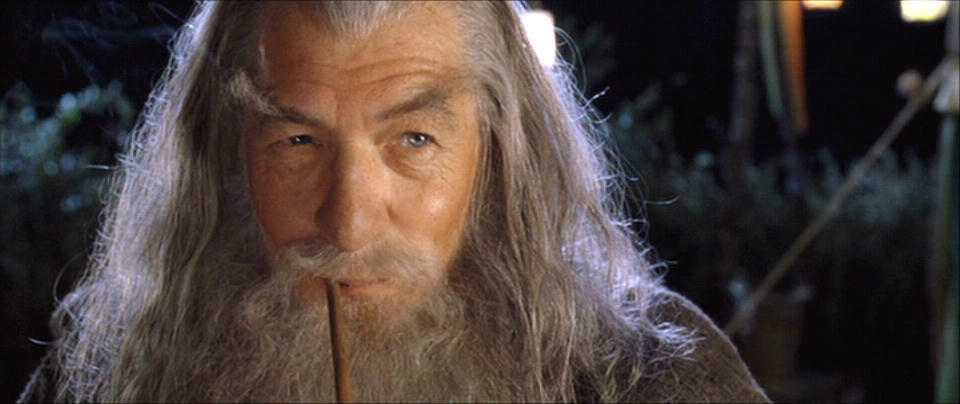
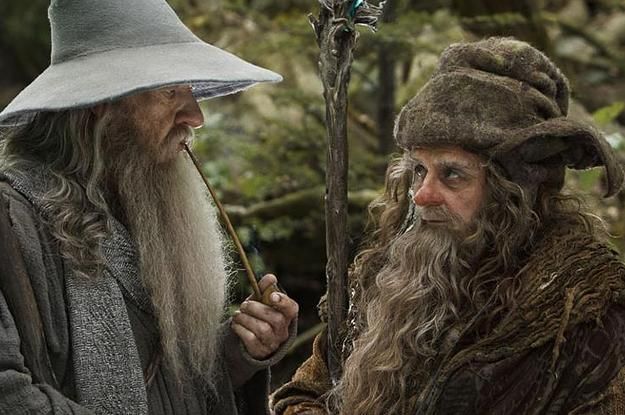
Fittingly, it would seem that the main mechanisms that Jackson uses to help bridge these narrative gaps are the wizards Gandalf the Grey and Radagast. In saying this, I do not aim to reduce their roles to mere plot devices: on the contrary, in some way I see it as nigh on poetic that these characters, who are so well-loved and revered by both characters in the stories and by readers and audiences too, who have so much power, wisdom and benevolence, should be the ones to ensure the successful metaphysical narrative weaving across the media of novel and film between The Hobbit and The Silmarillion. Perhaps we shouldn’t be so surprised. Whilst Radagast is elusive throughout Tolkien’s texts, Gandalf is presented as a character whose wizardry extends beyond telekinesis and otherworldly intuition to his ability to construct and affirm meaning for the characters around him. Indeed, when we first meet him in the very first chapter of The Hobbit, he engages an unwitting Bilbo into something of a verbal sparring match, after the latter has wished him a ‘Good morning!’. Looking at Bilbo ‘from under long bushy eyebrows that stuck out further than the brim of his shady hat’, Gandalf asks him:

‘“What do you mean?” he said. “Do you wish me a good morning, or mean that it is a good morning whether I want it or not; or that you feel good this morning; or that it is a morning to be good on?”’[5]

In his interrogation of the exclamation ‘Good morning!’ is a playfulness with which Gandalf employs and perceives language, pointing to the number of different ways in which Bilbo’s deceptively simplistic phrase could be used and interpreted. Gandalf’s questions expose the realms of meaning that underlie even the most apparently obvious of statements and, as such, successfully and wittily deconstructs both the phrase Bilbo has used and, importantly, the complacency with which he used it. As a result, along with the play, is an assertion of dominance, expressed through the performed uncertainty around what Bilbo means: in his questioning he demonstrates his own command of and ability to wield language, and therefore his ability to construct meaning. By questioning Bilbo in this way and subtly asserting his own dominance over language and its multiplicity of meanings, Gandalf’s introduction is none too reminiscent of ‘in the beginning was the Word, and the Word was with God, and the Word was God’, yet perhaps with more of a knowing wink and a glint in the eye from underneath those bushy eyebrows. Although Saruman is described as ‘subtle in speech’, I would argue that it is Gandalf’s playfulness with language that marks him out as more flexible in his thinking and the more compelling to those around him.[6] This linguistic dominance is developed later on in the novel where Gandalf uses narrative to convince the shape-shifter Beorn to allow Thorin’s Company of dwarves and Bilbo to stay in his hall having been pursued by goblins through and from the Misty Mountains. Aware of Beorn’s reticence for opening his home to strangers, and with a particular dislike for dwarves, Gandalf weaves the tale of the Company’s adventures with hints at their number and regular interruptions by the arriving dwarves at such a pace as to not offend Beorn.[7] We are told towards the episode’s end that,

‘Bilbo saw then how clever Gandalf had been. The interruptions had really made Beorn more interested in the story, and the story had kept his from sending the dwarves off at once like suspicious beggars […] “A very good tale!” said [Beorn]. “The best I have heard for a long while. If all beggars could tell such a good one, they might find me kinder.”’[8]

Gandalf successfully uses language and, slightly differently to his first encounter with Bilbo, the delay and deferral of meaning to ensure he is able to get what he wants and needs. Even though he and the Company are in a vulnerable enough position so as to rely on Beorn’s hospitality, Gandalf is able to use his, again, playful and ‘clever’ control of language and meaning to endear himself and the others. In particular, Tolkien emphasises that it is ‘the story’ and the means by which it is told that secures safety and, therefore, it is clear that the ability to use language in this way is as powerful a weapon for Gandalf as any of the other magic he may be able to perform. This is confirmed through the echo of the description of the dwarves as ‘beggars’: the story does not prevent Beorn from seeing the dwarves as ‘beggars’, yet the power of the narrative seems to enable Beorn to move past his preconceived distrust and disdain for the dwarves, even conceding that he might be more open in general if each story he met was ‘good’ enough. By ‘good’ we don’t necessarily mean that plot points of the narrative, although they help, but the way in which Gandalf has adeptly guided Beorn through what is essentially a carefully constructed unfolding of the truth. The irony of which is that perhaps Beorn’s distrust is not entirely misplaced, given Gandalf’s masterful yet creatively tentative handling of what actually happened and how many they are. Nevertheless, what is clear is that Gandalf the Grey occupies an important role in Tolkien’s work as a conduit and creator of meaning, which makes it all the more appropriate that his character is one of two wizards used by Jackson, in this same vein, to bridge the narrative gaps between The Silmarillion, The Lord of the Rings and The Hobbit. These narrative bridges revolve around the shadowy figure of The Necromancer. 

The Necromancer is only named four times in The Hobbit text, and the gift that Jackson gives a film audience is a cinematic expansion of these short hints given, of course, by Gandalf both about him and his fortress at Dol Guldur, thereby building something of a narrative bridge from The Hobbit to The Lord of the Rings. One hint appears in the very first chapter of the novel, where Gandalf describes his adventure to retrieve Thror’s map: ‘I was finding things out, as usual; and a nasty business it was. Even I, Gandalf, only just escaped’; and one, satisfyingly cyclical, in the final chapter, ‘Gandalf had been to a great council of white wizards […] they had at last driven the Necromancer from his dark hold in the south of Mirkwood.[9] Furthermore, the episode is given reference to, again with little expansion in The Silmarillion: ‘Mithrandir [the Elvish name for Gandalf] at great peril went again to Dol Guldur and the pits of the Sorcerer, and he discovered the truth of his fears [that the Necromancer was ‘the first shadow of Sauron returning’], and escaped’.[10] Moreover, Jackson, I would argue, successfully interleaves the council meeting and Gandalf’s investigation of Dol Guldur mentioned here into The Hobbit narrative, with the council, attended by Gandalf, Galadriel, Elrond and Saruman the White, taking place during the Company’s sojourn at Rivendell early on in the first film of the trilogy, and then the investigation of Dol Guldur after the Company enter Mirkwood in the second film. This latter interleaving is particularly poignant narratively because as the Company encounters the corruption of the old Greenwood forest, we see Gandalf explore the root of that corruption, which I think works seamlessly. The expansion of these moments in the films serve to build important narrative connections that Tolkien either hints at or simply misses. The revelation that The Necromancer is the spirit of Sauron beginning to re-take form in the final film in The Hobbit trilogy is an important set-up for what happens sixty years later in The Lord of the Rings, plus is an excellent opportunity to see Galadriel in all her power. What was, perhaps, a missed opportunity was Jackson’s lack of emphasis as to why the council does nothing to organise against Sauron once it is revealed that he has returned. Saruman clearly underestimates Sauron’s ability to fully amass power, as described very late on in the appendices of The Silmarillion, but I think, what should be, an extremely pertinent moment becomes slightly lost within the narrative of the Company.[11] In truth, there is a lot of action in this film: it begins with Smaug’s destruction of Lake Town and his killing at the hands of Bard, then the confrontation at Dol Guldur, Thorin’s antagonism and obsession with the Arkenstone, followed by the Battle of the Five Armies. There is a lot of action and huge visuals to be swept along with. The decision to not challenge Sauron comes thirty minutes into the film and, most unfortunately, is not particularly circled back to. Gandalf’s last lines in the film seem like a particular waste, even though they replicate those in the novel: ‘You’re a very fine person, Mr Baggins, and I’m very fond of you; but you’re only quite a little fellow in a wide world after all’. In the novel, these words are delivered as Balin, Bilbo and Gandalf discuss the prosperity of the Men of the Lake after the Battle of the Five Armies and Bilbo’s hand in helping to ensure that peace. [12] Jackson’s use of them almost sentimentally, however, as almost a parting caution to Bilbo about the power of his magic ring is slightly too cryptic to ensure the sort of foreshadowing that could have been used to more explicitly weave the end of The Hobbit films to the larger narrative of The Lord of the Rings. However, as I said at the beginning of this essay, whilst true merits of these films have emerged with time and further investigation, they are by no means perfect.

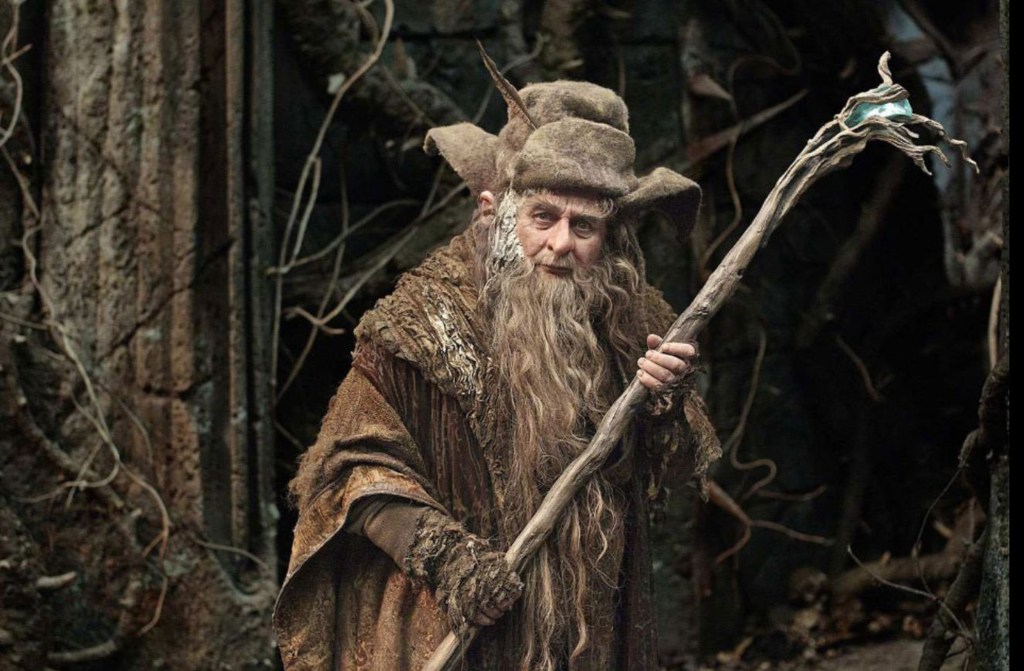
Something that cements Jackson’s attempt at narrative restructuring with, I argue, some great degree of success comes courtesy of the elusive and reclusive wizard Radagast. Whilst having scant mention anywhere in Tolkien’s books, his inclusion in these films was a brilliant, heartful choice which I think shows true warmth for the text on the part of the filmmakers. Not only does Jackson use Radagast to root The Hobbit films more securely into Tolkien’s context of Middle Earth, but he uses the wizard to bridge The Hobbit to some of the earliest events in the Elder days of the High Elves in The Silmarillion. In the first Hobbit film, when describing the corruption of Greenwood, Radagast describes the giant spiders in the forest as ‘some kind of spawn of Ungoliant’. In doing so, the filmmakers reference one of the most destructive and shocking moments in the early history of the Elves, where the first Dark Lord Morgoth, Sauron’s original master, uses a great, ravenous, corrupted spider called Ungoliant to destroy the sacred trees of light in Valinor, where she ‘belched forth black vapours as she drank, and swelled to a shape so vast and hideous that Melkor [precursor to the nomenclature Morgoth] was afraid’.[13]  Whilst the film only makes a small reference to this early and haunting moment of the mythology, so grotesque that even a character as epically vengeful and envious in the history of literature as Morgoth is rendered frightened, this connection built by Jackson through Radagast between the current condition of the Greenwood and the originators of decay and destruction at the very beginning of Tolkien’s world, shows how much thought has gone into what these Hobbit films could serve. They are not mere adaptations of one novel, but offer an explicit narrative bridge across the legendarium. These films are then, perhaps, more faithful adaptations of the legendarium than audiences claiming The Hobbit to be a children’s book are even aware of. We can see that the two wizards help to create this greater sense of meaning across the texts: Gandalf is used to enable The Hobbit to look forward to the later The Lord of the Rings, whilst Radagast is used to root The Hobbit in the legendarium, looking back to the past as he does to The Silmarillion, where previously The Hobbit was almost adrift between the bigger epic narratives.

All this to say: perhaps making The Hobbit into a film was never going to be as simple as the reductive mindset of ‘it’s a children’s book’ would allow. I may have been dismissive of these films when they first came out, arguing that so short a book could hardly require a three-film adaptation; but I am convinced as a result of this recent re-watch that, in making these films, Jackson undertook a bigger project, enfolding The Hobbit into the rest of the legendarium, enlarging its prospects rather than keeping it a stand-alone novel, whilst simultaneously paying homage to the warmth and good humour that has made it such a beloved narrative since 1937. With all of the richness embedded in the text, even and especially unconsciously done, The Hobbit appears, like its namesake protagonist, to have more to it than what meets the eye. There are faults with the films, it cannot be denied; but I do not think that this cinematic trilogy should be so easily discarded either. It makes sense that the novel, surprisingly dense as it is with the range and length of adventures contained within it and, as we have seen, extending beyond it, could not fit an average feature-length running time. My lasting thought upon writing this is that perhaps it would have been more suited to a television series format so that the barrage of episodic action could have been more evenly placed alongside the intricate narrative weaving that, it has become evident, is also required.


[1] The Hobbit, J.R.R Tolkien (London: HarperCollins Publishers Ltd, 2011), p.vii.

[2] https://www.theguardian.com/technology/gamesblog/2010/aug/10/games-science-of-immersion

[3] Ibid, p.vii.

[4] Ibid, p.xiii.

[5] Ibid, p.6.

[6] The Silmarillion, J.R.R Tolkien (London: HarperCollins Publishers Ltd., 2013), p.360.

[7] Ibid, pp.114-119.

[8] Ibid, pp. 119-120.

[9] Ibid, p.26; p.277.

[10] Ibid, p.360-1.

[11] Ibid, p.361.

[12] Ibid, p.282.
[13] Ibid, p.80.
What is the future of fame?

My 2021 began hideously hungover. I wept at a BBC Four documentary about the cultural history of the poem ‘Auld Lang Syne’, wolfed down serving after serving of tomato pasta (the only thing I can stomach in such a condition) and winced at empty bottles of Corona lying around all over the place, the playful irony of twelve hours previous now seeming exceedingly gauche. In between the dollops of pesto and wailing, I stumbled upon a four-part documentary series on BBC iPlayer called ‘Celebrity: A 21st Century Story’. I watched the series compulsively and found that it immediately forced me to re-assess and reflect upon my own relationship with celebrity culture, particularly as a member of the ‘tween’ market targeted during those unchartered rampant days of celebrity consumerism in the Noughties.

What began as a New Year’s essay in response to that single series has turned into a year-long retrospective project: in the past twelve months I have found myself constantly musing upon and internally pickling the issues of fame, celebrity and the power structures and dynamics that shaped the beginning of this millennium, as well as my relationship with them. My grappling with personal feelings and thoughts about this aspect of popular culture has been both mirrored in and fuelled by what became a wider societal re-appraisal of the Noughties that only gathered momentum throughout the year. From the New York Times’ ‘Framing Britney Spears’ in February and her unprecedented address of the court in June regarding her experience living under a conservatorship; to Mischa Barton’s compelling interview with the Guardian also in June; to the article in British Vogue’s July 2021 issue about the resurgence in ‘vintage’ Noughties trends like Blink 182 T-shirts, Fendi ‘bag-ettes’ and low-rise jeans and more; to Beyoncé and Adele speaking to their experiences with fame in Harper’s Bazaar and Vogue respectively; and the climactic ending of Spears’ conservatorship in November, the stories of the women harassed and demonised during the Noughties are, rightly, coming centre stage. What was confined and repressed is finally being given air to breathe.  

Absorbing and horrifying in equal measure, ‘Celebrity: A 21st Century Story’ charted the Western obsession with fame and celebrity culture from Channel 4’s ‘Big Brother’ to Instagram, through the cultural intersections of gender, class and politics. The documentary is nigh-on academic in its scope, covering reality television, print media, the treatment of young women like Paris Hilton, Lindsay Lohan, Amy Winehouse, the ‘WAGs’, Donald Trump, Boris Johnson, the Kardashians, Perez Hilton, TOWIE, the casts of Love Island and, of course, Britney Spears (in, I would argue, an even more gut-wrenching way than the New York Times’ ‘Framing Britney’ documentary, simply because her story is told within a four-hour wider context of misogyny and exploitation), and more.  

Kerry Katona interviewed for Celebrity: A 21st Century Story

Amidst the laying bare of the gross misogyny that many, particularly young women of my generation, consumed on a weekly basis in magazines like ‘Heat’, the documentary gave a platform for the likes of Kerry Katona, Charlotte Church and many others to speak about the hell that their lives were, so preyed upon they became by paparazzi and photographers. Who, however, to blame for this nauseating mess is ambiguous. Figures in the media industry pointed to an insatiable public appetite for such coverage, whilst the case is also made that the public’s desire for more was (and is) constructed and manufactured by those who claim they are just giving people ‘what they want’. Do we level the blame for aggressive, intrusive celebrity-baiting at the armies of paparazzi trying to earn a living, or the people who employed them? The magazine editors, the media conglomerates who published the images? The celebrities for making a choice to live a life that in the glare of public judgment? It is very unclear and maybe there doesn’t need to be a definitive answer: the point is, and well-articulated by YouTuber Broey Deschanel in her video essay ‘The Systemic Abuse of Celebrities’, is that a life lived in the spotlight as a ‘celebrity’, whether as an A-List actress or as a YouTube vlogger and influencer, becomes, perhaps inevitably, a form of abuse.

The opening notes of the 21st century are undoubtedly sour and sobering. In light of how amazing human beings can be, I couldn’t help asking: what the hell were we thinking? The opening of a new century, a new millennium, has been completely marred and defined by cruelty, excess, mass produced objectification and vilification as sport. The Faustian exchange that celebrity life encapsulates undoubtedly causes a huge amount of suffering for the human beings at the centre, which we may have always known deep-down but has all too frequently, perhaps, been forgotten in the mass-produced heady dopamine rush of alighting upon the latest mishap or scandal. These human beings, in their nuance and multiplicities, have been dehumanised and objectified, rendered symbols and screens for the shadow of the collective unconscious- everything we cannot accept and embrace within ourselves- and held to impossible standards of perfection in a game they can never win. For me personally, one of the most sobering moments was listening to footage of Keira Knightley on the BBC Radio 4 podcast series ‘Pieces of Britney’, another longform exploration of the treatment of young female celebrities during the Noughties. The clip, taken from an interview with Jonathon Ross in 2007, shows Knightley at the tender age of 22 beginning to shake as she describes relentless paparazzi intrusion into her life. It’s hard to believe that such a candid admission on national television was never taken seriously enough beyond Ross’ platitudes, and that no cultural conversation emerged around the terror facing young women on a regular basis. I cannot believe we were all, myself included, blind to it.

And, of course, it goes even deeper than this. What I think is important to analyse, along with the gender and class undertones of the abuse suffered by Spears, Lohan, Barton, Winehouse and Knightley etc., are the very obvious racial dynamics at play: there is a lot to learn about the inner psychology of white supremacy from looking at the ways in which these women were treated. Primarily, as brilliantly critiqued by Simran Hans in ‘Pieces of Britney’, the ‘white trash’ criticism levelled at Spears in particular was a deeply racially coded term, employed to shame her for her behaviour’s perceived proximity to blackness. Young white women were effectively punished by media outlets, acting as bastions for white supremacy, for acting in a way that was indicative of a betrayal of their race. As a result, this systemic punishing of white young women, bears all the classic hallmarks of breathtaking misogyny, with their bodies and whiteness being fetishized and objectified to the extent that their humanity is purposefully forgotten. It also demonstrates the sicknesses of self-loathing and self-hatred embedded within white supremacy. Ibram X Kendi describes white supremacy as a rain that we are all drenched in: white people believe they are safe from it because they are holding an umbrella, but that umbrella too is a structure of white supremacy. There is no escaping it. Similarly, writer and activist Rachel Cargle argues that white supremacy and racism are sicknesses that poison each generation: not just black people who are brutalised with it, but for white people who enact and espouse this violence, consciously and unconsciously. Perhaps the predatory behaviour of a culture that created a trap for preying on this group of white women is an example of this self-inflicted sickness. The seeming pleasure taken at torturing and brutalising these women, through paparazzi-hounding and endless abuse in print and internet media, is an offshoot of white supremacy, symptomatic of its paranoia in maintaining and perpetuating itself, punishing those who did not conform to its standards.

Of course, this coded abuse of white women walks in tandem with both the coded and overt abuse of BIPOC stars by the media. Whilst there was a predatory paparazzi focus on Spears, Hilton and Lohan in the Noughties, black artists and celebrities, then and now, have seen their lives, bodies and work unduly criticised, eradicated, appropriated and underappreciated by a white supremacist media culture. BIPOC stars face systemic racism that prevents them from being in the spotlight in the first place and then, once there, targeted with gaslighting, abuse and criticism from mainstream media as well as armies of social media trolls. As such, what I have observed is how boundaried some black muscians have been and become over this period of time, both preventatively and as a result of white supremacy’s toxic double standards and hypocrisies. Whilst none of these people have been strangers to racially coded criticism, it is clear that the likes of Beyoncé, Rihanna, Frank Ocean, Childish Gambino/Donald Glover, Tyler The Creator and others have combined vigilance and artistic ambiguity to stave off unhealthy media attention, working hard to keep themselves at arm’s length from the media woodchipper. Perhaps this is a self-protective proactive response in light of the ways in which black women like Nina Simone and Billie Holliday were torturously celebrated and reviled with equal measure. Be it through surprise album drops, hints and easter eggs on social media posts or downright disorientation- Frank Ocean’s green baby at the Met Gala in 2021 was genius- these black stars have refused to play the media game and, in so doing, have carved out truly experimental and industry redefining modes of work, art and being. Of course, the secrecy and vigilance is an additional, expensive layer of work and comes at many costs. Beyoncé talked about this explicitly in her rare interview with Harper’s Bazaar:

‘I’ve been intentional about setting boundaries between my stage persona and my personal life […] I’ve fought to protect my sanity and my privacy because the quality of my life depended on it’.

In a world of media gaslighting and wars over whose narrative succeeds, Beyoncé has painstakingly prioritised her cognitive and emotional clarity, setting down multiple lines that cannot be crossed in order to keep her and her family safe. She is emphatic about the importance for her boundaries, stating that:

‘those who don’t know me and have never met me might interpret that as being closed off. Trust – the reason those folks don’t see certain things about me is because my Virgo ass does not want them to see it… it’s not because it doesn’t exist!’

Beyoncé’s attention to detail in her art is legendary; the fact that this is also required to an astronomical extent to maintain her privacy and safety is an additional layer of work and effort that, whilst seemingly non-negotiable, requires a huge amount of energy and resources. But that emphatic, imperative ‘trust-’ is unequivocal: white supremacy may condemn her actions as ‘closed off’ but, ultimately, she is protecting herself. It’s a power move.

Frank Ocean building a staircase on a live stream

Whilst these high-profile black artists have been able to establish and assert boundaries through a consciously constructed ambiguity artistically and through heavily controlled and managed PR, white supremacy, of course, still manages to openly violate famous black people in the media. Whilst it may have become more difficult to smear the likes of Beyonce et al., who have become increasingly adept at wielding their own narrativizing power, there are groups of famous black people who are still incredibly vulnerable to targeted attacks. In recent years, racists and trolls have openly abused Leslie Jones and Lizzo: both powerful women in the own rights but, upon entering mainstream awareness, perhaps did not yet have enough cultural ubiquity or capital to secure their boundaries and safety. Concurrently, black successful sportswomen are hideously exposed to the forces of white supremacy to police and abuse them: Serena Williams, Simone Biles and Naomi Osaka have all faced systemic and spectatorial abuse online. Unlike the musicians, who are, perhaps, more able to obscure themselves behind veils of artistic expression, sport is, by its very nature, unfiltered and exposing. White supremacy is almost granted more access to these women, and, therefore, they are perhaps more vulnerable to its violence. The derision that white supremacy levels at these women, with a whole host of stereotypes, criticism and condescension thrown in, is particularly potent and widespread. Visibility seems to walk hand-in-hand with media abuse, so it would be impossible to critique the targeting of BIPOC women without mentioning Meghan Markle in the same breath. As a royal, one of her jobs was to be professionally watched and looked it, open to constant judgment, evaluation and criticism, much like the sportswomen. This made her vulnerable to intrusive levels of scrutiny and abuse, perhaps most pervasively when she was pregnant and undergoing a hugely significant physical transformation. This is not a coincidence.

*

Perhaps it is unsurprising then that, now, so many famous people are not only asserting their boundaries but also reclaiming their lives and narratives. Noticeably, over the past couple of years, there has been something of an uptick in the number of celebrity-produced documentaries that aim to offer a form of insight into the personal, private lives of celebrities. It may be easy to be dismissive when embarking upon a viewing of these documentaries about how constructed and constrained these forms of storytelling are, but there is no denying the chillingly dead looks in the eyes of young people, in particular, who are exhausted and have been nigh-on tortured by the circumstances their fame has brought them. To date, I have watched self-produced documentaries of and by Taylor Swift (Miss Americana, Netflix, 2020); Paris Hilton (This Is Paris, YouTube,2020); Billie Eilish (The World’s A Little Blurry, Apple TV,2021); Demi Lovato (Dancing With The Devil, YouTube,2021); and Justin Bieber (Seasons, YouTube, 2020). With Mischa Barton also stating this year in The Guardian that she wanted to produce a documentary about her life and experiences during the Noughties, perhaps we cannot blame these people from wanting to reclaim some of the agency, self-worth and power that seems to have be routinely and, often, catastrophically denied them.  A lengthy comparison could be made of the aforementioned docs: some opt for a fly-on-the-wall format; some give lengthy insight into the artistic process of song writing and music production; some form a personal and musical retrospective. Even if the claims to candidness, authenticity and ‘truth’ telling are awkwardly performative, and require a healthy pinch of salt for the cynical, there is no doubting the catharsis on show when these figures are in control of their own narrative and it is oddly relieving and emotional to watch. Of course, however, they are not all unproblematic.

Scooter Braun and Demi Lovato

Justin Bieber and Demi Lovato, in particular, have centred Scooter Braun in their recovery narratives, as much a friend and a mentor as he is their manager. Yet, this nurturing sage-like presence on their documentaries simultaneously functions as a redemption platform for Braun who has, seemingly and allegedly, gone out of his way to undermine the authority and self-determination of Taylor Swift. Famously, Braun sold the rights and master recordings of her first six albums to an investment fund for $300 million, without her consent, playing the game of music’s industrial capitalism to reap huge financial rewards for himself and leaving an artist with little sense of control or ownership over her own songs. His presence on Lovato’s documentary in particular, whilst important to Lovato’s recovery from addiction, feels uncomfortable when he is an active part in a system that has undermined the personal and professional wellbeing of another talented young woman.

It would be grossly naïve to think that as a result of this cultural moment of reflection that there will be an overnight rejection of celebrity culture. Fame may still be an enticing prospect for many, but I think it is increasingly clear that it is a double-edged sword. As with many areas of our lives, for example with regards to our relationship with the climate crisis, there is, I would argue, an increasing onus on personal responsibility and accountability to ensure the safety of the collective. We need to be conscious and honest with ourselves when we get dragged into having startlingly impassioned opinions and conversations about people we do not know anything about. Why do I care about looking at Jennifer Lawrence with a baby bump? What am I being distracted from? Where does our desire to stew in negativity and delight in other people’s pain come from? How is the language we use causing harm? Even if we never take the steps to actually target celebrities with viciousness, the dehumanising and objectifying language we use to talk about them infects the way we see and speak to ourselves, as well as everyone around us. As a public, we have to acknowledge how infantile it is to obsess over other people and their lives when we could so better serve ourselves by training that spotlight back onto our own shit.

What I think is different, however, now compared to twenty years ago is that a culture of activism has flourished through social media. Whilst the abuse of celebrities will shapeshift and morph into a new means of expression, there are legions of people online ready to resist.  We are all better off in a world with Jameela Jamil in it, for example, whose modelling of honesty and criticality on social media is exemplary. She cuts through bullshit like no one else, and is able to use her influence to affect change and empower others to do so, whether its advocating for Britney Spears and vulnerable demographics like trans and disabled people, or taking the fight for eating disorder prevention right to politicians and lawmakers in the US. The key is to remind people of the power they do have: it may not be overt embodied power that they feel on a daily basis, thanks to capitalism, but we all have the power to observe and challenge our own patterns and behaviours in this. Ironically, for many people this may mean abandoning social media all together: whilst there is much to gain from social media’s potential for connecting people and causes, it is also an aggressive, manipulative place that actively causes harm.

 And for the already famous? I think we are going to see increasingly controlled and boundaried behaviour. Stars have always reflected on whether the bargains made for fame have been worth it and I think we will see more and more reflections on this in the years to come, including retreats from visibility: symbolic of this, for example, is that Pamela Anderson left social media behind in January 2021, before this year’s reappraisal of celebrity culture even began. Whilst I don’t think we’ll see a mass exodus in her wake, because personal photos posted to social media will always be more valuable than paparazzi shots and the power this enables celebrities to retain is significant, celebrities will undoubtedly assert new means and methods of control to undermine and undercut the role of traditional media in abusing them. They have every right to do so and I believe we will all benefit as a result.

We keep changing all the time

The best ones lost their minds

So I’m not gonna change

I’ll stay the same

No rose left on the vines

Don’t even want what’s mine

Much less the fame

It’s dark, but just a game

It’s dark, but just a game

‘Dark But Just A Game’, Chemtrails Over The Country Club, Lana Del Rey

‘Élite’: The ‘Gossip Girl’ alternative

This article is dedicated to Charlotte Bender, Francesca Bender and Hanan Isse: my fellow obsessees

Video essayist Broey Deschanel recently posed the question: ‘Have We Grown Out of Gossip Girl?’ By looking at the class, gender and racial politics of the show, and the wider politics and issues with re-makes, her answer is an unequivocal and undeniable: yes. Whilst aesthetic nostalgia for Gossip Girl is high (because who wouldn’t want to eat lunch on the steps of the Met or venture an embellished headband?) it is a show that does not need resurrecting or an attempt at correction. Her analysis that Gossip Girl sided with elites, demonising working class characters, catching principled characters into a tangled web of deceit and selfishness whilst glorifying toxic chauvinism (Chuck sells Blair for a hotel), demonstrates that Gossip Girl is a show too riddled with the white supremacist hyper-wealth orthodoxy of its time to be worth redeeming.

The show is almost a historical artefact of capitalism’s anaemic attempt at self-criticism, eventually reinforcing itself and seducing everyone in its wake, characters and viewers alike, when arguments for capitalism were becoming increasingly tenuous in the context of recession, economic suffering and burgeoning inequality. This would go on to lay the groundwork for a subsequent decade, and counting, of austerity in the West. No amounts of references to F Scott Fitzgerald’s The Beautiful and Damned, Serena Van Der Woodsen’s favourite novel, could distract us from class-bashing snobbery, rampant aspirationalism and full-bodied immersion and defence of white privilege and supremacy.

Ironically, we are living in a time of studios hyperactively re-making, sequelling and prequelling everything: capitalism is so desperate to reinforce itself to itself and ensure a buck, that it cannot stomach the risk of making something new. I wrote about this in 2014 and there are signs that things are beginning to change. With the emergences of more experimental forms of television storytelling such as Master of None, Fleabag, I May Destroy You, Pose, The Politician and The Good Place against the backdrop of a larger appetite for non-white heteronormative stories centring around race, sexualities, genders and philosophies that have been previously untold in a popular way, we are seeing progressive shifts that render the prospect of shows like Gossip Girl more and more redundant. It has been particularly promising this year to see the number of films and TV shows exploring stories of race and class being feted and nominated for awards, Ma Rainey’s Black Bottom and Malcolm and Marie forming two of my favourite films so far, even if the jangling of white supremacy still echoes and reverberates throughout the creative industries (no Golden Globe nomination for I May Destroy You?)     

So, where can we go for an aesthetically-fuelled glossy teen melodrama? Is there place for such a thing in the twenty first century?

My answer: yes. Do I want to see well-dressed people getting into romantic dilemmas, going on coming-of-age adventures, disappointing people around them, ripping up expectations, finding their voices, breaking up and making up and all set to a fabulous soundtrack? Yes. Whole-heartedly. But it goes deeper than that. This need for stories about teenagehood reminds me of Frank Wedekind’s Spring Awakening, a late nineteenth century German play that sought to express and plug the gap in stories for and about teenagers to navigate the upheaval of adolescence. The play, scandalous at its first performance, covers sexual repression and expression, abuse, suicidal depression, homosexuality and the relentless pressure of morality and achievement in arbitrary school exams: issues that still feel relevant and familiar to teenagers now, with a quintessentially new iteration of perfectionism that entails a life lived through the filters of social media. This rite of passage has been maligned throughout much of Western history, with teenagers demonised and ridiculed for the seismic shifts they experience in their bodies and identities, without any kind of holistic guideposts to nurture and respect them through it. Our experiences as teenagers lay the groundwork for our future relationships with ourselves (and our therapists) and, as explored so well in the documentary Beyond Clueless, secondary school is a charged space to explore a heady mixture of emergent and predominant ideas, with the teenage body a soil, in its perpetual state of flux, expansion and contraction, to do this. I don’t spend my time watching back-to-back teen shows or teen films because the chaos of melodrama and angst no longer feels like an outward projection of my own internal tumult. But I continue to hold the genre in high regard, in much the same vein as Mark Kermode in his advocacy for the Twilight franchise. If we are to live in a society where teenagers are not honoured, then why should we damn genres that appeal and speak to this dramatic, archetypal experience that they are going through? Whether we have anonymous whistleblowers and gossip mongers, vampires or quixotic righteous dudes, teen films and shows are crucibles and allegories for bigger shifts, both personally and societally that are, whether they mean to be or not, both vitally hyperbolic and fascinating. In the case of Gossip Girl, it turns out, we should have been paying more attention.     

As such, we don’t need a new Gossip Girl or, god-forbid, the re-make of Clueless that we keep getting threatened with (the original should remain an untouched gem and deserves respect and adulation not an irrelevant, fatigued re-make). We already have a show that is compelling, compulsive, aesthetically pleasing and playing whack-a-mole with big teenage issues in a critical and entertaining way. Crucially, it also grapples with many of the issues that a new Gossip Girl may want to rectify and reconcile with to itself, which Broey Deschanel predicts will be watered down and disastrous. Issues like race, religion, sexualities and deconstructions of class power structures. My friends, I give you, Netflix original series, Élite.

Élite’s premise seems standard fare: told in flashback, three working class students are given scholarships to shiny, international, private school, Las Encinas, located in an ambiguous area of Spain, but most likely near Madrid. The scholarships are a form of compensation from the rich owner of a building company, who built a structurally inadequate state school that collapsed. The son of the owner of the building company also goes to Las Encinas with his extremely wealthy and aristocratic friends: immediately, as a result, there is discord, resentment and rivalry between the two groups. The backdrop of all of this is a murder investigation, as one of the students is found dead next to the swimming pool at Las Encinas. A heady mixture of Big Little Lies, Skins, Cruel Intentions and, yes, Gossip Girl, it is immediately aesthetically pleasing and riveting. At the very least, along with the rollercoaster ride of dramas and chaos, viewers have the additional pleasure of having learned a variety of Spanish swearwords. And the background reggaetón is always on point.

Without spoiling anything, the show deals with a plethora of teen issues: the standard first sexual experiences, family fall outs, teen pregnancy, ambition and inter-class/clique warfare. Additionally, there are higher stakes of HIV diagnoses, cancer diagnoses, threesomes, throuples, incest, blackmail, revenge porn and drugs thrown into the mix. In short: a whole lot of loco. Across the seasons, however, Élite goes on to explore the intersections of many of these issues in greater depth, most powerfully, the immigrant-working class experience and, in particular, the cultural tensions of growing up Muslim in the West. This includes relationships between faiths, homosexual relationships (the cutest gay couple ever has to be Ander and Omar), the politics of feminism and the hijab, and both subtle and overt forms of anti-Muslim hatred. We have rarely seen a character like Nadia presented on television and it is joyful to watch her unfolding across the seasons.

Even the intersections and illusions of wealth are explored: the differences between no money, new money and old money, with most of the judgment and consternation reserved for the aristocrats. Unlike Gossip Girl, the most despicable characters in Élite are the privileged who lie, cheat and betray others to maintain their social position, closing ranks and perverting justice through their family names and wealth. Self-preservation is constantly at work in Élite: this manifests as working class characters attempting to reject and resist the trappings of wealth and privilege to preserve their sense of dignity and self-respect; whereas, the wealthy pull up their drawbridges and manipulate the power structures to get their own way. They become unredeemable in the process. Yet there are some who do change, and there are some divine redemption arcs at work, the best I’ve seen since Steve Harrington in Stranger Things.

As such, where Broey Deschanel’s criticism of Gossip Girl focuses on the fact that everything, including the viewers, is subsumed by the inordinate toxic influence of power and privilege, in Élite, a form of equilibrium and, dare I say, comradeship between the classes eventually emerges. Of course, we are still based in a powerful, private school only accessible to the privileged few; but it feels like the upper classes are the ones who have had to adapt and give up something, in the form of their power and privilege, in order to survive and not the other way round. The only question that remains, as Season 4 approaches, is whether this will be maintained. My main criticism is that even with the introductions of Yeray and Malik in Season 3, there is plenty more space for black characters in the show, and I think the show has great potential in posing more questions on race. Needless to say: we don’t need a re-make of Gossip Girl. Élite is the show Gossip Girl should have been ten years ago, and I for one think we all need more of it.

Full disclaimer: I watched all three seasons of Élite during Lockdown 1.0 and it definitely became an emotional crutch when many of us, myself included, seemed to regress into a state of teenagehood, confined as we were to our rooms for months on end (explored so well in this article). If there is anything I need to add or qualify, let me know.

Paris Hilton and us

My tolerance and, indeed, indulgence of, what I deem to be, divine trash has its roots in the halcyon days of 2009. Drunk on a popular culture concoction of Gossip Girl and Look Magazine, and living with the unshakable desire to replicate Sienna Miller’s boho aesthetic (it never went well), I was taken in by perhaps the worst possible trash television. In January of that year, I promptly started watching and became hooked onto a show called Paris Hilton’s British Best Friend.

The premise was simple and utterly laughable: contestants lived in a fancy house and all competed to become socialite and heiress Paris Hilton’s British Best Friend. The show was a hot mess. The contestants all wore necklaces bearing Paris’s name, one contestant’s eligibility came into question because he was too young to get wasted in Las Vegas, and challenges included buying Paris presents, designing her a dress and enduring a twenty four hour clubbing crawl through Chelsea.

Paris Hilton was everywhere at the time. As one of the original reality TV stars, thanks to her show ‘The Simple Life’ which first aired in 2003, she was constantly photographed and gossiped about, and effectively paved the way for a new generation of people who became famous for being famous. I had five channels until about 2008, and so was unable to watch any American shows that were prevalent at the time. I read about all of Paris’s antics in trashy magazines and, even though I didn’t particularly care about her or her life, I felt like for some reason it was imperative that I had an opinion about it. I remember having in-depth knowledge, as did many people at the time, of extraordinarily specific details about her life: from her catchphrases, the names of her dogs and what her house looked like, to how much she weighed. I also remember absorbing hideously toxic stories of her relationships, break-ups, the sex tape her ex-boyfriend released without her consent and her friendship issues. Looking back, it is mad to think how much of her life was served up on a platter for public consumption, partially as part of her own doing, but also because the tabloid press were obsessed with her. Some of the specifics may have been fabricated or completely blown out of proportion; regardless, I had huge opinions about who she was and what she was like, even though I had never seen her in a television show until 2009.

In spite of all the candy-soaked ridiculousness and extravagance of the silly TV show Paris Hilton’s British Best Friend, something started to stand out to me about Paris herself. When on her own or with a small number of other people, her voice completely changed. Instead of the high-pitched baby voice for which she was famous, used to deliver her litany of catchphrases and vacant platitudes, her voice would become low, becoming a quintessentially deep Californian drawl. I recognised, even back then when I was still trying to navigate my own personae of public and private selves, that Paris Hilton had created an enormous Barbie façade. She knew the effect she had on people, she knew how to play a character and that underneath it all, possibly, was something else.

Since 2009 until today, I hadn’t given much thought or attention to Paris Hilton. Whilst still working successfully as a businesswoman and building her brand, her light was somewhat dimmed during the ascension of the Kardashians who went on to embrace the reality television medium and almost completely redefined it in their own image. Instagram came into my life in 2013 and, like many others, I began to walk in the footsteps of Paris et al. as I built and shared my own public narrative of my life. With the release of Sofia Coppola’s film The Bling Ring in 2013, I reflected on the role of figures like Paris Hilton, the obsession they inspire and, ultimately, suffer from. The film is such a captivating sojourn through the pitfalls and pandemonium of celebrity culture, at once capturing the perverse sublimity of materialism whilst also observing, with withering distance, the ugliness of ruthless greed. Hilton famously appeared in the film and allowed Coppola to film in her house, which had been burgled by the real ‘Bling Ring’ gang between 2008 and 2009.    

A couple of weeks ago, I watched the YouTube documentary ‘This Is Paris’. Fatigued by my job, by Covid-19, by 2020 in general, I geared myself up to watch some divine trash. It turned out to be anything but. Everything I had recognised about Hilton in 2009 came rushing back: the voice, the façade, the platitudes. What was interesting about the documentary, however, was that it became the means through which Paris reckoned with this construction of herself. She has evidently been aware of this character her entire life, but this seemed to be the first time she was confronting this part, this projection of herself, that we have all become so familiar with.

Significantly, the modulations of her tone of voice became increasingly stark. We see her squealing and cooing her way through the first half an hour of the documentary, posing for cameras, taking selfies and slinking around her house. This changes during a business trip to South Korea, where she divulges her long-term suffering with acute insomnia and nightmares. Immediately, this brings around her deeper, richer vocality that lasts for most of the rest of the film. Her mother, Kathy Hilton, pinpoints the adoption of ‘the voice’ forty five minutes in, as she describes her daughter as a ‘Disney child’, constantly decked out in rhinestones, faux-fur, glitter and pink and adopting a high-pitched voice to match. Kathy’s implication here is that Paris is dawdling through her adult life, very rich and successful of course, but clinging to childish totems and self-presentation whilst nearing forty years old. This isn’t necessarily a criticism, but an observable and critical fact.

What unfolds next is a deeply existential and moving piece of self-inquiry. This is a woman who appears to be trapped within a prolonged state of adolescence, who is afraid of taking steps into womanhood. Paris admits herself at around an hour in that ‘when you get married, you have to grow up’, before reflecting on her relationships and how they have never culminated in a marriage or children. Of course, the key to a happy, healthy life is not necessarily getting married or having children: this seems like an antique and regressive expectation for women, and it is perfectly fine if she doesn’t want those things. Indeed, an interesting part of the film comes when she discusses family and relationships with sister Nicky Hilton-Rothschild, who dissects whether or not Paris is living under a societal expectation or under her own volition when she ventures that she would like a family. This had echoes of Tinsley Mortimer, another famous blonde, curiously childish socialite, who had the exact same inner tussle whilst starring in the Real Housewives of New York City. Both Hilton and Mortimer have had their eggs frozen, and both are unsure as to whether their dreams of getting married and having children are ones that they inherently feel or are compulsions of patriarchy. Mortimer summed it up well when she drunkenly quipped, ‘maybe I’m just happy with chihuahuas?’ Confusion abounds for them both, especially as both have built brands and images that revolve around their own archetypal adolescence.

This adolescence is expressed, and in none more clearly than in Paris Hilton, through the voice. Jungian analytic psychologist Marion Woodman writes that the voice is deeply connected to the depths of womanhood, conveying a radical acceptance of the Feminine, the yin, that exists in all humans and not related to societal constructions of gender. The voice of the adolescent is girlish and high-pitched, whereas the woman’s voice is deep, slow and resonant. The voice of archetypal womanhood reflects an earthly connection to the body, that physical bridge between the material and the divine, honouring and loving its rhythms, needs and functions. The voice is the harbinger of someone who is present, receptive, in love with life, who embraces process over product and glories in connection, be it with friends, family, the glory of the dawn, poetry or  just really, really good food. The body, in particular the female body, has been repeatedly controlled, judged, denied and shamed throughout history, and is the main battleground of patriarchy; has been viewed and gazed upon through the eyes of denigration, sin and doom, when it should be hailed and revered in awe.

In the adoption of a high-pitched voice, therefore, Paris shows that she clings to the familiar simplicity and rootlessness of the adolescent. She travels constantly, never allows herself to take a break and longs for the day when she has finally made a billion dollars. And yet, something tells her she cannot go on like this. She is perennially exhausted, cannot sleep and feels increasingly dissociated and detached from her life and her sense of self. She admits that, yes, the high-pitched happy vision of ‘perfection’ is a character, that she knows few people who aren’t disingenuous, has huge trust issues and repeatedly finds herself in relationships were her boyfriends attempt to control her. The adolescent has run its course: it’s clear in this documentary that the part of her that wants to transition into womanhood and an authentic, connected life, leaving behind the dregs and frivolities of the adolescent, is trying to come to life.

However, transformation is rarely free from pain. Crucially, Woodman suggests, the body holds and records trauma, and needs to be consciously met with compassion and healing. We see this unfold in the last part of the documentary, where Paris reveals that as a teenager, she attended Provo Canyon School, a pseudo-correctional facility for wayward children masking as a school in Utah. She was forcibly taken there, mentally and physically abused, kept in solitary confinement and repeatedly threatened and shamed. Her insomnia and nightmares are rooted in her experience at the school, and her whole career is built upon her desire to escape from and not process her trauma. As a result, her trauma has lived on in her symptoms which now, through this documentary, have been brought out into the daylight. The teenager who suffered so much erected walls, hid behind a façade, pursued material wealth and notoriety and became the Paris Hilton character that we know today. It’s almost as though the hurt and pained teenager is still trapped in the body, revealing itself through a makeshift high-pitched voice, unable to transition to adulthood. Until, perhaps, now.

After speaking with a group of fellow survivors from the school, Paris is captured in her enormous walk-in wardrobe, surrounded by lines and legions of handbags, shoes and jewellery. She looks uncomfortable and openly questions why she has so much stuff that she never wears and never uses. It is a classic moment of a crystal castle shattering around the heroine, the one she built to protect herself from her pain and her trauma. It is eerie how these markers of success, affluence and perfection almost visibly turn into empty voids around her. It’s a tale as old as time: capitalism sells us a story that accumulating wealth and lots of expensive things is the key to our salvation and the happiness we yearn for in our lives, when in fact our endless ‘stuff’ serves to barricade us within ourselves, preventing us from any semblance of connection.

Paris Hilton was one of a number of architects that used capitalism, materialism and white privilege as a bedrock to elevate themselves financially and socially and literally influence the way in which Western society conceives of itself and presents itself. Even if we don’t care about Paris Hilton, we have to acknowledge that the way in which entertainment and social media work has everything to do with the impact she has had. It’s like when people say they don’t care about fashion and I almost instinctively now rattle off Miranda Priestly’s monologue about the blue belts in The Devil Wears Prada, a scene that remarkably and deftly captures the entwining of capitalism, fashion and supposed ‘free choice’. It is because of this that I think Hilton’s documentary is important: yes, she represents and models a dysfunctional relationship with work, materialism and privacy; however, she is also a blueprint for how as a society we all live with traumas, and that our traumas manifest in how we present ourselves, what we buy and how we live our lives. No one is free from their own personal reckoning, that day where we wake up, or are forced to wake up, and realise that we cannot carry on the way we have been living. Of course, the extent to which Paris Hilton barricaded herself from her own trauma is truly epic, but we all have our symptoms, we all have our addictions that make us crave more and more, preventing us from meeting ourselves exactly where we are meant to be (more often than not with our pain). If a more embodied, grounded and authentic version of Paris Hilton is left in its wake, which I am sure she will be, then this documentary and its subject, are wonderful teachers.

Lana Del Rey and whiteness

Beginning on the 21st May 2020, my phone blew up for a few consecutive days with incredulity, anger and disbelief at Lana Del Rey’s numerous statements directed at ‘the culture’. I still don’t really know what she is trying to define by that term. After the first statement, in which she namechecks numerous black female artists who have allegedly been allowed to sing about ‘being sexy, wearing no clothes, fucking, cheating etc.’ when she has not, I declared to one group chat that I would get our thoughts and analyses, which were extensive, down here. I held off writing straight away and I’m glad I did: what followed were even more spurious statements and rebuttals from Del Rey about how people criticising her had begun a ‘race war’, and that people who ‘misunderstood’ her should ‘fuck off’.  We saw her Instagram fill with images of white Hollywood movie stars, including that classic chauvinist James Bond no less, a GIF of her pole dancing in the ‘Gods and Monsters’ music video, and declarations that ‘no one gets to tell your story’. Del Rey claims that she embodies a ‘delicate’ form of femininity that is currently rejected by feminism, bizarrely claiming that it will be the forefront of a ‘new/3rd wave of feminism that is rapidly approaching’. We are, of course, already in the fourth wave and have been since the early 2010s. I aim to discuss Del Rey in relation to feminism at greater length in another essay.

With regards to race, Del Rey has, unfortunately, proven herself painfully unaware of how much privilege her whiteness affords her, and thereby has been unable to show how race and her question of feminism intersect. I can see why Del Rey believes that she is, in the words of  Ibram X. Kendi, ‘anti-racist’: she cast A$AP Rocky as her JFK in the ‘National Anthem’ video and wrote songs with him for ‘Lust For Life’; she has collaborated numerous times with The Weeknd; some of her best friends are black women who have featured prominently in her music videos and on tour from ‘Lust For Life’ through to ‘Norman Fucking Rockwell’; and she is giving all of the profits from her poetry collections as reparations to the indigenous Navajo community.  She has proven, however, that she is not necessarily anti-racist, with each new comment she released digging her heels into her first problematic statement even further until a defence of her is rendered almost impossible.

Lana’s original namecheck of predominantly black and Hispanic women, Doja Cat, Ariana Grande, Camila Cabello, Cardi B, Kehlani, Nicki Minaj and Beyoncé, was used to highlight how these women have been celebrated and rewarded by ‘the culture’ for being sexual, provocative and complex whilst she has been maligned. In doing this, she demonstrated a lack of awareness about the more significant barriers that Women of Colour (WOC) face in getting to a prominent position in the music industry in the first place, as well as equating these women, who are already exposed to latent racist exoticisation stereotypes, purely with sexuality and sexual mores. This is deeply ironic coming from someone who has both Nina Simone and Billie Holiday’s names tattooed onto her clavicle and has regularly referenced Holiday in her music, for example in the music video for ‘Summer Wine’ and on the song ‘The Blackest Day’ from the album ‘Honeymoon’.

Blackest Day Higher QUality

Simone and Holiday both famously used their art to fight racism and empower black youth throughout their careers, for example in the songs ‘Young Gifted and Black’ and ‘Strange Fruit’ and in numerous other contexts. This video of Simone talking about the artist’s duty to reflect the times, particularly with regards to fighting racism, is one that Del Rey has shared herself on her Instagram:

Nina Simone

It is bizarre, then, that Del Rey, who so idolises these black women who spent their careers and lives fighting racism, is unable to acknowledge and concede that bringing WOC into a conversation about how she has been hard done by the music industry is problematic. It does not matter how may times you tell people that you are not racist: if you are making racially coded comments and comparisons, even and especially unconsciously, then refusing to accept the fact that your white ignorance and privilege have been exposed by those very comments, you are being racist. For white people, our racism is often unconscious and unthought of: our work is to bring our assumptions and everything we take for granted as white people into consciousness, to learn, listen and ultimately become allies in the fight against racism, racial inequality and injustice. Not to dig our heels in, take offence and accuse others of starting ‘a race war’.

This need for clarity and consciousness has become even more sickeningly potent in the days after Del Rey’s flurry of racially coded and unapologetic statements. The video went viral on 25th May 2020 of Amy Cooper threatening Christian Cooper (no relation), a black man, that she would call the police and tell them that he was threatening her life when he had asked her to put her dog on a lead in Central Park’s protected nature reserve ‘The Ramble’. Amy Cooper chillingly showed how America’s law enforcement system, well known for its extensive brutality of black people, was geared in her white favour, and that she was more than willing to use it to get her own way at whatever genuinely life-threatening cost to Christian Cooper. Within days, we saw what the outcome could have been: George Floyd, an unarmed black man, suffocated to death by police officers in Minneapolis. In recent weeks, we have already seen how the American justice system values the life of Ahmed Aubrey, who was lynched by a white father and son in Georgia. It seemed serendipitous that we had this public genealogy of white supremacy and racism unfold so compactly this week:  from Lana Del Rey accusing people of starting a ‘race war’ when what she had articulated was racially coded and, yes, racist; to a white woman using her whiteness as a weapon to threaten a black man who left the altercation, thankfully, safe; and yet another terrible and all too familiar example of police officers murdering an unarmed black man. Even though what happened with Del Rey can be interpreted as a celebrity scandal, it does not exist in a vacuum. Every single part of the events of this week are connected, and are expressions of what is normalised and still accepted in a white supremacist society.

This is not, of course, a problem that only exists in the USA. As writer and journalist Reni Eddo-Lodge argues in her amazing book ‘Why I am No Longer Talking to White People About Race’, by focusing on race as something that happens on the other side of the Atlantic, Black British history is ‘starved of oxygen’ and not given the attention it needs. Racism and white supremacy are alive and well in the UK, and we cannot fall into complacency, believing that it is only in the USA that racism exists. I have spent the past few weeks writing an inquiry project for my teacher training qualification (PGCE) about race and curriculum in the UK and there is no doubt in my mind that the National Curriculum devised by Michael Gove, particularly in Key Stage Four English, serves to perpetuate white cultural hegemony, erasing, denying and ignoring the communities and cultural identities of Black, Asian and Minority Ethnic (BAME) pupils and anyone else who identifies as non-white British. White people are profoundly ignorant of the way in which we accept whiteness in all parts of our lives as standard and normal, as though our entire country’s history was not built off the back of slave labour and colonial oppression of BAME people. Now more than ever, white people need to be doing the work to make our unconscious privileges and ignorance, conscious. This is a battle, in part, because ideological vehicles like The National Curriculum hit us when we are young; but as responsible, conscious adults, we must actively educate ourselves. Too many people continue to suffer and we must do our part to fight and stop that.

This essay has been fuelled by anger, to be sure. But I also offer it in the spirit of generosity. I have been critical of Lana Del Rey because I think it is important for white people to call each other out and educate one another about the way our unconscious privilege and ignorance is a form of racial violence. As such, I want to provide a list of materials that have helped and continue to help me, as a white person, to recognise and check my own privilege and ignorance, which, I hope, help me to be an ally to all BAME people and actively fight racism. I recommend the following to all white people:

‘Why I am No Longer Talking to White People about Race’ by Reni Eddo-Lodge

‘About Race’ podcast by Reni Eddo-Lodge

‘Natives: Race and Class in the Ruins of Empire’ by Akala

‘The Hate U Give’ by Angie Thomas

‘Americanah’ by Chimamanda Ngozi Adichie

‘I Know Why the Caged Bird Sings’ by Dr. Maya Angelou

‘A Raisin in the Sun’ by Lorraine Hansberry

‘White Teeth’ by Zadie Smith

‘Becoming’ by Michelle Obama

‘The Ministry of Utmost Happiness’ by Arundhati Roy

‘The Wretched of the Earth’ by Frantz Fanon

‘Orientalism’ by Edward W. Said

‘OJ: Made in America’ by Ezra Edelman

‘Black Panther’ by Ryan Coogler

‘Straight Outta Compton’ by F. Gary Gray

‘Get Out’ by Jordan Peele

‘Mississippi Burning’ by Alan Parker

‘Lemonade’ by Beyoncé

‘Homecoming’ by Beyoncé

‘To Pimp a Butterfly’ by Kendrick Lamar

‘Kiwanuka’ by Michael Kiwanuka

Gal-dem

The Runnymede Trust resources

‘Let Them Drown: the violence of othering in a warming world’ chapter in ‘On Fire: The Burning Case for a Green New Deal’ by Naomi Klein

‘Episode 102: Empire State of Mind: overhauling the history we teach’ by ‘Reasons To Be Cheerful’ podcast

‘Episode 59: Black Revolution and Whiteness Psychosis with Kehinde Andrews’ by ‘Under the Skin’ podcast

The International Slavery Museum, Liverpool


Here are some works that I am yet to start:

‘How to be Antiracist’ by Ibram X. Kendi

‘Brit(ish)’ by Afua Hirsch

‘Things Fall Apart’ by Chinua Achebe

‘Bury My Heart at Wounded Knee’ by Dee Brown

‘Girl, Woman, Other’ by Bernadine Evaristo

‘Women, Race and Class’ by Angela Davis

‘Sister Outsider’ by Audre Lorde

‘If Beale Street Could Talk’ by James Baldwin

‘Ain’t I a Woman: Black women and feminism’ by bell hooks

‘Bad Feminist’ by Roxane Gay

‘Hamilton’ by Lin Manuel Miranda


I am absolutely in need of more recommendations, particularly films, so please do send me anything that you are aware of that will help me in my learning.

Love Note – Corona-party

On Tuesday 17th March 2020, I was told at 15:20, after a full day of teaching, that my placement was to be suspended with immediate effect. At this point, I am aware that my course will continue with online learning and seminars, that I have up-coming assignments that I will need to prepare and I have a stack of journal articles to read, but that I will be housebound for the foreseeable future. This has presented me with something of a paradox: being at home is both unnerving and reassuring; liberating from the busy-ness of normal life but may also create a void of emptiness that will leave me climbing the walls. As such, I am doing my best to come up with a daily routine of interesting things to do that will keep me calm. I think that, in spite of all the chaos, this is a really pertinent opportunity for me to dig into some of my interests and hobbies, learn some new things and keep staying curious. At this point, and it is still early days,  I have three books on the go, which I can barely believe myself, I am filling my days with interesting tasks and activities that prevent me from binging on television, and I am keeping positive and cheerful in light of a perfect storm of governmental confusion, media confusion and general upheaval.

‘What Would Boudicca Do?’ by E. Foley and B. Coates

Boudicca

This was a New Year’s gift from a dear friend and is a fun whistle-stop tour of remarkable women from history. I have decided to read a chapter a day over the course of whatever it is that is happening (am I self-isolating, in quarantine, living out a course suspension? Who knows). So far, I have read condensed histories of Boudicca and Mary Wollstonecraft. Tomorrow, Mae West. The book is fun, digestible, full of nuggets of important intersectional feminist history and reading just a chapter a day gives me something to look forward to for tomorrow.

Duolingo

Duolingo

I downloaded and started learning through Duolingo before the corona-party started, and I am now even more committed to keeping at it. Currently, I am refreshing and building up my French and I have started learning Welsh from scratch. I was inspired to start by a friend who is on a 200-day streak and I loved his commitment to the cause. Additionally, I was stunned by the fact that whilst I’ve been chugging away nonchalantly speaking, reading and writing in English alone, over half the world’s population is bilingual. Language learning is going to become more and more essential for Britons, especially in light of our new (sob) relationship with the EU, so I think it’s important that learning new languages and, by proxy, understanding the cultural contexts of different countries and their peoples, becomes more of a priority. French has always been of interest to me (I have delusions of grandeur about moving to Paris) and Welsh is an important part of my own personal heritage. My mum is a native speaker, as is my Grandma on my Dad’s side. Hilariously, they speak different dialects so can’t communicate with one another. Nevertheless, learning Welsh has been an absolute joy. I can just about tell people that I am a vegetarian from memory (dw’in ddim yn bwyta cig) and it is just delightful learning how to speak and write a language that so liberally uses the letters ‘w’ and ‘y’. Duolingo isn’t perfect, but it’s exactly what I need it to be right now: good for my brain, good for my cultural awareness and a diversion from binge-watching TV. Speaking of which…

The Good Place, Netflix *slight spoilers*

The Good Place

Of course a bit of Netflix was going to feature. MW and I are on the final series of this hilarious sitcom that incorporates trashbagism with the central tenets of moral philosophy. The writing is sharp, effortlessly condenses complex philosophical ideas into twenty minutes segments, has truly mind-blowing twists and a range of characters that I absolutely adore. Up there for me is Jason Mendoza, a hapless dimwit from Jacksonville, Florida, who has a heart of gold. Jason is one of the most stupid and naive characters I have ever encounterd but is extraordinarily emotionally intelligent. Whilst head haunch Michael has to scam and manipulate everyone else to get them to do the right thing, Jason is receptive, honest and the most in touch with what he needs. Our time with the show is coming to an end and I am going to miss it enormously.

Going for a walk

The Park Nottingham

MW and I went for a half an hour walk around the Park Estate in Nottingham today. We saw the first of the cherry blossoms coming out; a cute dog with a bandage on its paw who was still tugging its owner along; beautiful Lady-and-the-Tramp Fothergill architecture; my favourite cedar tree; and we talked about everything and nothing. It started trying to rain at one point and we both arrived home with rosy cheeks. Going for a walk was such a nice break from the work of the morning. We felt refreshed by it, we’d had some good exercise, and it helped us to disengage from our screens.

Staying connected

Meme FINAL

I don’t mean this in a mindless, compulsive way: more like checking in with friends and family members on a regular basis, if you can. I have had hilarious and lovely chats with my mum and Grandma today, as well as touching base with a variety of WhatsApp groups where the memes, bad jokes and cute pet photos are flowing. I think it would be quite easy to become very insular and isolated at this time. As much as it is nice to hole up for a while, we need to stay connected and active in a healthy way. Additionally, we need to be mindful of the isolation others may be feeling, particularly older people who are having to self-isolate. Age UK run a befriending service that I volunteered for last year, and I am sure they would appreciate more people signing up at this time. I wrote more about the importance of building relationships with older people here

 Yoga with Adriene, YouTube

Yoga With Adriene

As many of you know from my incessant ramblings, I have sworn by Adriene Mishler’s YouTube channel for years. It is free, full of warmth, wisdom and fantastic yoga practices, and is a go-to for grounding and exercise. Life is always uncertain, but we are experiencing that all the more keenly at this point: yoga is an amazing way to breathe into the uncomfortable feelings, emotions and sensations that may arise, especially if you are prone to anxiety. Her 30 day yoga journey, released in January and prophetically entitled ‘Home’ (where I am spending an awful lot of time at the moment), is one I will be gravitating towards. She also announced today a new yoga playlist that contains videos of practices that pertain to uncertainty and crisis. Just twenty minutes of tuning into my breath and dropping down into my body makes such an incredible difference to my day.

Pema Chodron

Pema

I couple my practice with reading a chapter of Pema Chodron’s ‘The Places That Scare You: a guide to fearlessness’. Chodron is a cornerstone of Buddhist wisdom and guidance, encouraging us to see our fears, anxieties and stuck points as opportunities for growth, self-knowledge and integration. Instead of pushing away or resisting old patterns that no longer serve us, we can get to know them, allow them to pass through, and grow our compassion for ourselves and, as a result, all human beings. We all struggle. We all have our edges that push us to our limits. In this time of collective uncertainty, chaos and fear, we have a real chance to see our lives clearly: we may not like what we see, but that’s OK. It’s better to be conscious of our choices than to live in ignorance or stuck in cycles of self-abandonment.

Music

Music

Over the past couple of days, I have revisited a lot of my musical favourites. I was partially inspired by Daniel Radcliffe’s ‘Desert Island Discs’ which was an absolutely delight. Since then, I have been listening to Father John Misty, Bob Dylan, Sade and Agnes Obel, with a little bit of Andrew Lloyd Webber thrown in (he did a Twitter poll for a song to perform and ‘All I Ask Of You’ from The Phantom of the Opera cam out on top. The whole thing is lovely: check it out). Normally at this time of the year I have my annual Stravinsky Rite of Spring binge due to the impending seasonal transition: it definitely still freaks me out even after all these years, but I wouldn’t be without it. I have started reading Tolstoy’s description of the Russian spring in Anna Karenina as a companion to Stravinsky. The violence and the vibrance of spring, with its renewal and rebirth, is both excruciating and profoundly beautiful.


N.B

I genuinely believe that coronavirus is forcing us to re-assess our social structures and our places within them. At no other time has such a compelling case been made for Universal Basic Income; the free childcare labour of grandparents has been shown to be so underappreciated; the undervaluing of the NHS, teaching, and ‘low skill’ jobs such as cleaning and delivery work has been exposed and challenged; rates of pollution dropped in China because of lockdown etc. This is a confusing and uncertain time, but it can be a fascinating time. I think it is giving us the chance to evaluate what most certainly is not working for us and what we can change in the most positive way. Business as usual wasn’t working before coronavirus, it certainly isn’t working now, and we would be fools to let this opportunity to enact progressive, socially aware and compassionate policies post-coronavirus to just slip away. I am not completely fluent in politics, I don’t know what the right answers are; but it is clear that we are in a unique situation where we can move to build a fairer, more just world where everyone is taken care of. I wish that people would stop worrying about market volatility as though it were something that wasn’t invented and perpetuated by humans in the first place. Let’s build something else.

Love Note – Yves Saint Laurent photo reel

This week has been, in a word, intense.

I went on the hen weekend to end all hen weekends last week (6 hours sleep in 48 hours); in a related move, I am now hideously ill and was confined to my sickbed all day yesterday sneezing, coughing and croaking my way through seminal teen film ‘Clueless’ and ‘Animal Farm’ by George Orwell; and I started my PGCE in English on Monday. There are emotions, curricula and pathogens flying all over the place in this house.

As such, and whilst still in the thick of my pity party, I am going to post the photos from my trip to the Yves Saint Laurent Museum in Paris. We’re in the thick of Fashion Month, with Paris just round the corner, so it feels pretty time-appropriate; plus there is nothing like pretty clothing to raise your spirits when you’re spluttering your way through multiple life transitions.

So here we have it, Yves Saint Laurent, with his epoch-changing Mondrian dresses, elegant evening wear and exquisite accessories. I also managed to get a snap of his reconstructed studio and design notes, which made the whole experience even more magical and intimate. If this doesn’t pick your spirits up on a rainy day, I don’t know what will.

DSC_4347


DSC_4342


DSC_4344


DSC_4351


DSC_4352


DSC_4353


DSC_4346


DSC_4345


DSC_4356


DSC_4354


DSC_4355


DSC_4350


DSC_4357


DSC_4361


DSC_4340