First Response: ‘Once Upon a Time… in Hollywood’ 2/2

Part Two: Tarantino’s representation of women

To continue my exploration of expectation in Quentin Tarantino’s Once Upon A Time… in Hollywood, (my critique of the ranch scene can be found here) I would like to discuss an aspect of the film that received a lot of traction in the run-up to its release and occupied commentators afterwards.

During the film’s promotional tour at Cannes Film Festival, a clip from Once Upon a Time’s press conference went semi-viral. It featured a journalist asking Quentin Tarantino about Margot Robbie, having been in films such as The Wolf of Wall Street and I, Tonya being given few lines as Sharon Tate in this film. The clip can be seen here. Tarantino unequivocally ‘rejects [the] hypothesis’ and Robbie answered that she ‘appreciated the exercise’ of using alone-time on screen to construct a character as opposed to being presented always in relation to or through interaction with others. This did little to convince some commentators upon the film’s release, including Clémence Michallon at the Independent, who concluded that Tarantino’s lack of dialogue for Robbie was indicative of Tarantino’s male gaze subsuming everything, which was both ‘insulting’ and ‘boring’.[1]

This has been a sticky issue in my thinking about the film. I am, as many of you aware, a big advocate for women being given nuanced, interesting characters in film. Having said that, I am not a strict disciple of the Bechdel Test, whilst I appreciate its importance as a basic bar for storytelling and representation on-screen.[2] (For the record: this film does pass the test). I really enjoyed Once Upon A Time… in Hollywood, but it’s true that Robbie does not say much and this is slightly uncomfortable: Sharon Tate does little more than put music on, drive around in a delightful Porsche and dance about. I can absolutely appreciate the criticism; however, I think this is, ultimately, a simplistic argument, given the self-reflection at work in the film and because of the way in which Tarantino uses the film and its setting to play with history and expectation.

Similarly, I think it is important to highlight that having dialogue in a film does not necessarily save women from poor representation (see my footnote on the Bechdel test). The journalist at Cannes suggested The Wolf of Wall Street as a film where Robbie was given plenty of dialogue to work with, and yet Martin Scorsese’s representation of her was sexualised beyond belief. Robbie was front and centre of Suicide Squad as Harley Quinn, and yet here too she was hyper-sexualised and Zac Snyder gave her little to work with beyond that. Michallon at the Independent makes the case that in Once Upon a Time, Tarantino uses Robbie as Sharon Tate to convey a deified form of femininity: ‘a luminous, kind, generous angel of a woman whose heart seems wide open to the world. It’s a flattering depiction, for sure, but it’s also terribly reductive […] a lifeless, perpetually cheerful doll’. I would argue, in the first instance, that the fact that we see these former attributes as reductions is a damning indictment both of the nastiness we tolerate in society and the way in which we accept being open-hearted and kind as completely unrealistic. Sharon Tate was described with reverence by the likes of Mia Farrow and was famed for her generosity and kindness, there is no reason why this should not be significant in Tarantino’s representation of her here. Secondly, I would like to argue that through the film’s use of history as a fluid play-thing, Margot Robbie and Sharon Tate were not reduced within the narrative of the film, and that in more ways than focusing on one female character, Once Upon a Time… in Hollywood waves in an empowered cohort of women and womanhood.

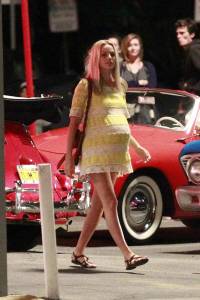
One of the most important parts of Michallon’s argument is that Tate does not experience any kind of personal growth and that ‘watching people just live is boring’. Of course, this is an extremely personal assessment: I happen to be an enormous fan of films where not a lot happens and what we are offered is an in-depth character study. What is so ironic about this claim, however, is that in real life, we cannot watch Sharon Tate live and we haven’t been able to since 1969. This is singularly important in the film. We might complain that not a lot happens because she spends a day on her own and she doesn’t talk to anyone, but there is some joy in watching a woman on a solo trip to the cinema (an exercise I would recommend all women indulge in/challenge themselves to at one point or another), enjoying time with her friends, dancing and having fun and preparing for motherhood when we know in real life that Tate was robbed of the chance of being able to do this. Furthermore, we are offered nuance in the dialogue-less-ness: in her interaction with a female hitchhiker, Tate drops off the woman, wishes her all the best on her ‘adventure’, thus suggesting that she spent the majority of the journey listening to someone else’s story; we are offered actual footage of Sharon Tate in the cinema that Robbie’s Tate watches, forming homage, an opportunity for self-reflection and, for us, a melancholy funhouse mirror of reality. It is an echo of the fact that this film plays with history, something that will be completely apparent by the end of the film.  Alternatively, although Tate is depicted as loving and loveable, the interpretation can be made that she displays smugness, vanity and happy-go-lucky privilege in her life as a white, blonde, beautiful woman; a kind of flip-side to the open-heartedness and generosity that some find so problematic. One way in which I think the film could have been improved is if Tate had had some kind of hand in killing the hippies in a badass, heavily pregnant way. And yet, just maybe, the best thing to do for a character who in life was a victim to such appalling violence, was to keep her removed from it.
pregnant

This is where bittersweetness seeps into the film: we know that in real life, she does not survive that night in 1969, and neither do her friends. When she offers Rick Dalton the opportunity to come into her house after the pool party of hippy carnage and the end titles begin to materialise on-screen, we know that we have reached the fairytale territory that only Hollywood can give us.[3] Primarily, it is Tate in the position of power: she is the one who could be a useful contact for Dalton, who spends most of the film choked up and flailing about, and not the other way round. She is the valuable, influential and powerful contact to have in the industry, not the male television star.  Additionally,  and similarly to seminal Tarantino revenge film Inglourious Basterds, which re-writes the history of the Second World War with Hitler and his cronies getting an epically fiery bloody death at the hands of escaped Jew Shosanna, in Once Upon a Time… in Hollywood we are offered an alternative reality where Charles Manson’s blood-thirsty hippies don’t butcher Sharon Tate,  but get their comeuppance at the hands of Brad Pitt and a cute dog, and Sharon Tate herself is in a position to offer help and support to Rick Dalton in the loving and kind way that we have come to expect from her. Tarantino offers us a moment where history was very different: where bad guys are punished, the good survive and everything should have been OK.

And yet, despite the satisfying end that is put to the hippies, the heroics of Cliff Booth and his dog and the hilarity of the flame-thrower in the garden shed, the ending here is poignant and sad, as opposed to the jubilation and bad-assery of Inglourious Basterds . The camera lingers on Tate, Dalton and Tate’s friends from afar, as they introduce themselves and discuss the attack. Their conversation is barely audible, and the camera stays put, almost from a high CCTV angle, as they slowly follow one another into Tate’s house. A lot of space is created between the actors and the camera and, ergo, the audience watching. It enables us to sit within this strange liminal space where we can enjoy and revel in what we have just witnessed; but the distance cultivates a sense of knowing; a knowing that this did not happen. Tarantino wrote that Sharon Tate stayed alive and continued to live her beautiful life, but we know that she didn’t, murdered as she was in the most horrifying and violent way. Pertinently, the camera then stays on Tate’s Porsche and the other cars they have in the driveway, using the visual metaphors to reflect the power of the Hollywood machine to re-write and re-create things as we want them to be. Hollywood is itself a vehicle for change, for creativity and for embracing life over destruction; or, at the very least, offering the façade of that. It has a twofold power to reflect change and to exact change; to re-write history but also to ensure that the future is safeguarded. Ultimately, in this case, Sharon Tate can only stay alive in the movies.

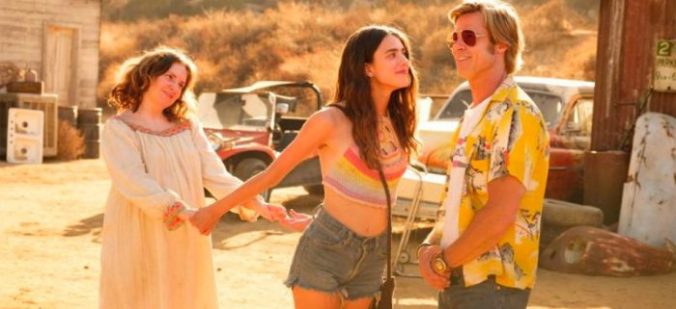
Hollywood’s role in the film is developed and explored in numerous parts of the film, in particular with regard to the representation and role of women. Importantly, and as mentioned in my critique of the ranch scene, Cliff Booth does not have sex with Pussycat, the underage hitchhiking hippy with impressive underarm hair, in his car. This is not what she expects or, perhaps, what the audience may expect, particularly as this is a dynamic that has pervaded the film industry for as long as Hollywood has been functioning. Harvey Weinstein was a producer and collaborator with Tarantino for every single film he has written and directed, so the significance of this scene cannot be overstated.
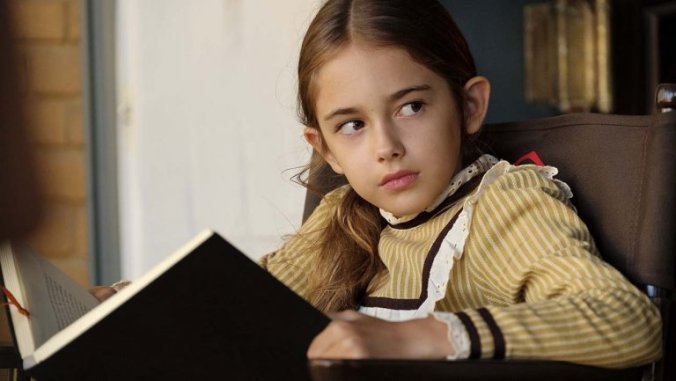
Trudi

Similarly, one of the shining stars of the film comes in the form of Trudi, played by the delightful Julia Butters. At only 8 years old, Trudi almost steals the film and her character is one of the standouts amongst a cast of standout performances. Her endearing and academic approach to the craft of acting is refreshing, powerful and leaves Leonardo DiCaprio’s Rick Dalton’s a gibbering, insecure wreck. Indeed, his entire self-worth on the set of the Western they are shooting together boils down to what Trudi thinks of his performance and his ability to achieve the performance, in particular through knowing his lines. In the scene where he gives himself a rollicking in his trailer, he mentions Trudi, berating himself to not show himself up in front of her. She, because of her commitment to her work, her ability to interpret and understand story, her thorough approach to research and her interest in the wider industry, is made out to be a force to be reckoned with. As with the subversive ranch scene, where Tarantino constructs the difference between psycho-killer hippies and the misunderstood, kooky youth, and thereby critiquing snowflakism, in Trudi we see the highest hope for future generations in film and beyond: doing their research, speaking their minds and not limiting themselves to who they think they should be. At the end of a long scene they shoot together, Trudi, who we know at this point Dalton completely respects and admires, tells him that he just put in the best acting performance she has ever seen, and Dalton immediately chokes up. His belief in himself completely stems from the way in which he is perceived by this precocious, wise and talented young girl and he can barely contain his emotion at having shone in her eyes.

As such, I believe that the argument that women are reduced in this film is not a very convincing one. Sharon Tate does not speak much in the film, it is true; but her role in the film, sensitively portrayed with the respect of Tate’s family in mind as much as for Tate herself, is to celebrate life and the power we have to construct our own narratives. If she had been killed at the end, then she would truly have served as a lifeless doll; but she lives, and she is glorious. She is not part of the overall plot because the plot is about two menopausal men trying to stay relevant. Robbie’s Tate does not have that concern and has ample time to while away the time, with added luxury of being on her own, both during the film and, thanks to the film’s revision of history, we can assume after the credits have rolled. To compound this, we have Trudi, a bright spark for the future who has plenty to teach the struggling Rick Dalton; and a man in Cliff Booth who respects the boundaries of power, age and experience by not taking advantage of a young girl. Tarantino has never shied away from giving audiences strong female characters, but in Once Upon a Time… in Hollywood he provides a much more subtle offering, playing with our expectations and using a variety of characters and dynamics to do a great justice to the women of the film and the actors who play them.


[1] ‘Quentin Tarantino’s male gaze in ‘Once Upon a Time… in Hollywood’ isn’t just insulting – it’s profoundly boring’, The Independent https://www.independent.co.uk/arts-entertainment/films/features/once-upon-a-time-in-hollywood-quentin-tarantino-sharon-tate-margot-robbie-lines-a9061446.html [accessed 12:05, 19th August 2019].

[2] The Bechdel Test, created by Alison Bechdel, suggests that to pass a basic representational threshold, films must have more than one female character, the female characters must speak to one another and the female characters must speak to each other about something that does not involve a man. Of course, many culturally celebrated films do not pass this test, but then neither do films like Gravity, A Star is Born and Arrival, in spite of the lengthy screen-time afforded to women and where the quality of the female characters is exceptional. Equally, there are many female-centric films where women have plenty of dialogue and on-screen time, but their lives and conversations revolve around men.

[3] I want to add here that the irony of Dalton proclaiming earlier on in the film that he is ‘one pool party’ away from Roman Polanski and then fighting a hippy with a flame thrower in his pool becoming his ticket to friendship with Tate, is just hilarious.
First response: ‘Once Upon a Time… in Hollywood’ 1/2

Part One: The Spahn Ranch scene

I went to see ‘Once Upon a Time… in Hollywood’, Quentin Tarantino’s latest film, on the 14th August 2019. As soon as the credits began to roll, opinions began to surface from cinema-goers around us:

‘It wasn’t very ‘Tarantino’ until the end’.

‘I wanted more of Margot and Leo together’.

‘Nothing happened’.

In many ways, this confirmed what I thought the whole film was reaching towards: expectation. Or rather, the dismantling and reflection upon what we want and what baggage we bring with us to a cinematic experience. The film focused on a number of things: the film itself, Tarantino as writer and director and Hollywood as a mechanism for hopes, dreams and ideology. In many ways, Once Upon a Time… in Hollywood was a perfect fit within Tarantino’s oeuvre, offering many moments of self-reflection, humour and a fluid sense of history. In two parts, I would like to discuss some important aspects of the film that stood out upon my first watch of the film: in the first, I offer a close reading of the ranch scene half way through the film and in the second, I challenge some of the commentary regarding the representation of women in the film, in particular Margot Robbie as Sharon Tate.

Primarily, I think it is important to acknowledge what I thought was problematic about the film and made for uncomfortable viewing. I was not a fan of the exchange between Brad Pitt’s Cliff Booth and Mike Moh’s Bruce Lee. I found Pitt having to take his fake hair off before their fight absolutely hilarious, but I did not think the representation of Lee’s karate fighting, including all of his sound effects, were the homage that Tarantino claimed they were.[1] It fell into the realm of mockery, in the same way that Kill Bill Volume Two descends into a kung-fu farce for a while. Any subtlety around these moments in both films is lost, and Lee is reduced to a laughable caricature. Similarly, I found the storyline of Booth killing his wife and getting away with it in slightly poor taste. Arguably, there is almost a Gatsby-esque ambiguity to this story: even with the flashback of Booth and his annoying wife on a boat, it could be argued that this is an event fabricated through rumour and speculation of extras and film crew, neither confirmed nor denied. Yet, with the number of women who are killed every week by a partner or former partner still not being treated as seriously as the social issue that it is, including the fact that funding for domestic abuse charities in the UK comes from the luxury tampon tax that menstruating women are subject to, I am not sure that ambiguity on such a subject should be pissed around with.[2]

There are many aspects of the film where Tarantino is playful with expectation, in a script that is often light-hearted, funny and self-deprecating in a way that we have not seen Tarantino play with before. Primarily, there are the references to feet all over the place: Pussycat’s feet squished against Booth’s windscreen; Sharon Tate’s bare feet in the cinema; Squeakie Froome using her foot to point Booth to George Spahn’s room etc. Tarantino’s foot fetish is something of Hollywood legend and the fact that there were so many shots of feet in this film suggests that he wanted to take the piss out of himself and the rumours for as long as he is able to. Similarly, there was the mention of Spaghetti Westerns not being worth Rick Dalton’s time: Django Unchained is famously an homage to the Spaghetti Western genre also starring Leonardo DiCaprio, who was nominated for an Oscar in that role, who here plays Rick Dalton. Additionally, the long, weighty scenes spent filming Dalton’s Westerns, and Dalton’s typecasting in Westerns in general, perhaps pokes fun at the fact that Tarantino’s last film, and the film that succeeded Django Unchained, was The Hateful Eight, another Western that had a Roadshow running time of over three hours and was described as sluggish, slow and boring by many critics.[3] Tarantino doesn’t let himself off the hook in Once Upon a Time… in Hollywood, and the film feels, in many ways, humorous and self-aware as a result. It doesn’t perhaps command the edginess of Pulp Fiction or the epic odyssey-feel of Kill Bill, Reservoir Dogs or Django Unchained, but the humour is still on-point and the effect is a lightness that has rarely shown up in Tarantino’s films before, where crime and violence is purposefully more prolific and commonplace.

The part of the film that most demonstrates Tarantino’s toying with expectation comes when Cliff Booth is taken to the Spahn hippy ranch on the outskirts of Los Angeles. The scene is already set for expectations and stereotypes being toyed with as Booth rejects the sexual advances of the hitch hiking hippy Pussycat on account of her age. She reveals that she has performed all sorts of sexual favours for men who have picked her up in the past. The couple have chemistry and Booth has signalled his interest in the number of times he spots Pussycat around Hollywood prior to their actual meeting; however, this white middle aged man decides to go no further with her when the sexual opportunity is presented to him on a plate. For a cinematic white alpha male to turn down a spontaneous encounter feels pretty progressive: James Bond certainly wouldn’t have done. It seems here that Tarantino is playing with what we expect from white leading men in Hollywood and, in turn, the representation of women, which I explore more deeply in my next essay. In a film that has ‘Treat Her Right’ by Roy Head and the Traits as its first soundtrack listing (with lyrics like ‘If you want a little lovin’ / You gotta start real slow / She’s gonna love you tonight now / If you just treat her right now’) Tarantino is offering something more progressive in the realm of relationships between men and women. It is appropriate that the stereotype of the older man involved with a younger girl is subverted, especially in light of the revelations about Harvey Weinstein, and Hollywood itself becoming the epicentre of the worldwide #MeToo and #TimesUp movements.

margaret-qualley-once-upon-a-time-in-hollywood-700x321

Once at the ranch, Tarnatino sets a ghoulish and eerie scene, with waifish young women and long-haired men looming about evidently having drunk the Manson Kool-Aid. Tension builds as Booth pushes to see his old colleague George Spahn, whom he suspects has been overruled and overrun by the hippy family. We are told, however, that he is ‘napping’.  A woman called ‘Gypsy’, played by the infamously controversial Lena Dunham, seems to be in charge of the place; George’s house is a dirty hovel; and Dakota Fanning, playing Squeakie Froome, is formidable with her piercing eyes, her commands and her commitment to watching television. Booth doesn’t take no for an answer and enters George’s room where… George is napping. George wakes up, becomes pissed off that he has been woken up, seems to be absolutely fine and wants to go back to sleep so he can watch television later. Tarantino builds up a big expectation that there is something rotten at the ranch, that George is probably out of his mind and that a big bust-up or reckoning is on the cards. However, everything is fine. Weird but fine. Squeakie is freaky, but she’s fine. She doesn’t lie to Booth about George being asleep and she is as ruthless about what she wants as Booth is himself. With Lena Dunham hanging about, in her first major on-screen role after the divisive and complicated Girls, we assume that there must be something questionable going on. Her casting in this part of the film feels almost deliberate precisely because she irks people and makes people uncomfortable. And yet, she is relatively harmless.

Similarly, and moments later, we begin to expect a big bust-up between Booth and Tex, a male hippy on a horse who is summoned back to the ranch after Booth beats up a guy who burst his tyre. Tex epically races back to the ranch, Tarantino giving him lengthy screen time as he rides through the canyon, providing beautiful wide panning shots of him galloping in the sunshine, as per the Westerns parodied at the beginning of the film. Unfortunately, he arrives too late because Booth has already driven off, happily listening to the radio. Over the course of his writing career, Tarantino has never shied away from surprising us with violence or building up action to a violent crescendo; yet, in the instance of Tex in particular, the time for violence to erupt is slightly out of joint. This is an opportunity for violence to bubble up into a lengthy fist-fight or shoot-out but he arrives too late. As such, I would argue, the opportunity for violence to be delivered to us on a plate is purposefully missed. Tarantino attempts to frustrate what we come to expect from a Tarantino film by holding our lust for quintessential Tarantino violence at bay. Booth beats up a hippy for puncturing his tyre and he kind of deserves it. Beyond that, there is nothing superfluous.

Furthermore, I would argue that casting the likes of Lena Dunham and Dakota Fanning to lead an anonymous cast of slightly weird but, in the moment, harmless characters, is a nod to cultural anxiety held around youth. Lena Dunham is interesting casting because she is held simultaneously in high regard and disdain by the viewing public; Fanning, on the other hand, has successfully navigated child stardom, has a brilliant reputation in the industry and has many impressive performances to recommend her.  In a time where Millennials and Gen-Zers are treated with disdain for their focus on the climate crisis, identity politics and everything a conservative older generation decries as snowflakism, Tarantino delivers a bunch of layabout hippies who, in this moment, are weird but ultimately fine. The familiarity and renown of these actors in particular helps to convey and play with this. Of course, there is the spectre of Charles Manson looming over the hippies, but Tarantino makes the point to distinguish between a misunderstood misfit youth and actual psycho killers. To cement this, he uses another surprisingly familiar face: Maya Hawke, daughter of famous Tarantino regular Uma Thurman. [4] Hawke plays Flower Child, a member of the hippy group who abandons the three murderous ‘pig-killing’ hippies (whose exchange reminded me of Pumpkin and Honey Bunny in Pulp Fiction), steals their car and leaves them in the lurch. Using such a recognisable face to play a weirdo but who wants no part in violence and carnage helps Tarantino to establish this spectrum of youth and to play with our assumptions and expectations. There are always going to be weirdos and arseholes, but not all of them are going to go on a killing spree; we may expect certain behaviours and outcomes from a group of people, or violence in a Tarantino film, but that is because we bring our own baggage of what we want and what we think with us wherever we go.

Tarantino is at an interesting point in his career where he can toy with being self-referential and also with the expectation of what we think we are going to get with a Tarantino film. He has a backlog of material with which people are extremely familiar and, as such, he can and does frustrate and toy with what he has constructed for us to want over the thirty years he has been writing. The ranch scene isn’t explosive and I can see how people might interpret that it all falls slightly flat and underwhelming, because nothing actually happens. However, with beautiful irony and in a way that builds up to the later chaos, this scene is rich with posturing, preconceptions and imagery, and I think that is perfect story-telling within the world of Once Upon a Time… in Hollywood. In some ways, this is a sunny, light and hopeful film and Tarantino leaves out violence until it is truly necessary at the end of the film (and he really goes to town with it in the best possible way). But that does not mean that the rest of the film is passive and blank: it seethes with tension, with frustration, weirdness and curiosities. As I will explore in my next essay, it is also tinged with undeniable melancholy and bittersweetness. Whatever expectations we have of a Tarantino film are healthily disrupted by the ranch scene in particular and I think it is a brilliant move on Tarantino’s part.

[1] ‘Quentin Tarantino Defends ‘Arrogant’ Portrayal of Bruce Lee in ‘Once Upon a Time in Hollywood’’, https://variety.com/2019/film/news/quentin-tarantino-bruce-lee-once-upon-a-time-in-hollywood-1203299921/ [accessed 17:07 19th August 2019].

[2] ‘The women killed on one day around the world’, https://www.bbc.co.uk/news/world-46292919 [accessed 21:24, 20th August 2019].

[3] https://www.rottentomatoes.com/m/the_hateful_eight/reviews?type=top_critics [accessed 21:22, 20th August 2019].

[4] I want to show an awareness here that Maya Hawke’s presence in the film is an interesting one, considering her mother’s estranged relationship with Tarantino, who forced her to drive an unsafe car during the filming of Kill Bill. Click here for Thurman’s interview with the New York Times detailing the incident as well as the harassment and violence she was subjected to at the hands of Harvey Weinstein, Tarantino’s financier and creative partner: ‘This is why Uma Thurman is angry’, https://www.nytimes.com/2018/02/03/opinion/sunday/this-is-why-uma-thurman-is-angry.html [accessed 21:46, 20th August 2019].    

Abyssal Cuteness

This essay was first written and published on Everyday Analysis in 2014.

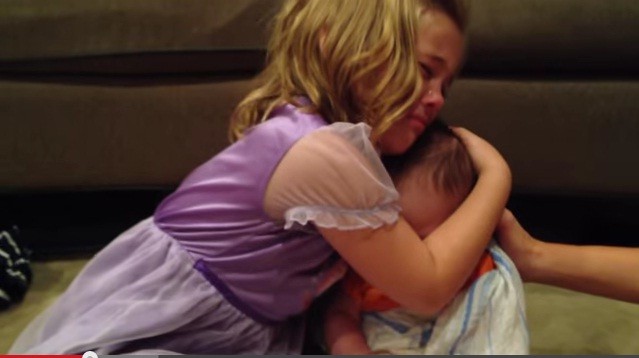
One of the latest videos to go viral in recent weeks (note: this video was also published in 2014 and now has 42,195,765 views) centres around a young girl howling with despair at the thought of her baby sibling growing up, and her own fear of dying ‘at one hundred’. You can watch it here and by clicking on the image below:

Abyssal Cuteness

The general cyber consensus of this video is that this is a moment of undeniable ‘cuteness’, a claim that is perpetuated by saccharine blogging sites who share the video, for example ‘Hello Giggles’. ‘Cuteness’ may, perhaps, warrant its own analysis for its pervasive presence on the internet, with the innumerable animal/baby/animal and baby/ baby and animal and baby animal videos that continue to appear on social media. Here, however, I would make the case that the video captures an abyssal moment in this girl’s life where, like King Midas capturing Silenus the companion of Dionysus, we learn that ‘the very best of all things is completely beyond your reach: not to have been born, not to be, to be nothing’.[1] She does not want her brother to grow up and stop being ‘little’, and she simultaneously bemoans her own inevitable aging that will ultimately lead to her death.

The terror and horror of her and her brother’s existence is conveyed not through her language but in a choking cry half way through and at the end of the video, which the subtitles describe as ‘inaudible’. She is audible, because we can hear that she makes noise, however the noise she makes in her terror is seemingly outside of language and also beyond our ability to articulate in language. The girl, therefore, embodies the Dionysian impulse where, as described by Nietzsche, ‘the whole excess of nature in pleasure, pain and knowledge resounded to the point of a piercing scream’.[2] Her panicked coughing moan is the expression of her pleasure at the baby’s ‘cute smiles’, her affection for him, which is repeatedly conveyed in her kissing his forehead, and her pained fright at her recently acquired knowledge that both she and him are aging and finite.

This expression of the Dionysian that sees the girl intoxicated by the truth of her existence and thrown into self-oblivion is, however, still engaged in a dialectical tension with its alter drive, the Apollonian, without which it could not emerge. Nietzsche describes the condition of the Apollonian as ‘an existence in which everything is deified, regardless of whether it is good or evil’.[3] Although in western culture we no longer exist with a pantheon of anthropomorphic gods, I argue that an economic system of consumer capitalism sees every literal ‘thing’ similarly deified, spawning an exuberant culture of commodities which construct and offer identity. This is prefigured in the video in the princess dress that the girl wears, an item that enforces societal norms of gender and hierarchy which, therefore, enables a moderated self for the girl to be constructed. The Dionysian impulse that envelopes her destabilises this appearance of heteronormativity which appears to have structured her life.

With reference to Raphael’s painting Transfiguration, Nietzsche suggests that the Apollonian and Dionysian are reciprocal and depend upon each other. This is achieved because the Apollonian gives way to the Dionysian, which is redeemed with the reinstatement of the sublime Apollonian image. In this video, the re-establishment of the Apollonian, which has already been prefigured in the girl’s princess dress, comes in the way this video has been elevated to a position of ‘cuteness’, from the comments on YouTube to the chat shows that have had ‘exclusive’ interviews with the girl post-abyss. Whatever ‘cuteness’ may mean, the perpetuation of this word perhaps allows people, or more specifically adults, to semi-patronisingly reflect on this girl’s struggle with the chaotic state of her existence in this abyssal moment. However, it is not beyond the realm of possibility that ‘cute’ has also become a barrier for those whose lives are too structured by the Apollonian culture of ‘things’, and who resist the tormenting Dionysian impulse that, we have come to understand, is never too far away.

[1] Friedrich Nietzsche, The Birth of Tragedy trans. Douglas Smith (Oxford: Oxford University Press, 2000), p.27.

[2]Ibid, p.32.

[3] Ibid, p.27.

Love Note – RHOBH vs. RHONY

If you are not interested in trash, please feel free to respectfully move along. This week, I can’t help but indulge myself.

i-cant-rhony

There are two series in the Real Housewives franchise that I have devotedly committed to over the past nine years: The Real Housewives of Beverly Hills and The Real Housewives of New York City (hereafter known as RHOBH and RHONY respectively). These shows are undeniably a platform for consumerism and toxic aspiration, sustained rivalry amongst women, and have been part of a culture that has conflated and confused reality with authenticity. Yet, I get an absolutely enormous kick, and a whole lot of laughs, from watching these shows. It’s fun to analyse the mechanics and machinations of people, their friendships, their families and their neuroses operating in a petri dish for the most ridiculous parts of being human. I have also enjoyed, and continue to enjoy, the deep discussions, critiques and reminisces I’ve had with other fans about the sheer hilarity and drama that we have borne witness to. Is it OK to alleviate keenly-felt principles about the representation of women on screen, constructed storylines for drama and rampant exhibitionism of wealth? I don’t know, but apparently it’s what I anticipate and revel in on a weekly basis.

Some brief synopses for those of you who are unfamiliar:

RHOBH – Follows middle-aged stars of the small-screen, former models and child stars swanning about in Beverly Hills securing promotional gigs, creating popstar alter egos, running accountability businesses, swimwear lines, luxury restaurants and a QVC clothing collection. There is much self-promotion and product placement, air-kissing and a Lynchian sense of seething instability to the whole thing.

LVP

RHONY – Follows middle-aged successful entrepreneurs, Upper East Side socialites, former tenuous European royalty (via marriage then divorce) and a woman who is the physical embodiment of the untold enigma that is an international lifestyle brand. Again, there is much self-promotion and product placement, but also unbridled (often drunken) chaos and almost grotesque levels of silliness from pretty much the first minute of each episode to the last.

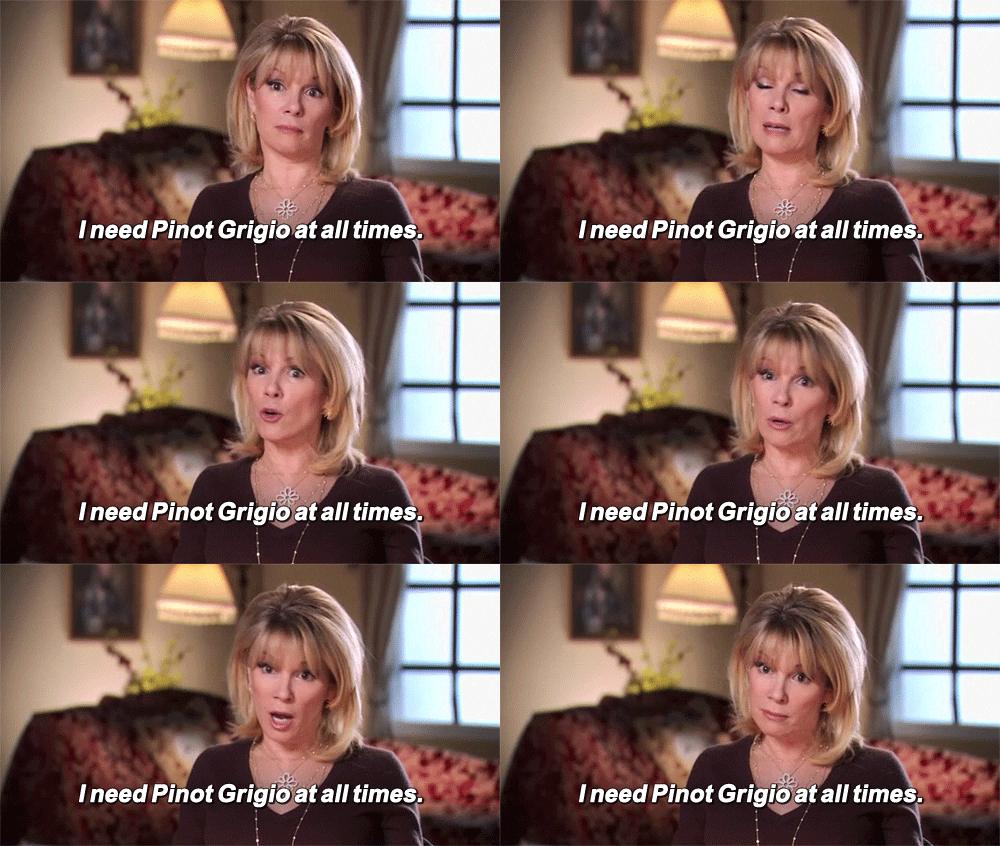
Pinot grigio

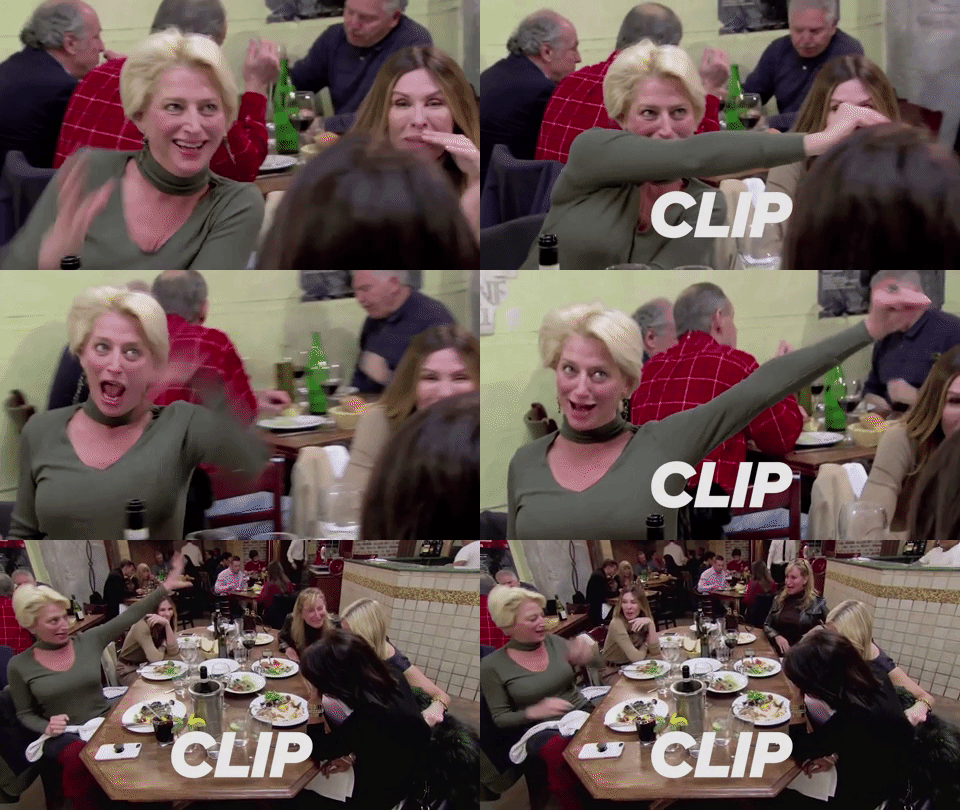
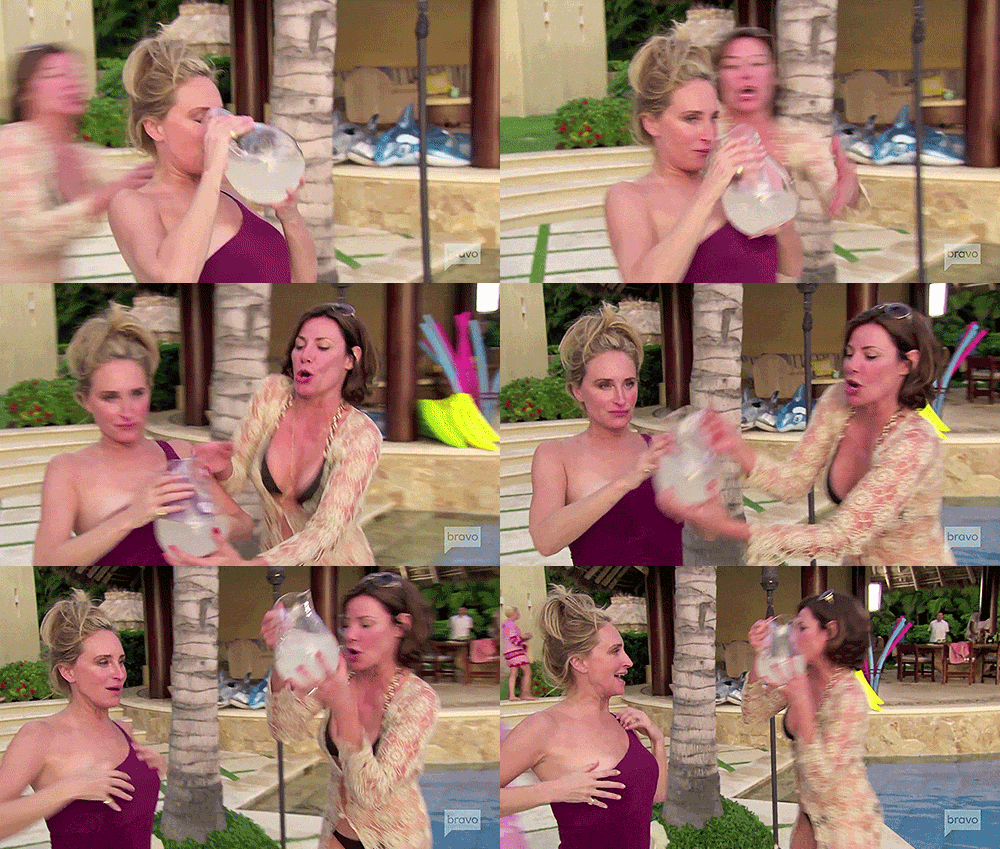
Both shows have a similar format but a very different sensibility to them. In RHONY, the mess is perpetually on show and it often seems you cannot move for it. Whether it’s Aviva Drescher throwing her prosthetic leg on the floor; Dorinda Medley yelling ‘Clip!’ and other obscurities after numerous very dirty martinis; Ramona Singer screaming ‘Take a Xanex!’; Ramona Singer doing just about anything; Luann de Lesseps using the word ‘cabaret’ more than should be legal; Tinsley Mortimer sat in a wedding dress with her mum Dale weeping over ultrasounds of her frozen eggs; Sonja Morgan drinking from any receptacle possible and trying to have sex with anything that moves; and Bethenny Frankel swinging between keeping everyone ship shape with sarcasm and sass, and her emotional spirals of loss, abuse and need for control, the show doesn’t have to look much further than the basic eccentricities of its cast to produce something interesting each week. There is very little that the cast don’t reveal about themselves on the show, which is what has kept fans loyal and hooked for over ten years.

clip

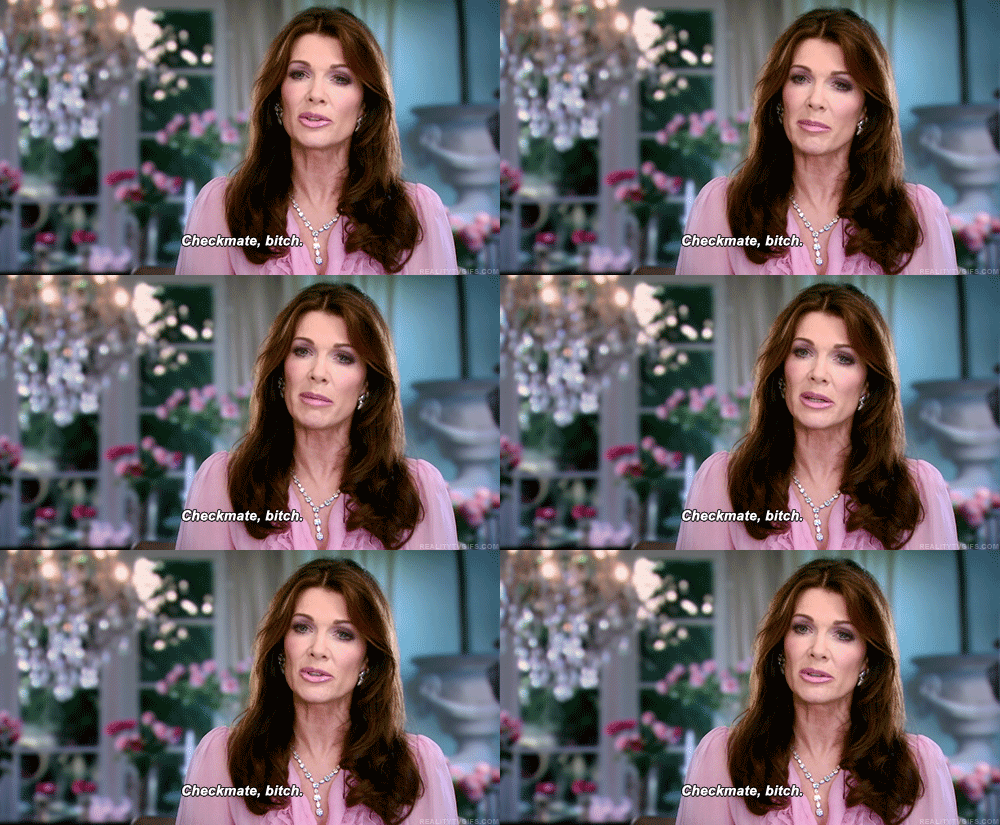
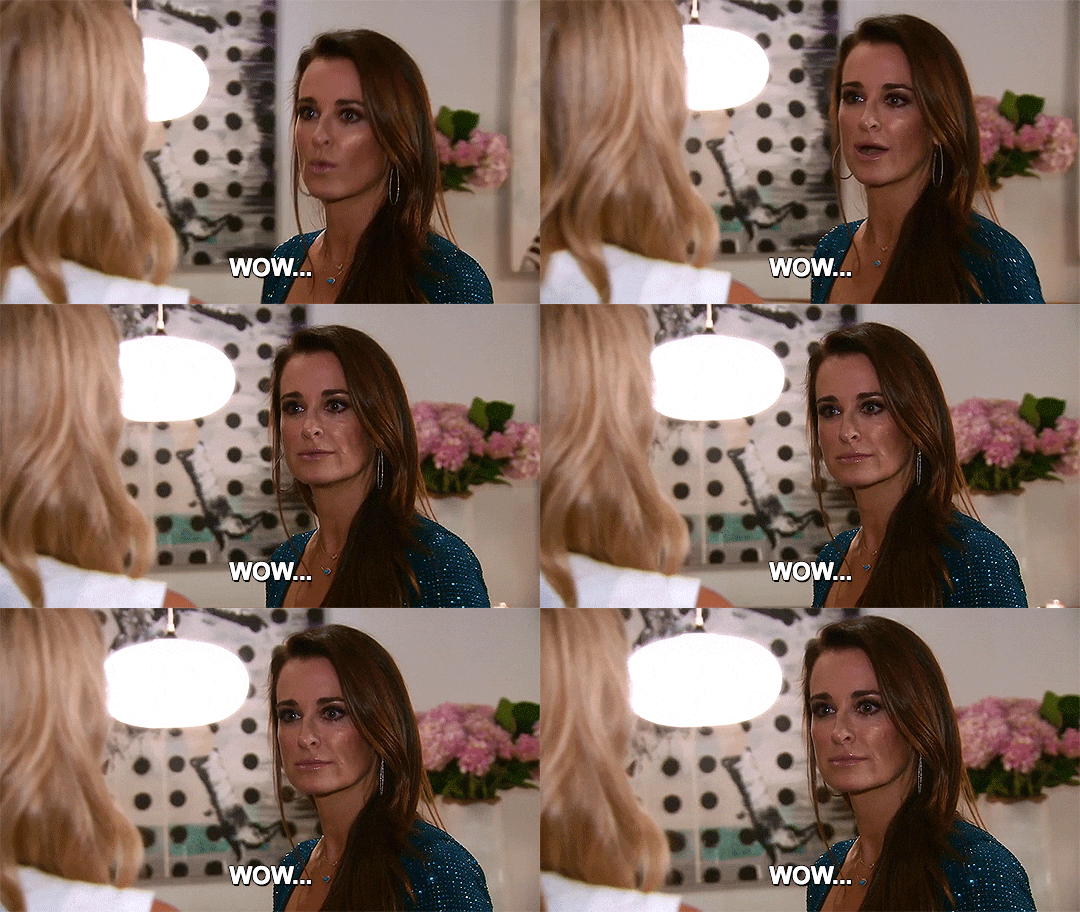
RHOBH, on the other hand, is a very different kettle of fish. Indeed, it is almost a fascinating study in superficiality and repression. This is not to say that the superficial is not also present in RHONY, but cast members are more forthcoming and savage with their exposure of their own, and others’, bullshit. In RHOBH, the cast members, whilst fun, humorous and enjoyable to watch, have a hard time portraying even a basic level of realism. Sure, we see Kyle Richards doing the drunken splits every so often, Lisa Rinna wiping down hotel rooms and Erika Girardi digging into pumpkin pie, but the vast majority of the time, the cast members are reluctant to even be filmed eating. In one of the most recent episodes, a large bowl of cheesy pasta is brought out and there is a palpable tension in the air (apart from with Kyle and Teddi who tuck in, but definitely feel slightly guilty about having done so). On a trip to Amsterdam a few seasons ago, the RHOBH women skirt around eating space cake in a café, whereas the RHONY women would have been all over it, out the door and over the rainbow.

LVP AMS

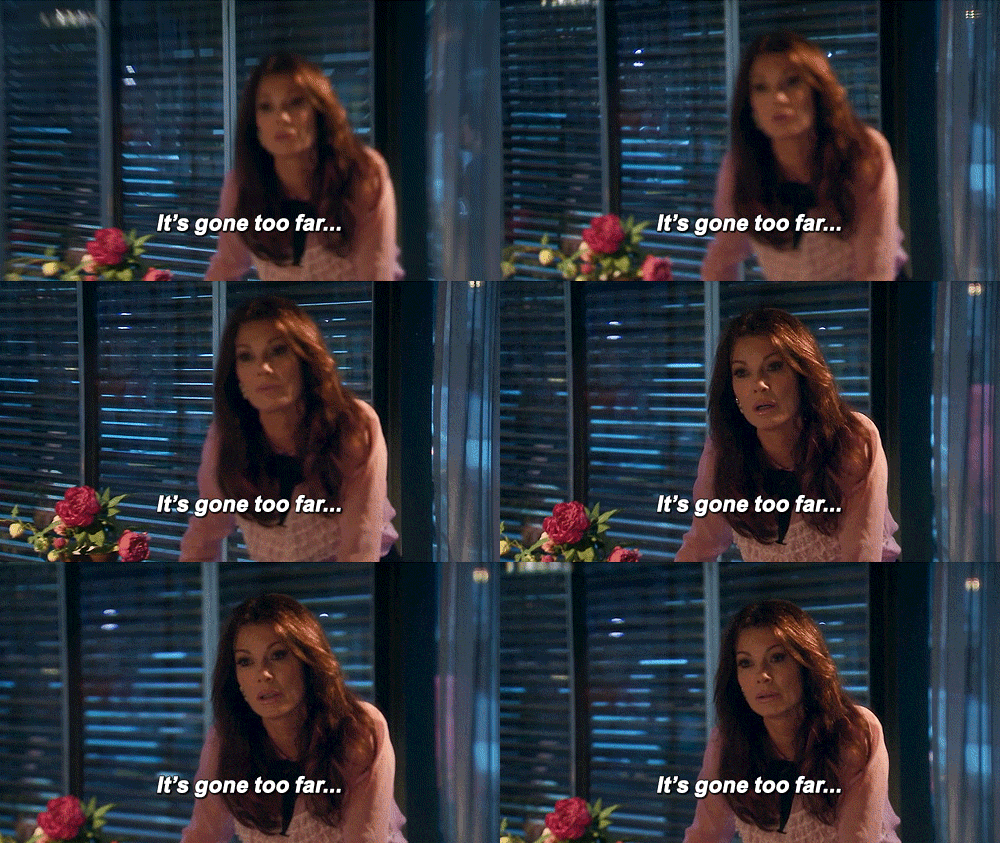
The RHOBH women are much more concerned with maintaining an image of absolute perfection, which means that when the show takes a turn for major drama, it can get very dark. You only have to have a basic knowledge of Freud to understand that what is repressed always returns, and in RHOBH we’ve seen almost cataclysmic fallout around addiction, abuse and loss alongside the beautiful mansions, the shopping trips on Rodeo Drive, lunches at Villa Blanca and spa days in Ojai. From the heart-breaking and very emotional rollercoaster ride that is sisters Kyle and Kim Richards’ relationship, Taylor Armstrong’s abuse at the hands of her husband, who went on to take his own life, Lisa Rinna smashing a wine glass after insinuations were made about her husband, and Erika Girardi having a melt-down in Hong Kong about the safety of her police officer son, it’s clear that the RHOBH women expend a lot of their energy on the show hiding behind a veneer of attempted perfection. Where in RHONY, chaos levels maintain a steady level, in RHOBH chaos violently erupts and is inescapable for everyone involved.

Kyle

This may explain why the most recent series have been a little dry for RHOBH. True, recent additions like Denise Richards have been giving the show more of the casual chaos normally exhibited in RHONY, but as far as a compelling storyline goes, they’ve been clutching at straws for a while. But then the depths to which things plummet on the show makes me think that maybe we should be OK with a bit of glossy boredom. RHONY on the other hand is the gift that keeps on giving. Divorce, addiction, loss and friendship break-ups are dealt with here too, but are always served with a sardonic self-aware wink. This is the kind of dark humour that feels totally and utterly in-keeping with the general disposition of the city that is their namesake. Let’s all drink to that…

Better Sonja with pitcher


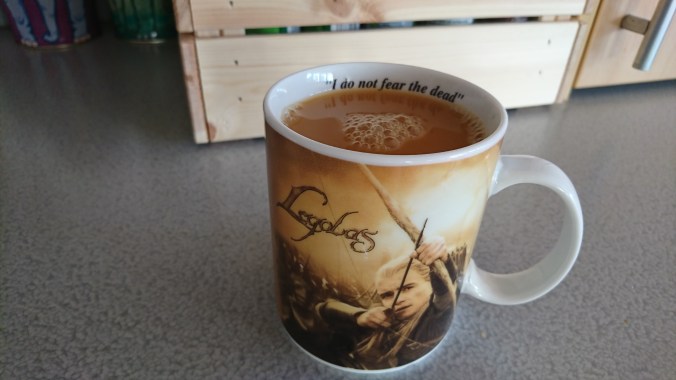
Love Note – A (Legolas) Mug of One’s Own

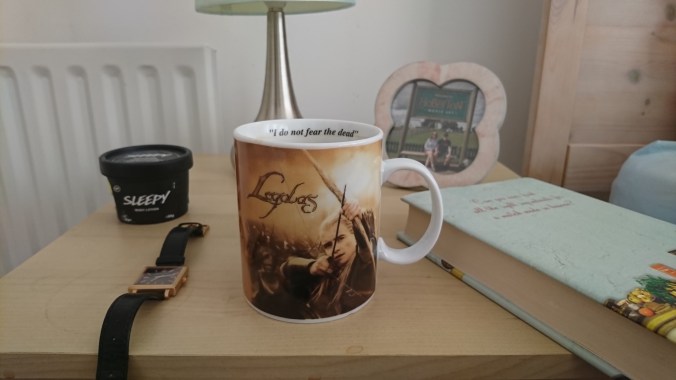
Over the weekend, I realised that this beautiful piece of crockery (see photos) is over 15 years old and my head nearly exploded. What better way to commemorate and celebrate it than to write a Love Note? None, I think you’ll agree.

Whilst it has always been inherently more acceptable to fawn over Aragorn, Boromir or (in my case) Haldir from the Lord of Rings, who are all obviously and exceptionally lust-worthy, I have always had an incredibly soft spot for Legolas. Yes, I think it’s problematic to my ego that he has better hair, cheekbones and skin than me; but there was something about his inspired use of a bow and arrow, his bilingualism and his intuitive power of interpreting tree emotions that really captured my attention when I first saw the Lord of the Rings films aged 10.

1d14dc87060b176c6040ed1c02ee74fa

In the years that have since passed, and the numerous re-watches they have brought, I have noticed that Orlando Bloom’s line delivery perhaps isn’t as slick as his hair and his archery skills are actually impossible (you can’t shoot more than one arrow at once and expect them to both go in a straight line, more snaps for the visual wizardry at Weta). Nevertheless, my love for Legolas has been immortalised in this exquisite, now slightly ageing mug.

DSC_3632

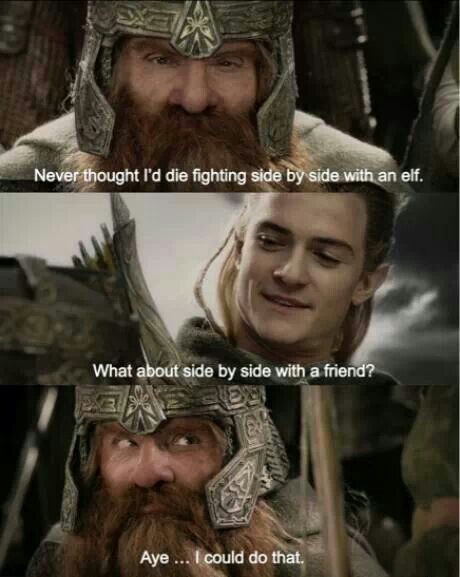
There he is, looking calm and slightly perturbed on the field of battle with his bow and arrow, the sepia tint adding historical and emotional weight to the whole situation. What is wonderful about Legolas, as with many of the rest of the Fellowship, is that he is willing to commit to a cause that is bigger than himself. From looking at his mug on this mug, he isn’t as consumed with his cheekbones and maintaining his lovely hair as people would have him; he is a representative for all the elves, putting his life on the line to rid the world of absolute fascist power, destruction and despair. He may not carry the charisma of Aragorn, but he carries the wisdom that 2931 years inevitably entails, so there is little wonder that he sometimes appears aloof and impenetrable. His camaraderie with Gimli by the end of the trilogy is the stuff of literary and cinematic friendship legend.

78179c5d329f1b75656e2c32f740a280

To say that this is my favourite mug is an understatement. Whenever I have felt anxious, this is the mug I have reached for; the mug that has seen me through the entirety of school, university, the existential, economic and sartorial chaos of post-adolescence, and, of course, Brexit; the mug I have proudly presented full of tea or hot chocolate (never coffee) when treasured friends and family have come to stay; the mug that has helped me to nurse myself and others back to health through the tens of colds, sniffles and lurgies that have snottily bloomed over the years; and the mug that has allowed me to proudly live my Lord of The Rings love on a regular daily basis.

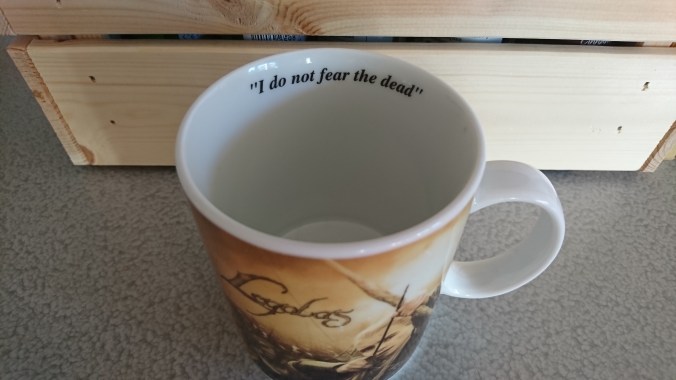
One of the many wonderful things about this mug is that it can help ascertain and flex the depth of knowledge and understanding of the Lord of the Rings franchise. The keen-witted amongst you will notice that Legolas does not actually say the line, ‘I do not fear the dead’, which is printed on the inner rim of the mug.

DSC_3623

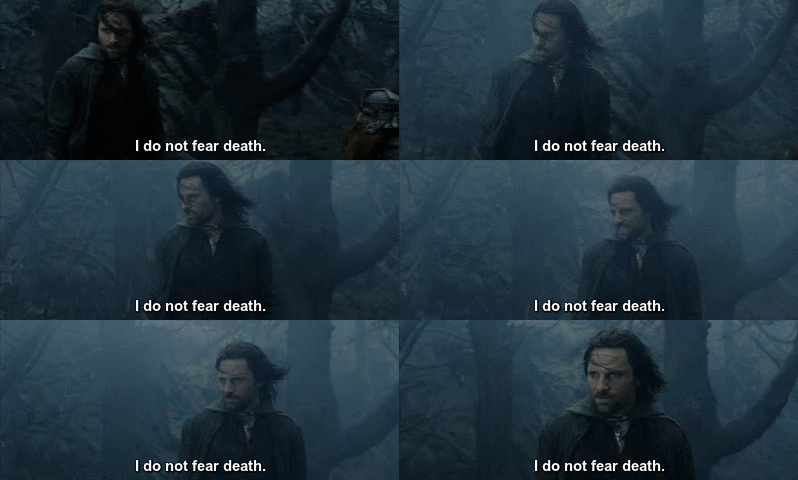
In fact, no one does. The closest anyone gets to saying this line is Aragorn in The Return of the King, who declares ‘I do not fear death’ as he descends into the Dwimorberg mountain to secure the allegiance of the Dead Men of Dunharrow.

tumblr_n07jwfpWBJ1r8dxhoo1_400

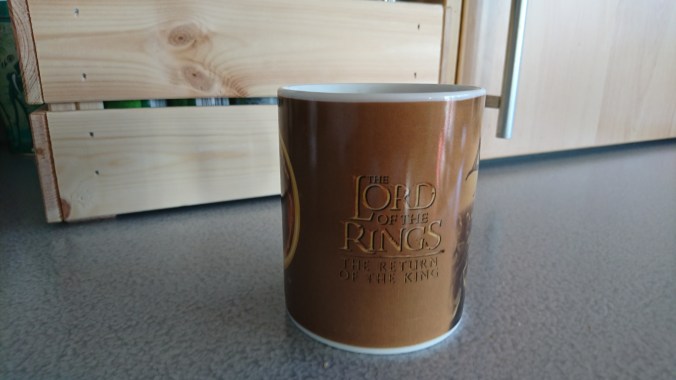
Additionally, this mug purports to be merchandise (unofficial I realised in light of these inaccuracies) for The Return of the King and yet from the armour of the enemy soldier looming behind him, I can deduce that, here, Legolas is fighting Uruk-Hai. This means this film still of Legolas actually comes from the Battle of Helms Deep in The Two Towers, where he, Aragorn, Gimli and Gandalf the White fought alongside Théoden of Rohan against Saruman, who helped to birth this breed Uruk-Hai in the first place. Not in The Return of the King.

DSC_3621

You may think that, in light of this, what is effectively, a cheap, inaccurate, probably knock-off mug is not really worth my un-ending love and devotion. In actuality, it makes me love it all the more. It is imperfect, evidently tried hard and just wants to serve up something warm and comforting, which it does every single time. I subscribe completely to Marie Kondo and basic tenets of Shinto philosophy that we must endeavour to surround ourselves and display in our homes belongings that spark joy in our lives. This mug helps to alleviate the doubts, frustrations and fears of my day: it is my absolute pleasure to bring it out and let it warm me.

DSC_3628

Love Note – Graphic Novels

The world is full of dark, difficult and complex issues that need to be sensitively and appropriately discussed. War, genocide, abuse, loss and our hopes of building a better life for ourselves are all incredibly difficult conversations that need to take place: but how? Is there are right way to talk about these things? How can we ensure that we get the greatest insight into the emotional and critical upheaval when unimaginable things happen? This is where art and literature have always been important. Film, visual art, poetry and novels have always helped to expand our understanding of what it means to experience life and all of the social, political and archetypal challenges that we face. Representation of experience is crucial in helping us to understand the world around us, but when what we are talking about is so traumatic or challenging, it is even more important to think about how these are presented.

Graphic novels, otherwise known as comics, are an almost niche area of textual production that are, in my opinion, some of the best media for representing conflict and its fallout. Edward Said, in his tribute to Joe Sacco’s Palestine wrote that:

‘In ways that I still find fascinating to decode, comics in their relentless foregrounding […] seemed to say what couldn’t otherwise be said, perhaps what wasn’t permitted to be said or imagined, defying the ordinary processes of thought, which are policed, shaped and re-shaped by all sorts of pedagogical as well as ideological pressures. I knew nothing of this then, but I felt that comics freed me to think and imagine and see differently’.[1]

Graphic novels help us to ‘see differently’ because they are a hybrid form that combines accessible, but no less wonderfully ambiguous and complex, art with punchy storytelling. They give an imaginative and, at times, extremely personal telling of stories, bringing drawings and language into conversation. Fragments of images, language and spatial organisation on a page builds an almost compulsive narrative that can at once expose and explode systemic injustice and power structures (what are complicit with Said’s ‘ordinary processes of thought’), whilst also attempting to make sense of the personal experience within them. I don’t think it’s a coincidence that some of the most famous graphic novels are autobiographical memoirs, which focus on the experience of the individual against the backdrop of something much greater and, oftentimes, misunderstood or difficult to represent. We have two confusing and compelling worlds clashing, the public and the private, and the graphic novel attempts to navigate us through both.

I find reading graphic novels to be an incredibly immersive and compelling experience. I recently finished reading Malik Sajad’s Munnu and had to share my thoughts on this text and some of my other favourite graphic novels. These texts take us to the depths and fringes of human experience, re-write what we think about the world, countries within the world, and the people within them. They blow open preconceptions and stereotypes that we are fed, and my understanding of conflict and world history, is all the more rich and nuanced as a result.

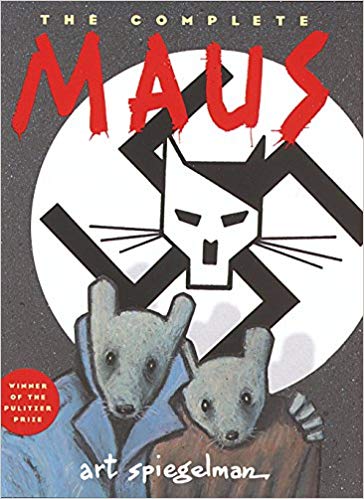
Maus, Art Spiegelman, 1980


Maus


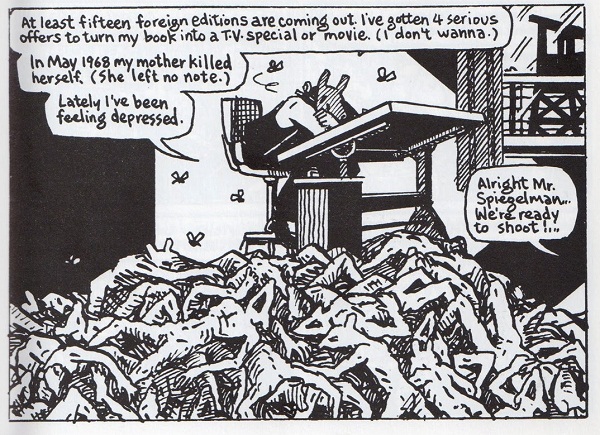
Maus is one of, what I consider to be, the Holy Trinity of graphic novels. It portrays Spiegelman as a young cartoonist, interviewing his father Vladek about his experiences during the Holocaust. The comic charts Vladek’s survival of Nazi atrocities, but also portrays Spiegelman’s oftentimes strained and difficult relationship with his father. The two regularly butt heads in ways family members often do when a deep amount of love and respect is patched over with trauma, neurosis and unrealistic expectations. Notably, the characters in Maus are all presented as animals to represent their different ethnic groups: Jews are depicted as mice, Nazis as Germans and Americans as dogs. One of the panels that stood out most to me is one that presents Spiegelman himself wearing the mask of a mouse, sat at his desk, talking about the opportunities that have come with his novel’s publication. Around him are littered the bodies of Holocaust victims.

maus2

This panel suggests that through the production of Maus, Spiegelman has assumed almost unwanted ambassador status for his presentation of Holocaust testimony. The artificial mouse mask, tied at the back of his head, points to the idea that in the telling of this story, he has almost performed his Jewish identity, and become a spokesperson for Holocaust victims and survivors in the process. He has achieved acclaim and appreciation off the back of so much death and horror, signified by the cadavers gathered around him and his drawing desk, yet still struggles to maintain his sticky relationship with his father. As a result, the dissonance between his success and the emotional burden his success has become weighs heavily on him, entangled as it is with feelings of guilt, misplaced responsibility and fraudulency. The Holocaust is such a difficult and upsetting subject to discuss and represent, and Spiegelman demonstrates great sensitivity and self-awareness in his handling of such a traumatic and barbaric event. The novel is not only a historical document of his own father’s survival, but also provides a platform for conversations about how we successfully represent the un-representable, and all the responsibility that brings.

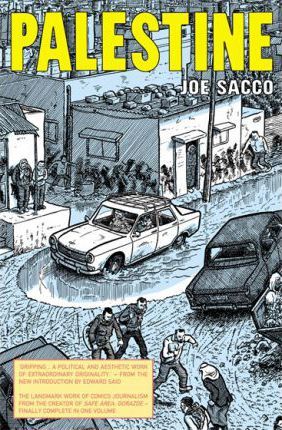
Palestine by Joe Sacco, 1996

palestine cover

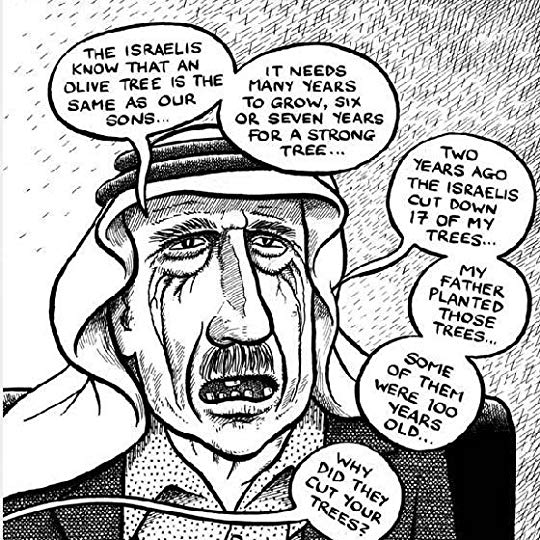
The second graphic novel in the Holy Trinity follows a Joe Sacco, an American journalist, travelling to Palestine and the Gaza Strip to witness and interview oppressed Palestinians during the Intifada. In the West we are given a very limited idea of the history and lived experience of Palestinians under Israeli occupation on the West Bank. This graphic novel has been hugely influential in its multi-dimensional perspective of conflict; and especially those conflicts that receive little traction in the news or are obscured by global and media power players. Sacco gives voices and faces to the seemingly unending hardship on the West Bank and in the Gaza Strip that easily bypasses the consciousness of many in the West. The violence and terror that Palestinian men, women and child experience on a daily basis is front and centre of Sacco’s novel, as he tracks his own journey from bystander and objective interviewer, to witness.


Palestine


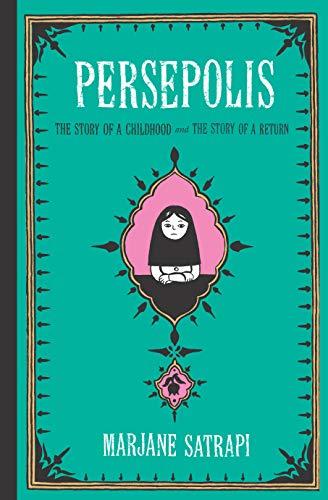
Persepolis, Marjane Satrapi, 2000 and 2014

Persepolis cover

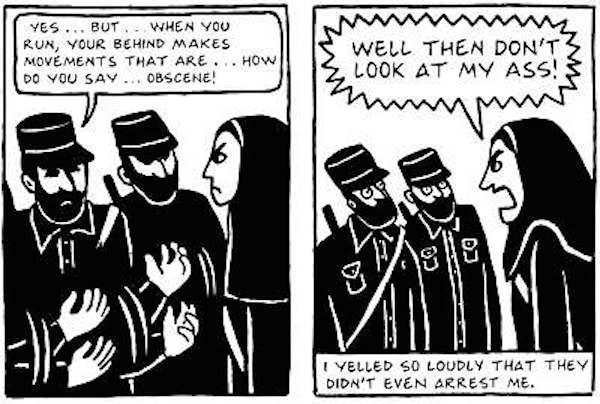
This novel is the third graphic novel in the Holy Trinity. Persepolis blew open what I knew and understood about Iran and Iranian history. As far as I was aware, when I first read this novel in 2010, Iran was a rogue bogeyman country, intent on making nuclear weapons to blow everyone up and destabilise the Middle East permanently, and that was the way things were and the way things always had been. As with my original perceptions of the Palestinian conflict, this graphic novel proved this idea of Iran to be completely limited and short-sighted. Through the story of her family and childhood, Satrapi presents Iran as a vibrant, secular country before the Islamic Revolution, and depicts the horror of war as Iran and neighbouring Iraq are drawn into a deadly conflict. She presents the oppressive practices and rules enforced in school and in public, in particular regarding women’s rights, whilst struggling with her own direction in life, with her time in Europe marred by racism and homelessness.

Persepolis

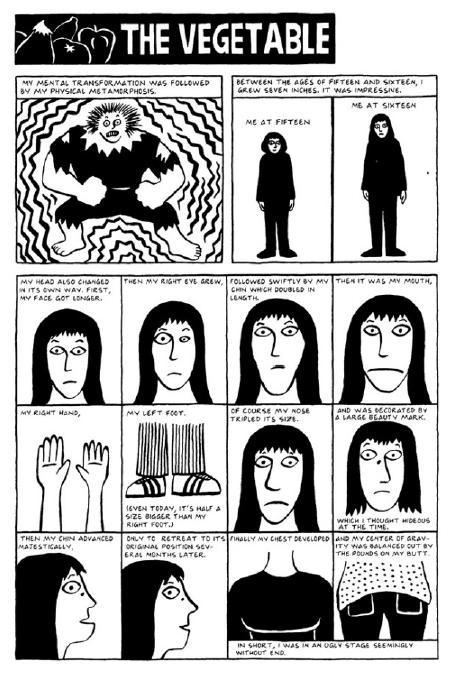
Persepolis is a coming-of-age story like no other, offsetting universal teenage angst and confusion (the start of The Vegetable chapter with panels of Satrapi’s face changing through puberty spoke to me like little else) with religious extremism and Western xenophobic bigotry. The novel provides both creative freedom for Satrapi to explore her own personal story and to shine a critical light on the injustices and pervasive power structures that successfully control people in both the East and West. At the same time, the graphic novel, with its black and white colour scheme and regular panels, successfully conveys the claustrophobia of living in a world where you are penned in by cultural expectations, conflict, bigotry and your own demons.

embodiment-1


Munnu: A Boy from Kashmir, Malik Sajad, 2015

Munnu

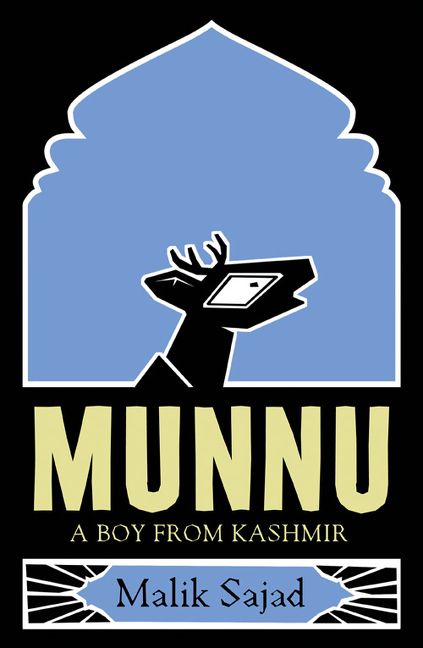
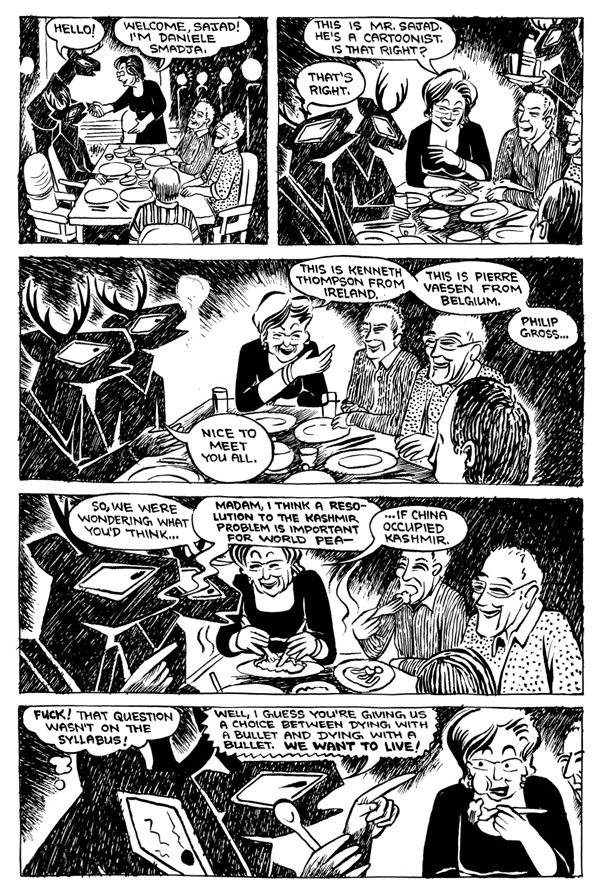
In the tradition of Maus, Persepolis and Palestine, Munnu follows the coming-of-age of the eponymous Munnu, the youngest member of a family living and hailing from war-torn and devastated Kashmir. In a similar vein to Maus, Sajad uses animals, specifically Kashmiri deer, to highlight Kashmiris’ endangered status as a free and independent people. The novel balances the intricacies and tensions surrounding the conflict and hypocrisies between Kashmir and India, Kashmir and Pakistan and amongst Kashmiri resistance groups, whilst also exploring family, existential anxiety and trauma as a result of conflict, and the power of cartoons to grant personal freedom. The final panel is particularly unnerving and unsettling, and I was most touched by young Munnu grappling with his fear of death. Munnu also critiques the West’s seeming inability to comprehend the severity of the conflict in Kashmir and its ineffectiveness in using diplomatic pressure and might to bring about a resolution.  I recently discovered that Munnu has not been published in India, which is very telling about the current tensions unfolding in Kashmir as a result of the occupation and how powerful, and thereby threatening, this graphic novel has been in exposing them.

eu-embed-sajad-malik


Red Rosa: A Graphic Biography of Rosa Luxemburg, Kate Evans, 2015

51DFPaAiudL._SX348_BO1,204,203,200_

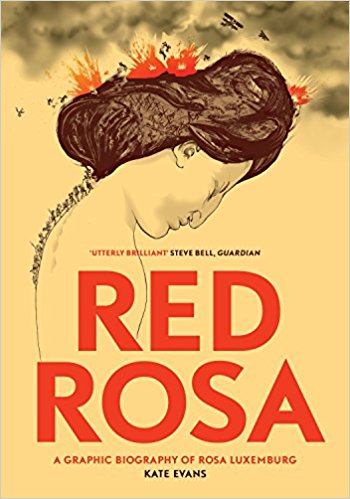
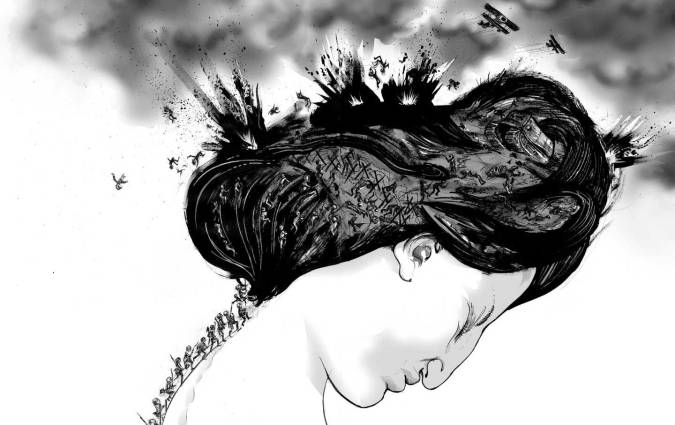
Rosa Luxemburg is a giant of the Left and nowhere else has her life and work been so beautifully presented and so articulately explained than in this graphic novel. Luxemburg’s philosophy that Marx was not beyond criticism, even though she took her political and economic position from his work, is a lesson for us all: nothing is beyond critical interrogation, especially the people we most admire and whose thinking has been the most influential for us. The concise and accessible exploration of Luxemburg’s philosophy includes her radical pacifism: my favourite panel coming with Luxemburg’s response to the First World War: head bowed, she is disturbed and weighed down by the destruction and wanton chaos of a war that will end nowhere and will result in the deaths of millions of working class people. Evans also gives us an insight into Luxemburg’s personal life, the incredible obstacles she overcame to become a writer and political leader, and her relationships with close friends, family and lovers along the way. This graphic novel, and its subject matter in Luxemburg, is absolutely inspiring.
RedRosa_extract_TheNation_img


Other graphic novels to explore:

Dragonslippers: This is what an abusive relationship looks like, Rosalind B. Penfold, 2006

Diary of a Teenage Girl, Phoebe Gloenecker, 2002

Threads: From the Refugee Crisis, Kate Evans, 2017

Tamara Drewe, Posy Simmonds, 2007


[1] Homage to Joe Sacco, http://journeyofideasacross.hkw.de/anti-narratives-and-beyond/edward-w-said.html [accessed 22/05/2019].

Love Note – Mustang

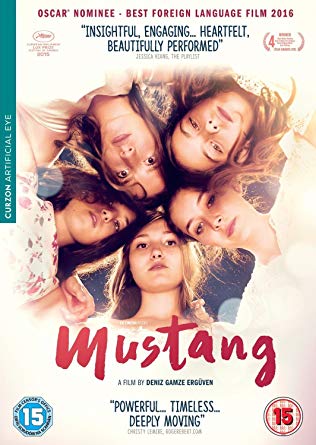
Sisterhood truly is the most potent, inspiring and exasperating relationship: where grievous bodily harm can magically turn into profound silliness, which can turn into deceptive and mysterious thefts of anything from books and clothes to biscuits, which can turn into profound existential bonding conversations about love, life and the Real Housewives (substitute RH with your mutual sisterly trash). Jane Austen knew it with Pride and Prejudice and Sense and Sensibility; Louisa May Alcott knew it with Little Women; Phoebe Waller-Bridge knew it with Fleabag; and Deniz Gamze Ergüven absolutely knew it with Mustang. I re-watched Mustang a couple of weeks ago and it is still one of the most compelling and emotionally charged films about sisterhood I have come across.
The plot revolves around five sisters: Sonay, Selma, Ece, Nur and Lale, and told largely through the point of view of Lale, the youngest. The sisters live with their ultra-conservative grandmother and uncle in a small village in northern Turkey. One day, after Lale tearfully says goodbye to her teacher who is moving to Istanbul, the sisters go to the beach with some male friends and play in the water. They are spotted and reported to their guardians, who effectively turn their house into a prison and arrange marriages for the girls. It is at times devastating, brilliantly funny and an incitement to free spiritedness in all teenage girls, especially when confronted with the deepest and darkest patriarchal forces.
And those patriarchal forces are well and truly horrifying. One of the scenes seared into my memory is at the wedding, where the girls’ uncle, Erol, who has proven himself to be aggressive and violent not only with the girls but with their grandmother (his mother), stands drunkenly and happily in the middle of the dancefloor, eyes closed, firing his gun into the air. Where the girls had at first been dancing, they cower around him, clamping their hands to their ears as he shoots and shoots. When I first watched the film, I thought to myself ‘Why on earth is he happy? Why is he celebrating?’ He cares nothing for the girls beyond keeping their virginity intact and, with hideous irony, it is heavily suggested that he sexually abuses two of them. Maybe he is just happy that they are no longer his responsibility and that he’d fulfilled some kind of patriarchal role in getting them married off? I think this is part of the way there: in this scene, ultimately, Erol is relishing his power. He is the one with his hand on the trigger, asserting and revelling in his dominance over the lives and fortunes of his nieces. It is sickening and infuriating to watch.

Additionally, watching Lale learn how to drive holds such urgency and pathos. Selma tells her that she was unable to escape because she couldn’t drive and Lale refuses for that to become her reality too. She tries and fails and tries again to learn how to drive, enlisting the help of truck driver Yassin, even though she is easily only 11 or 12 years old. Driving is a right we so take for granted in the UK, but is a fundamentally powerful means of power and control in religious and conservative countries. The importance of women being allowed to drive in countries like Saudi Arabia is all the more pertinent after watching a film like Mustang.

Amongst the hellish religious conservatism that the film actively exposes and challenges, we see the enduring and undimming power and pleasures of sisterhood, in all its multi-faceted manifestations. Indeed, the gentle intermingling of relatively light-hearted sisterly dramas with the devastating cultural power dynamics is what makes this film at once irreverent and tragic. We see the sisters defending one another from beatings; breaking out of the house to attend a women-only football match, then gossiping and messing around in their bedroom. One sister tells of how she radically subverts the injustice and intrusion of virginity tests by partaking in anal sex to prevent ‘losing her virginity’, before later on warning another sister that she’ll rip her head off if she steals her clothes again. As such, the film perfectly balances the magically mundane sisterly qualms and quarrels with the bigger, scarier patriarchal violence that determines their freedom and their happiness.

In this, I think the film goes a step further than Jeffrey Eugenides and Sofia Coppola’s The Virgin Suicides: the Lisbon sisters are only ever a mystical figment of the young boys’ suburban imagination, never fully realised as ostensible young women with desires, quirks, tempers or interests, Lux being, perhaps, the exception. Mustang shows that coursing underneath all of the patriarchal violence, double standards and unfairness of being a young woman living under religious conservatism, is the understanding, camaraderie and mutual struggle of being a girl and having female siblings. It is both heart-warming and heart-wrenching and speaks to anyone who has had a sister who has driven them absolutely mad but who will stand shoulder-to-shoulder with them through whatever chaos comes their way, patriarchal or otherwise.

81+T5SU2JGL._SY445_

Wastelands

I originally wrote and gave this paper in 2014. After a weekend reading T.S Eliot’s ‘Four Quartets’ for the first time, I decided to commit this paper to my blog. In the paper, I compare the fallout of conflict in ‘The Burial of the Dead’ form Eliot’s ‘The Wasteland’ and Titania and Oberon’s quarrel in Shakespeare’s ‘A Midsummer Night’s Dream’ (the featured image here is Vivien Leigh playing Titania in 1937).

*

Under this conference’s umbrella theme of war and literature, I am specifically interested in investigating the aftermath of conflict, seeing what literature has to say about war when it is over. T.S Eliot’s ‘The Wasteland’ is a seminal 20th century text, published four years after the 1918 Armistice and I would like to suggest that it is involved with a negotiation of the condition of modernity in the wake of the first terrible ‘Total War’. It is a text that in a number of ways bemoans war because of the death and decay it leaves behind it, but is simultaneously a violent and aggressive attack on preconceived notions of form and meaning, suggesting that it relies on war, indeed it is an act of war, to create something new and radical. I have restricted my close reading of ‘The Wasteland’ to the first part, ‘The Burial of the Dead’.

The title ‘The Burial of the Dead’ suggests a final action that commits dead bodies to the ground, keeping the spheres of the living and the dead completely separate and thereby allowing the living to continue with life. However, the poem opens with an image that suggests otherwise:

April is the cruellest month, breeding

Lilacs out of the dead land

We are presented with living things, lilacs, rising out of a ground that belongs to death, but is not necessarily dead in itself because it is involved with growth, not stagnation and inertia. Thus a paradox emerges: whilst the ‘burial’ of the title suggests a movement of taking extinguished life down to the ground, the opening of ‘The Wasteland’ suggests a movement of death bringing something life-like back to the surface. The poem emphasises that this is a ‘cruel’ movement instigated by April, a month that traditionally has a cultural relationship to spring and new birth, but here becomes the site of death becoming an inescapable presence that infects life and the living. The snow of winter covers this ‘land’ which enables us to temporarily ‘forget’ its disturbingly deathly quality and, potentially, the conflict that made it this way, (Winter kept us warm, covering / Earth in forgetful snow’) but April serves as a reminder that the earth is teeming with deathliness.

This is cemented by the speaker’s reference to lilacs, which are flowers with a mythological history: Syringa (the botanical name for lilac) was a nymph who hid from the amorous advances of the woodland god Pan by turning into a bush of flowers. Therefore, lilacs are involved with disguise and have a history that suggests that figuratively, there is more to them than what meets the eye. Within the context of ‘The Burial of the Dead’, the lilacs are masked harbingers of death, metaphors of bodies belonging to death that are hidden but nevertheless inherent to the post-war landscape. The use of the verb ‘breeding’ to describe the production of the lilacs complies with this, a word that is defined in the OED as ‘bringing to the birth’. It points to the bodily, inorganic quality of the lilacs that re-enter the sphere of the living hidden within the form of a flower. This image is echoed at the end of ‘The Burial of the Dead’ when the speaker calls out to Stetson:

“That corpse you planted last year in your garden,

Has it begun to sprout? Will it bloom this year?”

There has been a reversal in the terminology of growth and surfacing employed: whereas the lilacs are bred out of the ground like bodies, the corpse, it is proposed, will grow out of the ground like a flower, sprouting and blooming. This implies a commonality between the flowers and the corpse, suggesting that they are exchangeable and fluid.  The distinctions between them are done away with because they are both objects coming forth from death’s land, and we can see that the landscape inhabited by the living is at the mercy of a deathliness that seeps into it as a result of horrendous conflict, making the two states of life and death indistinguishable.

This can also be seen in the speaker’s description of London;

Unreal City,

Under the brown fog of a winter dawn,

A crowd flowed over London Bridge, so many,

I had not thought death had undone so many.

The repetition of ‘so many’ points to the extraordinary number of people that the war brought into contact with death in one way or another. The image suggests that in the aftermath of conflict, death controls and oversees existence, stripping life away from people left behind and reducing them to a deathly state whilst still alive. As a result of an existence defined by death blurring itself with life, the city and the people within it are ‘unreal’, occupying a liminal and disturbing position that they might not be able to properly identify themselves, hence the interchangeability of the lilacs with the corpse as previously mentioned. Death’s infection of life has become hegemonic, and is not challenged and questioned by the inhabitants of the city.

The image of the ‘brown fog of winter dawn’, a pervasive meteorological nuisance, helps to exacerbate the murky and indivisible landscape of deathly life, and also helps to develop the poem’s melancholic and depressive tone. It is at this point that I want to draw a comparison between ‘The Wasteland’ and ‘A Midsummer Night’s Dream’, a text produced 300 years earlier, where we are also presented with a traumatised landscape that has resulted from conflict. Eliot’s ‘fog’ recalls the image of the fog produced by Titania in her description:

But with thy brawls thou hast disturb’d our sport.

Therefore the winds, piping to us in vain,

As in revenge, have suck’d up from the sea

Contagious fogs.

This is one of numerous images of the sickly landscape described by Titania that has resulted from her conflict with Oberon over an Indian boy. The personified seasons and elements have been neglected by the fairies, and avenge this abandonment by unleashing nature’s fury, causing chaos, sickness and ‘distemperature’ through floods, rotten harvests and ‘rheumatic diseases’. Most importantly, however, and in a way that links to Eliot’s wasteland, is that Titania shows how these have caused the seasons to change and merge with one another:

[…] the spring, the summer,

The childing autumn, angry winter, change

Their wonted liveries, and the mazed world

By their increase, now knows not which is which:

And this same progeny of evil comes

From our debate, from our dissension;

We are their parents and original.

Titania warns Oberon that the seasons have inadvertently undone themselves and have exchanged and adopted the appearance of each other, in the process throwing off what categorises them individually. The identities that contain and separate them from each other have collapsed so that now it is no longer obvious what time of the year it is supposed to be, causing confusion and bemusement amongst human beings. This motion is similar to what is at work in ‘The Wasteland’, where the boundaries separating death and life have disintegrated and death has blurred and intermingled with life, manifesting explicitly in the realm of the living, meaning that it is now difficult to successfully differentiate between the two states. However, there is a significant difference between ‘The Wasteland’ and ‘A Midsummer Night’s Dream’: Titania delivers this speech during the middle of the conflict. Not only is there time for the situation between them to be resolved, which over the course of the play is achieved, she and Oberon have the power and the capability to reverse the deconstruction. As the fairy Queen and King, the parents of the seasons and the elements, they can restore the status quo through reconciliation and ending their conflict.

However, in ‘The Wasteland’, the conflict is already over and the speaker and humanity as a whole are left in a world that has not been restored to its previous state, but has seen the irreversible movement of death entering into the sphere of life and having an unwavering presence amongst the living. The speaker is not in a position, indeed no one is in a position to solve this, which is evident in the speaker’s assertion: ‘I was neither living nor dead, and I knew nothing’. Titania and Oberon know that if they reconcile and take up their parental responsibilities, the seasons will once again don the right appearance. However, the speaker in ‘The Wasteland’ is trapped between the states of life and death and has neither the power nor knowledge to resolve the conditions, and does not know how to continue existing within them. This is because death is the ultimate powerful force at work that has made itself an unquestionable presence that undoes people’s relationship with life, rendering them deathly whilst still alive. The poem suggests, therefore, that there is nothing more powerful and controlling than death in the post-war wasteland.

We have seen that the post-war environment that the speaker of ‘The Burial of the Dead’ presents is one that is mournful and aware of the presence of death that conflict has brought into the world. I would like to argue that this war has bred another war:  ‘The Wasteland’ as a poem that has been produced in a damaged and deathly world, has no choice but to carry on attacking, suggesting that the only way to exist is to perpetuate conflict. This it achieves through an attack of established poetic conventions, taking on the quality of the death it presents by rigorously undoing the standards we are familiar with. One of the last phrases of ‘The Burial of the Dead’s’ curious ending is ‘You! Hypocrite lecteur!’ which translates as: ‘You! Hypocrite reader!’ We can see that the speaker constructs a notion of readership through the use of ‘you’ that it immediately challenges by addressing the ‘you’ in French and by accusing ‘you’, this reader, of being a hypocrite, itself a curious insult that suggests that we are guilty of falsely professing some kind of virtuousness. I would argue that it points to the futility of people attempting to live life forgetting to acknowledge or pretending to not acknowledge that death is an almost tangible feature of the post-war landscape. Nevertheless, we can see that the poem aggressively sets up a concept that we might be familiar with, the position and audience point of a reader, but immediately undercuts it, throwing it into doubt and uncertainty through the use of a different language to the predominant one employed, and by using it imperatively to challenge and question. This is one of a number of ways in which the poem destabilises comfortable notions of poetic address, form and meaning, attacking conventions and norms in a threatening and war-like manner to create something new. Another example of this would be the endless references and inferences that are made in the body of the poem and for which Eliot provides notes at the end, which playfully lead to new references and inferences. It thus aims to send one on nothing short of a wild goose chase to uncover a meaning that the poem suggests, in doing so, does not exist.

Therefore, the poem, in this its first part, presents life post-war as not a unified thing, but is something pertaining to, undone and controlled by death. As a result of this, poetry itself is fragmentary, and can do nothing but arise from the ashes of one war to begin another, on the poetic form, and our conceptions of form and meaning. This, ‘The Wasteland’ suggests, is not wholly regrettable, and is an unmistakeable and undeniable condition of modernity post-1918.

Dior: Designer of Dreams

On Friday 5th April, I trundled down to London to visit two very excellent friends. We have partaken in a number of cultural weekends in the capital over the past few years, with trips to see the Savage Beauty exhibition at the Victoria and Albert Museum, The Vulgar: Fashion Redefined at the Barbican, the Vogue 100 exhibition at the National Portrait Gallery, the West End production of Tennessee Williams’s Cat on a Hot Tin Roof starring Sienna Miller and Jack O’Connell (where somehow we managed to get seats in a box, very jammy), amongst many other lovely, fun activities. This weekend was in every way just as lovely: in spite of a sketchy visit to a fancy restaurant off Regent’s Street where we were made to feel like actual scum, we shopped in Arket, visited the new Archlight cinema in Battersea, drank all the Taddy Lager at a Samuel Smith’s next to Liberty’s and spotted BBC Middle East correspondent Jeremy Bowen at Denmark Hill station and started smirking at him by accident. He definitely thought we were insane. The highlight of the trip, however, amongst all the other loveliness, was our visit to the Dior: Designer of Dreams exhibition at the Victoria and Albert Museum.

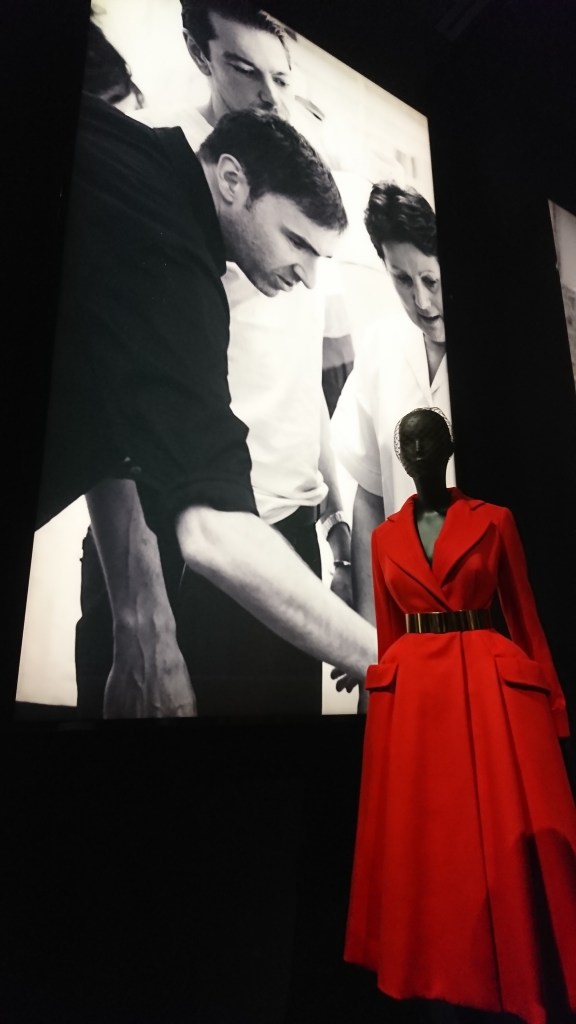
My first academic introduction to Dior came through the documentary, Dior and I: a fly-on-the-wall film that followed Belgian designer Raf Simons as he took up the mantle of creative director in 2012. I had been aware of John Galliano’s tenure, largely thanks to Lily Cole who was a veritable goddess in his designs, but had little actual passion for the house of Dior beyond that. I have a penchant for the theatrical in fashion, but I was more into Alexander McQueen, Vivienne Westwood and Marc Jacobs at Louis Vuitton at the time. Galliano was famously fired from Dior after an anti-Semitic rant outside a café in Paris, and this created a space at Dior for something new and different. The film introduced us to Raf Simons, with his refreshingly modern aesthetic and his endearing emotionality. Reading from Christian Dior’s autobiography and discussing art, it became clear that Dior was on the cusp of being reimagined for a new generation. I fell for the brand then and there.

Raf

I came to learn from Dior: Designer of Dreams that the fact that there is even a house of Dior is nigh-on miraculous. Christian Dior founded the label in 1947, creating the ‘New Look’: he divined an ultra-feminine silhouette, re-introducing women to sensuality after the austerity, deprivation and destruction that encompassed life during the Second World War. In no more than ten years, he built a booming, globally successful fashion house, placing his love for women at the very heart of his work. He introduced the H line, the Bar jacket and many other ingeniously crafted designs to emphasise curves, create drama and indelibly flatter. Tragically, he died in 1957; but in the short but very sweet time he had, he laid the foundations for one of the best-loved fashion houses of all time.

I believe the key to Dior’s success in his lifetime and beyond can be attributed to his commitment to women. Indeed, he seems to have dedicated his whole sartorial life to making women look and feel beautiful. He said:

‘Deep in every heart slumbers a dream, and the couturier knows it: every woman is a princess’.

It is one thing for men to say that they love and support women, but it is almost overwhelming how much Christian Dior repeatedly practiced and demonstrated that love through his creations. He knew how to make women feel special through the alchemical combination of silhouette, colour and craftsmanship. He in no way objectified women: instead, he placed womanhood and femininity on a pedestal to be absolutely adored. I used to be very sceptical of traditional notions of femininity: I’ve read my Judith Butler, I understand that gender is performance in many ways. However, where so much disrespect and abject hatred of women and their bodies has been witnessed and experienced throughout history, for a man to be so readily loving and devoted to women, is amazing. Similarly, I do not subscribe to monarchy or regal inequality in any way, but I think the reference to princess-hood can be read more archetypally. His work helps to bring women back to the sense of their own worthiness: that, yes, each one of us is unique and special, with dreams and ambitions, and a powerful capacity for conscientiousness, compassion, joy and love. All of these things make us inherently beautiful. I know a lot of women, including myself, have a hard time believing that, but Christian Dior is here to remind us, in a sartorial, fashionable way, that it is truly is the case.

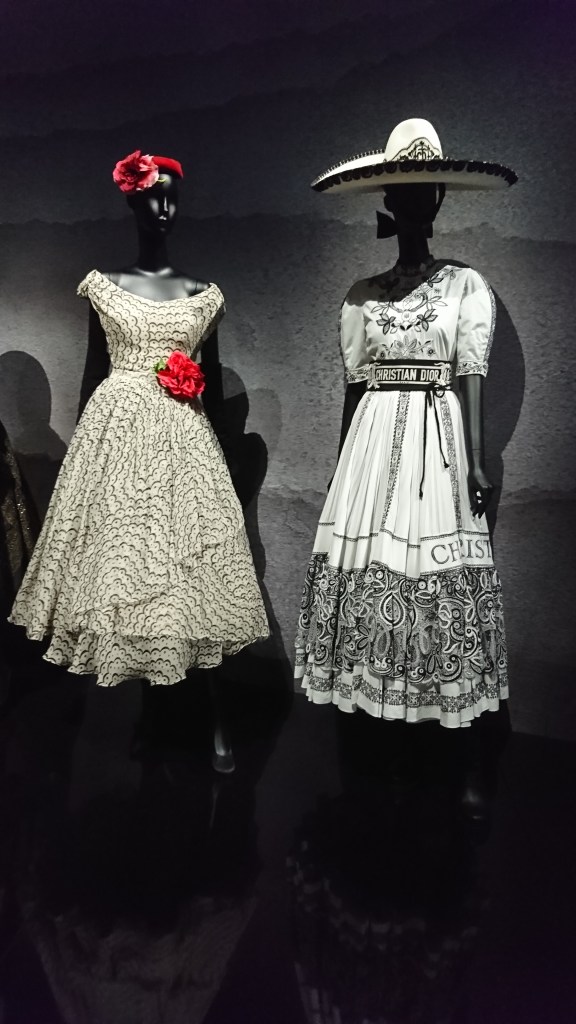
Christian Dior’s legacy has been kept intact thanks to a line of wonderful designers who placed women and what women want at the core of their work. Everyone, from Yves Saint Laurent to Maria Grazia Chiuri, have adhered to his silhouettes and inspirations, but subtly and ingeniously regenerated and refreshed them for each generation of women that passed their way. The exhibition presented and reflected this fact beautifully, placing pieces from all of Dior’s eras next to one another: for example, these two dresses from 1953 and 2019:

Mexican Dior

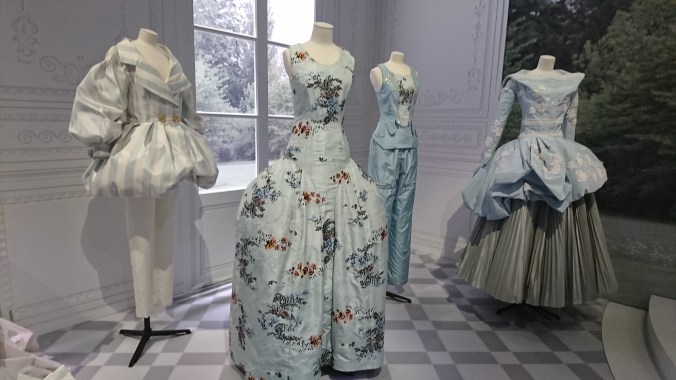
Both of these dresses nod to Dior’s interest in Mexican art and sartorial sensibility, speaking to each other across the years.[1] Although the Dior logo splashed across the dress on the right is a dead giveaway that it is a 21st century piece, they could both feasibly have come from the same collection. Similarly, the 18th century-inspired collections exhibit both continuity within the house of Dior and their individual designer’s unique perspective and flair:

18th century Diors

On the far left we have Gianfranco Ferré’s imagining of an 18th century coat, followed by Raf Simon’s cornflower blue dress with drop-waist hip emphasis; then we have another Raf Simons creation, this time a two-piece of intricately embroidered top with combat trousers; and finally a theatrical John Galliano dress with a billowing top and voluminous pleated skirt. All of the pieces are intrinsically Dior and could have walked down the runway in exactly the same show. But, we are also introduced to the subtle modernity of Simons, somehow taking an archaic hip style and making it contemporary and cool; the free-spirited proportion-play of Gianfranco Ferré; and the drama and craftsmanship of Galliano. The accusation has been levelled (at Simons in particular) that these collections for Dior are archivist; however, we can see clearly how the directors have honoured the history and mystique of the house whilst also exploring their own creative interests and personal aesthetics. It makes the collections personal but also part of a fluid, historical whole.

I will always have the softest of soft spots for Raf Simons because his work is just so polished, interesting and fun; but this exhibition formally introduced me to the work of Maria Grazia Chiuri. Up until now, I have reservedly watched Chiuri’s tenure blossom with popularity from afar. I was not convinced that slapping ‘We should all be feminists’ and ‘Why have there been no great women artists’ onto T-shirts to be sold for hundreds of pounds was particularly intersectional. I am still absolutely sure that capitalising on a buoyant new wave of feminism for commercial gain whilst reinforcing exclusivity and hierarchy is not how I want my intersectional feminism to look. However, this exhibition taught me that this woman bloody well knows how to make fabulous clothing. We wandered around the exhibition, pointing to one exquisite dress after another, exclaiming ‘I want that. I want that. I want that’, most of them originating from her sketchbook. Chiuri’s silhouettes are not as avant-garde as a Galliano, nor are they as refined and modern as a Simons, but they are dreamy beyond belief. Deceptively simple forms make way for frothy, fairytale content: her dresses become canvases for beautiful entwining flowers, embroidered constellations, elegant tulle and third eyes.

MGC3MGC2MGC5MGC6

MGC1MGC4MGC8MGC7

I have a newfound respect for what Chiuri is accomplishing at Dior. Namely, creating exceptionally designed clothing, luxurious without being fussy, whilst also, with those clean and elegant lines, very wearable. I would opt for any of these dresses in a heartbeat (please sartorial gods, please).

Without spoiling the exhibition too much for those who are still to visit, the final room was quite literally breathtaking. We audibly gasped and gaped at the twinkling ballroom setting we found ourselves in, debating whether or not we’d overreacted to the splendour on show. The gasps and squeals that came behind us as others entered the room confirmed not. The whole effect was magical: the glittering dresses, the rosy lighting, the cavernous space, everything. Time permitting, we could have sat in that room for ages just absorbing it all.

Dior: Designer of Dreams was another triumph for the Victoria and Albert museum. The layout and story of the exhibition is pitch perfect, demonstrating seamlessly the historical threads of the fashion house, as well as showcasing the individual contributions of the creative directors. The exhibition is a tribute to everyone who has been involved with the house: from Christian Dior himself and his creative directors, to the petit mains creating the designs at the atelier and the women chosen to represent the brand (it features dresses worn by Natalie Portman, Charlize Theron, Rihanna and Lupita Nyong’o). It celebrates womanhood, femininity and the princess within each woman, and the paradox that is a success built upon a winning and delicate combination of history and modernity. Needless to say, if you can get to it, go.


[1] What was also brilliant was that the curators had taken great pains to stress the pitfalls and damage of cultural appropriation, highlighting the ways in which Grazia Chiuri in particular sought practical help and input from Mexican women in the production and presentation of her Mexican-inspired collection.

Love Note: Skiing and Snowboarding

“I felt my lungs inflate with the onrush of scenery—air, mountains, trees, people. I thought, “This is what it is to be happy.”

I am fortunate enough to have spent many years learning how to ski and it is one of my favourite things on the planet. Esther Greenwood’s description of the sport in Sylvia Plath’s The Bell Jar (see above) is absolutely accurate and I couldn’t have put it better myself. I am aware that skiing is a leisure preserve of the middle class and is obscenely expensive; indeed I haven’t been on a skiing holiday in years because I can’t afford it. However, through skiing, I have had some life-changing experiences, met some amazing people and had a whole lot of fun:

Experiences like being five years old and falling off a drag lift and crying in despair (I thought I was lost forever). My instructor, Yannik, scooped me up, tucked me safely in front of him and got me safely up the mountain. There, he kneeled down next to me and pulled off his glove revealing that his right hand was missing. Seeing this shocked me into silence and he said warmly, ‘If I can ski with one hand, you can do anything’;

Bouncing through bumpy forest trails as part of a crocodile of squealing children, gasping with laughter, barely in control and skiing through the most magical wintry surroundings;

Having existential conversations with fellow ten year olds on chair lifts: kids I met and knew for a week, put the world to rights with and then never saw again. This included one British kid I met in Colorado who, after an extensive conversation about winning the lottery, turned out to be related to my P.E. teacher who had taken early retirement after winning the Lotto jackpot a mere two weeks before;

Battling my way down notorious slopes like ‘Sache’ in Val-D’Isère, ‘Shock’ in Breckenridge, ‘Creux Noir’ in Courchevel and ‘Ghengis Khan’ in Vail;

Experiencing the elements in a visceral way, whether it’s gliding around in brilliant sunshine and sparkling snow, or using your gloves as a makeshift mask when snow is hitting your face in sharp pellets;

Learning how to properly carve by an Australian called John who lived his best life teaching kids how to ski during the winter and working as a carpenter in the summer;

Witnessing and experiencing a multitude of mishaps and injuries, for example: falling off a chairlift due to a cacophony of communication errors; falling off a T-Bar with a friend due to a lot of bad luck (why am I always falling off things?!); watching my dad plough into a snow wall he couldn’t see because it was the same colour as the cloud we were skiing through (I almost wet myself laughing); chomping on my tongue during a fall and spitting blood for ten minutes; watching someone in my ski group snap a ligament in her leg and being tobogganed down the mountain; and, the worst, watching 18 year old Neal Valiton tumble to his death during the 2007 IFSA World Freeride Championship in Tignes.

Skiing is fun and some mistakes are unfortunate and unavoidable, but anyone who doesn’t take yours and their safety extremely seriously isn’t worth skiing with. The mountain is beautiful but it is not always your friend. In light of this, it can become an incredibly mindful sport: you plonk yourself on the side of a mountain and somehow you have to get down as safely as possible. For me, crazy as it sounds, what ensues is a very clear and concerted inner conversation with myself. I have to navigate my way through ice and moguls, through white outs with zero visibility and the chaos that are nursery slopes at the end of the day, deciding how big or short my turns have to be, how much speed I can afford to pick up and how the rest of my group are getting along. In the process I give myself pep talks, sometimes even sing to myself when I get a good rhythm, and the whole effect is ridiculously calming.

This was proved again last weekend when I had my first snowboarding lesson at the Tamworth Snow Dome. To begin with, it felt almost sacrilegious because I had abandoned skis and poles for extremely comfortable boots and a single plank with sharp edges. But, after a shaky start, which included screaming in the instructor’s face as he helped me to edge down the hill, I dropped down into that calm, mature inner place that doesn’t always make itself known on a day-to-day basis. It was clear and confident, and sounded like: ‘OK Harper, we’re here now, on a snowboard, slightly out of control, what are we going to do about it?’ I slowed down, becoming mindful of my body and it’s movements (including the limits of what I was currently able to do) and, in so doing, embraced this new and disorientating experience. I have realised that my work is to try and tap into this place a lot more often.


(Featured image is my photo of El Pas de la Casa resort in Andorra, 2015)